We're officially a Great Place To Work® certified company, India | 2026–27

Mayank Patel
Nov 5, 2024
5 min read
Last updated Dec 23, 2025
Are you aware that close to 66% of organizations use DevOps to automate their workflows?
If not, here’s a quick explainer: DevOps blends development and operations into a unified process to boost productivity. It’s a game-changer for businesses of all sizes.
However, like anything in tech, DevOps isn't always smooth sailing. When things go wrong, you would know it's probably time for a DevOps audit. But when do you call the experts?
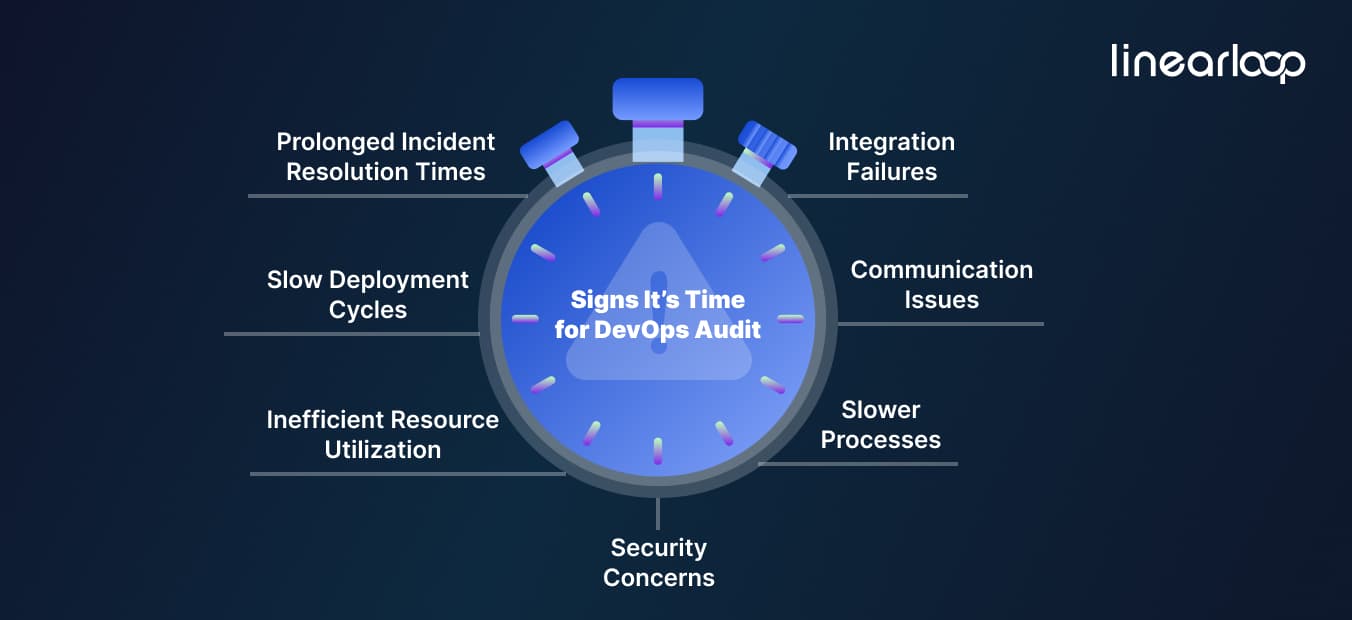
In this article, we will take you through seven telltale signs that may imply your DevOps setup could do with some fine-tuning. By the end of it, you'll know exactly when to reach out for that much-needed audit!
You know that feeling when you're stuck in bumper-to-bumper traffic? That's what your CI/CD pipeline might look like if things aren't smoother but complicated. If you’re seeing:
A DevOps audit can help identify the specific pain points in your CI/CD pipeline and recommend targeted improvements. This might include implementing more robust automated testing, standardizing development environments, or adopting more advanced CI/CD tools to streamline your processes.
Also Read - What Is DevOps and How Does It Work?
The core principle of DevOps is to break down silos between development and operations teams. Persistent communication gaps lead to slower deployments, more downtime, and a frustrating work environment. These issues usually arise from deep-rooted cultural barriers or poor collaboration processes.
Watch out for these warning signs:
A DevOps audit can help identify the root causes of these silos and suggest strategies to break them down. Your DevOps audit checklist might include implementing shared tools and dashboards or establishing cross-functional teams to foster a culture of shared responsibility and continuous improvement.
Ever feel like you’re still living in the stone age when everyone else has moved on to smart tech? If you’re manually deploying code or constantly tinkering with configurations, you’re not moving fast enough. Look out for these indicators:
A DevOps audit can help identify areas ripe for automation and suggest appropriate tools and practices. This might include implementing Infrastructure as Code (IaC), adopting container orchestration platforms, or utilizing AI-powered DevOps tools to enhance efficiency and reduce manual overhead.
In today’s threat landscape, security can't be an afterthought. Ongoing vulnerabilities and compliance issues not only put your systems and data at risk but also lead to costly breaches, fines, and loss of customer trust.
Watch for these warning signs:
A DevOps audit can help you transition towards a more robust DevSecOps approach. This might involve integrating security tools into your CI/CD pipeline, implementing automated compliance checks, and adopting practices like threat modeling and security chaos engineering.
The audit can als address key areas of concern for assurance, security, and governance. Auditors follow ISACA’s outlined DevOps audit controls to manage these risks effectively.
Efficient resource management and scalability are key to controlling costs and maintaining performance in a DevOps environment. Without them, you risk unnecessary expenses, poor user experiences, and limitations on growth and adaptability. These challenges often arise from poor capacity planning, inefficient infrastructure design, or underutilization of cloud-native technologies.
Look out for these indicators:
A DevOps audit helps address resource management and scalability issues by evaluating practices and strategies. It may recommend auto-scaling, containerization with Kubernetes, or cloud-native services for better resource use. It can also suggest using infrastructure-as-code for consistent environments.
Quick and reliable feature deployment has become critical these days. Slow deployment cycles or long time-to-market can result in missed opportunities, frustrated stakeholders, and an inability to respond to user demands.
Also Read - The Role of DevOps in Mobile App Development
Also, it’s necessary for you to watch for these red flags:
A DevOps audit identifies the root causes of deployment challenges and suggests improvements. This may include implementing feature flags for safer deployments, adopting blue-green or canary deployment strategies, and refining testing processes to catch issues earlier.
Effective monitoring and rapid incident response are essential to maintaining system reliability and performance. If your team is in constant firefighting mode due to monitoring and response issues, it’s time to rethink your monitoring strategy.
Watch for these clues:
A DevOps audit can help you shift from “fixing” mode to “preventing” mode, with better monitoring, real-time insights, and faster incident response times.
Recognizing these signs is crucial for maintaining peak DevOps performance. But you don't have to navigate this journey alone. Linearloop's expert DevOps services are designed to help you identify and address these challenges head-on along with offering a handy DevOps audit checklist.
Our experts have vast experience of different software domains. They will dive deep into your processes and offer tailored recommendations to streamline your workflows, strengthen collaboration, and boost your delivery speed.
Don't let DevOps inefficiencies hold you back. Reach out to Linearloop for a comprehensive DevOps audit and unleash your team’s potential at the fullest.


Why DevOps Mental Models Fail for MLOps in Production AI
Most teams break AI systems by doing something familiar. They take the same DevOps playbook that made their software reliable, scalable, and fast to ship and apply it to models in production. Pipelines turn green, deployments succeed, dashboards stay quiet, and yet, the system starts making worse decisions.
The problem isn’t tooling or effort. It’s a category error. DevOps is built for deterministic systems where correctness is stable once code ships. AI systems don’t behave that way. Their behaviour shifts with data, time, and feedback. This is why teams keep getting blindsided in production. They monitor infrastructure health while model behaviour quietly degrades. They roll back code while the data has already moved on. Treating MLOps like DevOps systematically hides the failures that matter most.
DevOps works because software systems behave in ways engineers can reason about, predict, and control. The mental models behind DevOps were shaped by years of operating deterministic code at scale. When something breaks, there is usually a clear cause, a reproducible failure, and a reliable way to restore a known-good state. That alignment between how software behaves and how DevOps operates is why the model holds so well in production.
The moment a model enters production, you stop operating software and start operating behaviour. The system is no longer deterministic, and correctness is no longer stable. Even if the code never changes, outcomes do.
Models are probabilistic by design. Identical inputs do not guarantee identical outputs over time because behaviour is learned from data, not encoded in logic. That behaviour is tightly coupled to training data, feature pipelines, and the live input distribution. When the distribution shifts, as it always does in production, model correctness shifts with it. Nothing fails loudly. The system keeps responding and it becomes wrong.
Production data introduces a state that DevOps systems rarely face. User behaviour influences future inputs. Model outputs change user decisions. Those decisions feed back into training data. Small errors compound through feedback loops, slowly rewriting the conditions under which the model was valid.
Time becomes an active failure vector. Correctness decays even without deployments. Rollbacks don’t restore reality. Tests can’t represent live conditions because labels are delayed or incomplete. Infrastructure metrics stay green while decision quality degrades underneath. This is the fundamental change: Models turn production systems into evolving, self-influencing systems that DevOps mental models are not built to control.
Also Read: Canary Releases in Serverless: DevOps Best Practices for Safer Deployments
Once models are live, most teams don’t rethink how they operate systems. They inherit DevOps assumptions by default, because those assumptions have been correct for years. The problem is that these assumptions no longer map to how ML systems behave in production. Each one creates a blind spot that compounds over time.
In DevOps, a green pipeline usually signals safety. The code is tested, deployed, and running as expected. In MLOps, a successful deploy only confirms that the model binary is live. It says nothing about whether predictions are correct, calibrated, or still aligned with reality. Behaviour can be wrong from the first request, and nothing in the deployment process will tell you.
Teams rely on offline metrics, validation datasets, and pre-deploy checks to assert readiness. This works for software because production behaviour is stable. ML systems face delayed labels, partial feedback, and shifting data distributions. Tests validate performance on past data, while production failures emerge from data the system has never seen.
Latency, error rates, and uptime remain the primary health signals. These metrics stay green even when prediction quality collapses. Models can degrade silently, serving confident but wrong outputs, without triggering a single infrastructure alert. The system appears healthy while decision quality erodes underneath.
DevOps assumes you can return to a known-good state. ML systems don’t have one. Rolling back a model doesn’t roll back user behaviour, incoming data, or feedback loops already influenced by previous outputs. By the time a rollback happens, the environment the old model was trained for no longer exists.
In production, these assumptions fail in ways that standard DevOps signals are structurally unable to detect. The system keeps responding, pipelines stay green, and incident dashboards remain calm, while decision quality degrades underneath. By the time teams notice, the damage is already systemic rather than isolated.
Also Read: How to Use Shadow Traffic to Validate Real-World Reliability
Adding more MLOps tooling feels like progress because it looks like control. More dashboards, more pipelines, more automation. But tools don’t correct mental models. They inherit them.
Most MLOps stacks are built as extensions of DevOps: CI pipelines for models, registries for artifacts, deployment automation, and infra monitoring. These solve delivery problems, not behavioural ones. They make it easier to ship models, not to understand whether those models are still correct in a changing environment.
When the underlying assumption is “if it deploys cleanly, it’s safe,” tools reinforce false confidence. Drift detectors fire after damage is done. Offline evaluations lag reality. Alerts remain tied to infrastructure health rather than decision quality. The system becomes better instrumented, but no more observable where it matters.
This is why teams with mature MLOps stacks still get blindsided in production. They didn’t lack tooling. They lacked a model of operations that treats behaviour, data, and time as first-class production concerns. Without that shift, more tools simply help teams fail faster and more quietly.
Also Read: How to Manage Kubernetes CRDs Across Teams Using DevOps Best Practices
DevOps optimises for safe delivery. MLOps must optimise for sustained correctness. The difference matters because model behaviour changes even when code doesn’t. Fixing production AI requires adding capabilities DevOps was never built to handle but new control surfaces.
If your AI keeps breaking in production, the instinct is usually to stabilise deployments or add more checks. That rarely helps. The failures you’re seeing are caused by what you’re not observing once they’re live. The fastest way to regain control is to fix the operating model, not the tooling.
AI systems break in production because teams operate them using mental models built for software. DevOps gives you speed, repeatability, and safety at the point of delivery. It does not guarantee correctness once a model is exposed to real data, real users, and time.
MLOps isn’t a broken version of DevOps. It’s a different operational problem. One that requires treating behaviour, data, and decay as first-class production concerns. Until teams make that shift, pipelines will stay green while systems quietly drift away from correctness.
At Linearloop, this is exactly the gap we help teams close. We work with engineering leaders to redesign how AI systems are operated in production, focusing on behavioural observability, ownership, and long-term reliability, not just deployment mechanics. If your AI looks healthy but keeps making the wrong decisions, it’s an operating model problem, and that’s where we come in.

Mayank Patel
Jan 28, 20266 min read

Canary Releases in Serverless: DevOps Best Practices for Safer Deployments
Serverless makes deployments feel deceptively simple: you push code, the platform scales it automatically, and production traffic begins flowing almost immediately. But that same speed can turn small mistakes into large incidents when something goes wrong. In a serverless environment, a faulty release rarely fails in isolation because the platform fans it out across thousands of concurrent executions before you have enough signals to react, which means the cost, reliability, and user impact escalate faster than most teams expect.
This is where canary releases stop being an optional optimisation and become a core part of DevOps best practices, especially if you care about maintaining deployment velocity without gambling on production stability. Without a controlled canary, every serverless deployment is effectively a full cutover, where rollback happens only after real damage has already occurred.
If you already run serverless workloads in production and want to ship changes safely without adding process overhead or slowing teams down, this blog is for you. The focus here is on the operational practices that help you detect failures early, contain blast radius, and automate rollback before a bad release turns into a widespread outage.
Serverless removes servers, but it doesn’t remove failure. It changes how failure spreads.
In traditional systems, a bad deploy usually rolls out gradually. But in serverless, none of that friction exists. The platform scales your mistake instantly. If your function is triggered by traffic, events, or retries, a faulty release can fan out across thousands of executions in seconds.
While auto-scaling is the first multiplier, retries are the second. Many serverless workloads are event-driven. When something fails, the platform retries automatically. That can mask the original failure while increasing load, cost, and downstream pressure. You think you have resilience. What you actually have is amplified failure.
Observability is the third problem. Functions are short-lived, logs are fragmented, and errors may not surface where you expect them. By the time dashboards catch up, the damage is already done.
This is why applying traditional deployment thinking to serverless breaks down. The system behaves differently under failure. Canary releases aren’t about polish here. They’re a safety mechanism that compensates for the speed, scale, and automation that serverless introduces.
Also Read: How to Use Shadow Traffic to Validate Real-World Reliability
In serverless systems, deployment safety is not optional. The platform removes friction, but that friction was often the only thing slowing failures down. When every release can scale instantly, you need a way to validate changes under real production conditions without exposing the entire system to risk.
That’s where canary releases fit into DevOps best practices. They turn deployments from a single irreversible action into a controlled experiment.
Once you accept canary releases as a baseline DevOps best practice, the next question is how to do them safely. In serverless systems, safety comes from designing deployments that assume failure and limit its impact by default.
The principles below are what separate controlled rollouts from accidental production experiments:
Also Read: How to Manage Kubernetes CRDs Across Teams Using DevOps Best Practices
Once the principles are clear, execution comes down to routing. In serverless systems, routing is where most canary strategies either work cleanly or fall apart. You’re not just shifting user traffic. You’re controlling how requests, events, and retries reach different function versions under real load. So, the strategy you choose has to reflect how your system is triggered.
Request-driven workloads are the easiest place to start, but they still require discipline. Traffic is synchronous, user-facing, and latency-sensitive. Small degradations show up quickly, which makes canaries effective if scoped correctly.
The key is controlled traffic weighting. Route a fixed, low percentage of requests to the new version and keep the rest on the stable path. Don’t ramp aggressively. Let the system sit long enough for cold starts, cache misses, and edge cases to surface. Avoid global rollouts and scope canaries by region, endpoint, or tenant where possible.
Event-driven canaries are harder because failure is less visible and retries distort reality. Start by limiting event exposure. Only a subset of events should flow to the new version. This keeps retry storms and cost spikes contained if something goes wrong.
Watch retry behaviour closely. Retries delay detection while amplifying load across queues, databases, and third-party systems. Also, account for delayed feedback. Event pipelines don’t fail instantly. Give canaries enough time to surface lag, backlog growth, and downstream timeouts before increasing exposure.
Also Read: How to Design Cost-Efficient CI/CD Pipelines Without Slowing Teams
Observability-first deployments treat measurement as a prerequisite. You decide what “healthy” means before you release, and you watch those signals continuously while the canary runs.
Leading indicators tell you something is wrong before users complain. In serverless, these matter more than raw error counts. Small latency shifts, rising retry rates, or increased cold starts often show up minutes before hard failures. These signals reflect system stress. If you wait for obvious errors, you’ve already missed the window where rollback is cheap.
Serverless platforms surface failure through economics and limits. Sudden cost spikes, unexpected concurrency growth, or throttling events are often the first sign of a bad canary. These aren’t finance metrics. They’re reliability indicators. When a new version behaves inefficiently or triggers retries, the bill rises before dashboards turn red. Ignoring these signals means learning about failures after they’ve scaled.
Safe canary deployments need a clear, repeatable flow that removes judgment calls during a release. When something goes wrong, the system should already know what to do. The steps below reflect how mature serverless teams operationalise canaries as part of everyday DevOps best practices.
Serverless fails when speed isn’t matched with control. Canary releases give you that control without sacrificing velocity. They turn deployments into reversible, observable steps instead of high-risk events.
When done right, canaries aren’t an extra layer of process. They’re how mature teams ship confidently in systems that scale instantly and fail loudly. They reflect strong DevOps best practices, such as clear ownership, automation over heroics, and safety built into the system. If your serverless deployments still rely on full cutovers and manual rollbacks, the risk isn’t theoretical. It’s waiting for the next release.
This is where platform thinking matters. At Linearloop, we help teams design deployment workflows where safety is encoded into the system. If you want serverless speed without production anxiety, that’s the conversation worth having.

Mayur Patel
Jan 22, 20266 min read