NodeJS vs PHP: Which One is Better for Backend Development

Mayank Patel
Nov 7, 2022
5 min read
Last updated Apr 14, 2025

We are living in an automated world and software development is an integral part of it. And when we talk about software development, it covers the front end as well as the back end.
Our blog will revolve around comparing the two leading backend development technologies i.e. PHP and NodeJS.
So, if you are browsing for NodeJS vs PHP is the right place. Also, being an experienced software development company in India and USA, we always say, each technology or programming concept has its own worth. Nothing is purposeless.
The ultimate aim behind any technology is to meet the requirements of the project conveniently. Moreover knowing each of them will be helpful for decision-making.
Also, if you are looking for PHP developers or Node JS developers in India or USA, we are your exclusive service partner.
Linearloop is one of the most prominent software development companies in India & USA, and we are offering PHP and Node JS development services in India as well as in the USA.
PHP is a server-side script language and its full form is Hypertext Preprocessor. PHP is an open-source found in the year 1994.
The language has gained a lot of attention since the time of its foundation. And if we talk about data, approximately 78.9% of the websites are developed in PHP.
Moreover, if you are looking to hire PHP developers in USA & India, Linearloop is always there. We have experts having dynamic experience in web development.
Apart from that we always give value to the client’s expectations and our commitment. So, hiring our developers assures nothing but quality.
Furthermore, if we talk about Node JS, is a cross-platform open-source that runs JS (JavaScript) code. Ryan Dahl developed the concept in 2009. The main agenda behind the foundation of NodeJS is to facilitate fast, scalable, and robust web applications.
With Node JS, developers get the flexibility to write command-line tools and server-side scripting using JS. Here the JavaScript code runs beyond the boundaries of the browsers.
Apart from that, NodeJS synchronizes the activities of web development through the implementation of JavaScript.
Here at Linearloop, we are providing Node JS development services in USA and our countless projects are successfully running across the globe. Also, do not hesitate to contact, us if you are looking to hire Node JS developers in India and USA.
So, from the above-written content, you may have an idea that both PHP and Node JS work differently. We can say, PHP is easy to implement whereas the concept of NodeJS revolves around performance and it gives multiple options for the organization of the data.
Now we will dive into a detailed comparison including PHP and Node JS performance benchmarks.
As we know, the backend of software is the same as the backbone of the body, so we need to strengthen the backend by implementing the most suited and powerful technology.
Also Read: Hapi vs Express: Best Node.js Framework Comparison
The first parameter, at which we will compare PHP and Node JS is coding speed. Developers find PHP to be faster than Node JS. And it is true, an experienced developer can code faster in PHP compared to Node JS because PHP does not need compilers or converters.
With PHP, developers get the flexibility to establish simple connections to the SQL database without any hosting elements.
And in the case of Node JS, application deployment becomes more sophisticated because it runs the environment quickly by keeping the workload on the server low.
Furthermore, with NodeJS, maintaining a two-way connection website with free data exchange is possible. As a result, developers save lots of time if they are dealing with multiple threads.
Conclusion:
The speed of coding is faster in PHP and it can be a solution if an instant solution is required. But if your project demands efficient and sustainable results, Node JS should be adopted.
Performance:
PHP renders a slower loading process and hence its performance is not as Node JS.
Node JS has no waiting downtime and it offers real-time data efficiently. So, when it comes to the execution of code and performance, Node JS gets the point.
Conclusion:
Moreover, being an experienced Node JS development company in India, we recommend using Node JS if you are dealing with complex and large-scale projects.
Extensibility:
The extensibility of PHP is good and because of its combination with HTML it is widely used for many content management engines like WordPress and Drupal. Moreover, it leads to easy and cost-effective development.
Furthermore, you can also extend PHP with LAMP technology like SQLite, MySQL, mSQL, PostgreSQL, and MS-SQL. Moreover, it can also be extended with non-relational databases such as MongoDB, Redis, and ElasticSearch.
Node JS works using JavaScript and it can easily be extended with HTML, Ajax, and XML. Furthermore, there are many JS frameworks & instruments with Node JS and Node JS is a well-known server-side framework.
Additionally, it has many inbuilt package managers which are called Node Package Managers. And it is the largest software catalog with 650,000 free code packages.
Also Read: MobX vs Redux: Comparison – Which Performs Better?
Conclusion:
Depending upon the parameter of Extensibility, Node JS gains the point here. But again, we will bring one thing to the notice, always select the technology depending upon the requirement of your project.
Functionality:
As we have said earlier, PHP is easier as compared to other backend technologies and because of this reason, the majority of websites are developed using PHP.
As far as its functionalities are concerned, PHP is considered as a dynamically developing programming language because developers always come up with new ideas and stuff of development.
If we talk about the functionality of Node JS, it is a better approach than PHP because it has all the required functions under one roof.
Hence developers prefer working with Node JS because of a seamless package without fragmentation of functionalities.
Related Blogs :
Node.js vs Python: Which Backend Technology to Choose in 2021?
Conclusion:
Here we can say a draw because both concepts are equal in terms of functionalities. They facilitate all the needs efficiently.
Final Words
PHP and Node JS, both are in demand and efficient backend technologies. Selecting any of them is dependent upon the project’s requirements.
Using our best practices, we have shown the comparison between Node JS and PHP. We hope you will be able to connect.
Moreover, reach us if any query comes up! Have a great time ahead!

Related Posts
Some Etiquette That Every Backend Engineer Should Follow
In the frenzied realm of digital product engineering, backend engineers emerge as the quiet champions, tirelessly working behind the scenes to guarantee that applications operate seamlessly while maximizing efficiency. Within Linearloop, we fully appreciate the indispensable contributions these specialists make in crafting resilient systems that fuel contemporary applications.
Yet, mere technical expertise falls short; embracing backend engineer etiquette stands as paramount for nurturing a thriving work atmosphere and securing fruitful project achievements. This article embarks on an exploration of the fundamental etiquette that every backend engineer ought to embrace, underscoring the significance of communication, teamwork, and professionalism, along with an unending quest for knowledge.
Backend engineer etiquette comprises a collection of professional standards plus practices that shape how these developers engage with their peers while navigating their tasks. It's all about fostering a culture rich in respect, cooperation, and responsibility amongst development teams.
Adhering to these principles enables backend engineers to boost their effectiveness, nurture more robust connections with colleagues, and positively influence project achievements. Apart from this, it can guide businesses to create a culture of ownership when they hire backend engineer.
Navigating the realm of backend development proves intricate, often demanding sophisticated problem-solving skills. Lapses in etiquette may sow seeds of confusion, diminish productivity, and cultivate a toxic work atmosphere.
On the flip side, a dedication to professional conduct can usher in enhanced communication, elevated collaboration, and superior code quality. In an industry where the backend developer skills evolve ceaselessly, upholding a solid grounding in etiquette facilitates engineers' ability to adapt swiftly while flourishing.
Also read: What Is Back End Developer? Roles & Responsibilities of Back End Developer?
Effective communication lies at the core of thriving backend engineering endeavors. Backend engineers need the ability to express their concepts with precision while engaging in meaningful discourse with team members spanning diverse disciplines.
- Active Listening: Actively absorbing insights from colleagues cultivates comprehension and harmony. This practice enables engineers to fully apprehend project requirements while addressing efficiency concerns.
- Clarity in Documentation: Crafting clear documentation stands as vital for upholding codebases while facilitating the transfer of knowledge among team members. Well-structured documentation allows for seamless onboarding of new developers and significantly diminishes the chances of errors occurring.
- Constructive Feedback: Offering constructive critiques during code review sessions plays a pivotal role in sustaining rigorous coding standards. Engineers ought to emphasize the code itself rather than personal biases, thereby fostering a culture dedicated to continual enhancement.
- Regular Updates: Keeping stakeholders informed regarding progress aids in managing expectations while ensuring unified objectives within projects. Consistent updates help avert misunderstandings while maintaining alignment among all involved parties.
The partnership between frontend and backend developers remains essential for crafting seamless user experiences. Backend engineers must grasp the importance of their role in enhancing the functionality of the front end.
- Respect Roles: Recognizing the expertise of front-end developers and valuing their contributions fosters mutual respect. Comprehending each other's roles paves the way for trust and smoother collaboration.
- Joint Problem Solving: When challenges surface during development, working together to find solutions nurtures teamwork. Participating in collaborative troubleshooting sessions often yields innovative solutions that benefit both perspectives.
- Shared Knowledge: Exchanging insights on APIs, databases, and system architecture elevates the competence of the entire team. This flow of information helps bridge the gaps between frontend and backend development.
- Regular Check-Ins: Organizing frequent meetings to review project progress encourages open dialogue and empowers teams to tackle challenges proactively.
Code reviews form a cornerstone of the software development journey. They offer invaluable opportunities for learning, sharing best practices, and enhancing code quality.
Guidelines for Conducting Effective Code Reviews
- Focus on Code Quality: In the realm of code reviews, prioritize quality over personal tastes or styles. Illuminate areas needing improvement while also commending well-executed features.
- Be Respectful: Approach the code review process with empathy and respect. Acknowledge that every developer has a unique style; constructive criticism should aim to uplift rather than dishearten.
- Encourage Discussion: Cultivate an atmosphere where team members feel empowered to discuss coding choices candidly. Promoting dialogue clarifies intentions while fostering shared understanding.
- Set Clear Expectations: Formulate guidelines that define a successful code review process within your team. This encompasses timelines, feedback expectations, and criteria for approval, ensuring everyone is aligned.
Also Read: Node.js vs Python: Which Backend Technology to Choose in 2021?
Receiving feedback stands as a cornerstone of professional development for backend engineers. The manner in which one responds to criticism can substantially shape their career path.
- Maintain a Growth Mindset: Embracing feedback as a chance for development instead of perceiving it as a personal affront encourages ongoing enhancement of skills.
- Separate Personal Feelings from Professional Feedback: Recognize that feedback relates to work performance, not intrinsic value. Adopting this outlook allows engineers to concentrate on actionable insights while minimizing emotional responses.
- Seek Clarification When Needed: If feedback appears ambiguous or unjust, requesting clarification can clarify misunderstandings while delivering valuable perspectives on areas that require growth.
- Implement Changes Proactively: Taking the initiative to incorporate feedback into subsequent projects reflects a genuine commitment to personal development and professionalism.
Professionalism encompasses myriad behaviors that help cultivate a constructive work atmosphere.
- Punctuality: Arriving promptly for meetings signals respect for colleagues' time, fostering a sense of accountability throughout the team.
- Meeting Deadlines: Regularly honoring deadlines instills trust among team members and stakeholders. It showcases reliability along with dedication to project success.
- Positive Attitude Under Pressure: Upholding composure in the midst of challenges showcases professionalism and sets a constructive example for fellow team members.
- Dress Code Compliance: While numerous tech companies champion casual dress, recognizing when to don appropriate attire—such as during client interactions or presentations—illustrates a commitment to professionalism.
The technology landscape perpetually shifts, making ongoing education vital for backend engineers striving to stay competitive within their domain.
- Stay Updated on Industry Trends: Regular engagement with industry news via blogs, podcasts, webinars, or conferences keeps engineers informed about emerging technologies that align with their work.
- Participate in Online Communities: Becoming a member of forums or online groups enables backend engineers to exchange knowledge with colleagues while gleaning insights from the experiences of others.
- Engage in Professional Development Activities: Taking part in workshops or enrolling in courses centered on new programming languages or frameworks enhances skill sets while fostering adaptability in this ever-evolving landscape.
- Mentorship Opportunities: Seeking guidance from seasoned developers offers invaluable advice while creating opportunities for networking within the industry.
Maintaining a healthy balance between work and personal life is essential for sustained success as a backend engineer.
- Set Boundaries: Clearly delineating work hours prevents burnout and ensures productivity during those designated times.
- Encourage Team Members to Prioritize Personal Commitments: Supporting colleagues in their need for time off or flexible schedules reinforces a culture that values well-being alongside output.
- Promote Breaks During Work Hours: Advocating for brief pauses throughout the day aids in maintaining concentration while alleviating stress levels among team members.
- Lead by Example: Demonstrating respect for personal time inspires others to follow suit—creating an environment where everyone feels appreciated both personally and professionally.
Cultivating relationships within the tech community can profoundly influence career advancement opportunities for backend engineers.
- Attend Industry Events: Engaging in conferences or meetups allows backend engineers to forge connections with peers while staying abreast of industry trends pertinent to their roles.
- Engage on Social Media Platforms like LinkedIn: Actively participating in discussions and sharing insights nurtures connections within professional networks while highlighting expertise in specific areas of backend development.
Also Read: NodeJS vs PHP: Which One is Better for Backend Development
- Collaborate on Open Source Projects: Contributing to open-source initiatives not only sharpens technical skills but also unveils opportunities for networking with fellow developers who share passions for similar projects or technologies.
- Seek Mentorship Opportunities Within Professional Networks: Identifying mentors capable of offering guidance while expanding professional connections benefits personal development as well as career growth over time.
In summary, following proper etiquette as a backend engineer stands as crucial not just for personal achievements but also for nurturing positive relationships within development teams at organizations like Linearloop—a firm devoted to providing high-quality software solutions through collaboration among talented professionals dedicated to excellence in every facet of their work processes!
By adopting effective communication tactics, collaborating harmoniously with frontend developers, upholding professionalism, prioritizing continuous learning, respecting work-life balance, and networking strategically, all these components play a vital role in establishing oneself as an outstanding member within any tech environment!
If you seek to hire backend developers who embody these principles while delivering remarkable outcomes—don’t hesitate to reach out! Together, we can create innovative solutions tailored specifically to meet your business requirements! Seize the opportunity to collaborate with top-tier talent who grasp not only technical demands but also the essential elements of backend engineer etiquette, ensuring your projects thrive from beginning to end!

Mayank Patel
Sep 30, 20246 min read
Maximize Productivity with These Top Python IDEs and Code Editors
Python is a leading open-source, general-purpose, and high-level programming language. It is popular all over the world due to its versatility and ease of use.
Python is widely used today for developing websites, software, automating tasks, data visualization, data analysis, and more. Its ease of learning has also attracted many non-programmers to start learning it.
Whether you're an experienced developer or a beginner, it doesn't matter; you can utilize various text editors for coding in Python. Many text editors offer additional tools for code generation, and some Python-specific editors are effective.
Programmers can use Python code editors and integrated development environments (IDEs), or Python IDEs. You can use different types of tools to improve your productivity and efficiency while working with Python programming language.
A software application that provides different types of all-inclusive facilities to developers for software development is known as Integrated Development Environment (IDE). It includes a code editor, debugger, and various build automation tools.
The developers prefer to use Python IDEs because they improve productivity by providing features like intelligent code completion, syntax highlighting, version control integration, testing, and easy debugging processes.
A code editor is also known as a lightweight tool that developers use to edit and write fresh code. It provides some of the basic features like syntax highlighting, code formatting, and simple debugging capabilities.
Unlike Python IDEs, code editors concentrate solely on editing and managing code, thereby enhancing speed and efficiency for agile coding and lightweight projects.
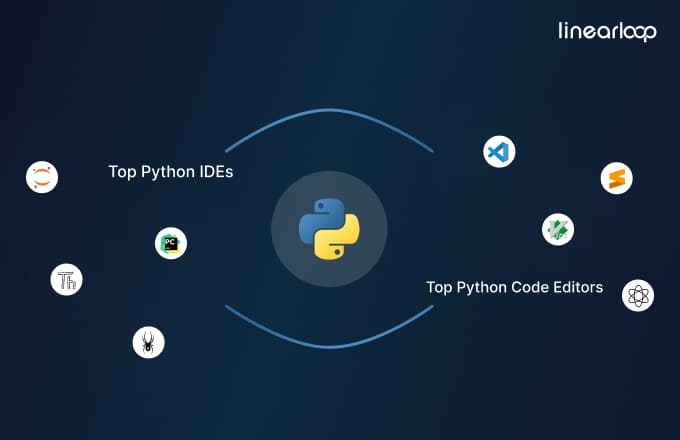
Explore the list of best code editors for Python:
1. Visual Studio Code: Visual Studio Code is also known as VS code and it is a free, open-source code editor developed by Microsoft. This editor is written in an electronic language and it works smoothly on operating systems (OS) like Windows, macOS, Linux, and many more. It is popular among developers due to its versatility and extensive range of features.
- Features:
a) Extensibility: It offers thousands of extensions that can be used to add various functionalities.
b) IntelliSense: This feature helps to do smart code completions, syntax highlighting, and error detection.
c) Built-In Git Integration: It allows you smooth version control with Git and GitHub.
d) Integrated Terminal: It is one of the main features of VS code as you can run terminal commands directly within the editor.
e) Debugging: Use the most powerful debugging tools with breakpoints, call stacks, and an interactive console.
2. Sublime Text: Sublime Text is a widely used text editor that is known for its speed, reliability, and rich set of features. It provides support for different types of programming languages including Python. Sublime Text is a perfect choice for you because it comes with powerful interfaces and text editing features.
- Features:
a) Goto Anything: With this functionality, you can quickly navigate to files, symbols, and lines.
b) Command Palette: Easily access different types of commands and features using a simple keyboard shortcut.
c) Multiple Selections: You can make multiple changes simultaneously.
d) Split Editing: Get the option to view and edit multiple files side by side.
e) Package Control: Instantly install and manage different types of packages & extensions.
3. Vim: Vim is an open-source and free terminal-based code editor that can be used on operating systems (OS) like macOS, UNIX, and Windows. It is a lightweight code editor that can be customized through different types of plugins and extensions. Vim includes some of the advanced features and commands that can help to easily navigate and edit the text.
- Features:
a) Extensive Plugin System: Different types of plugins are available on platforms like Vim-Plug, Pathogen, and Vundle to extend Vim's functionality.
b) Syntax Highlighting: It provides support for syntax highlighting for many programming languages to improve code readability and reduce errors.
c) Modal Editing: It uses different modes like insert, normal, visual, and command to separate editing tasks and improve productivity.
4. Atom: Atom is a well-known open-source and free code editor that is being developed by GitHub. Atom code editor is a preferred choice among developers who want to use a tool that can be customized according to their requirements.
- Features:
a) Package Manager: With the help of this package manager, you can easily browse and install new packages in the Atom code editor.
b) Themes: Customize the look and feel as it comes with various options of themes.
c) Teletype: The developers can easily collaborate in real-time.
d) Smart Autocomplete: It provides relevant suggestions while you are writing the code.
Read More: What should you look for before hiring Python developers?
Explore the list of top Python IDE tools that you can learn more about:
1. PyCharm: PyCharm is a robust and fully-featured IDE that is developed by JetBrains and is specifically designed for Python development. There are two versions of PyCharm available. One is the free community edition and the other one is the fully-featured professional edition that is paid. It is an IDE that can be used on operating systems (OS) like Linux, macOS, and Windows.
- Features:
a) Intelligent Code Assistance: It offers some of the most advanced code completion, real-time error checking, and powerful refactoring tools.
b) Integrated Tools: PyCharm provides support for web development frameworks like Django, Flask, and database management.
c) Debugger and Test Runner: This IDE includes a graphical debugger and an integrated test runner to easily handle the code.
d) Version Control Integration: You can smoothly integrate PyCharm with Git, SVN, Mercurial, and other version control systems.
2. Spyder: Spyder is an open-source and free IDE that is designed to handle scientific computing and data analysis. It is also one of the most lightweight IDEs for Python development and it is also known as Scientific Python Development IDE. Spyder works smoothly with popular Python packages like NumPy, SciPy, and Matplotlib.
- Features:
a) Variable Explorer: You can easily inspect different types of variables and data frames with user-friendly interfaces.
b) Integrated IPython Console: Use this functionality to execute the code more interactively and visualize final results.
c) Editor with Syntax Highlighting: You can enjoy its code completion and real-time analysis functionalities.
d) Plotting Support: It provides an inline plotting facility so that you can enjoy immediate data visualization of the code that you wrote.
3. Thonny: Thonny is an open-source, free, lightweight, and simple IDE that is specifically designed for developers who are learning Python. It also helps the developers to get insights into basic Python operations. Thonny is also known for providing a clean and straightforward interface with plenty of features to offer an easy learning curve.
- Features:
a) Simple Interface: This IDE’s minimalist design ensures that it will reduce distractions while writing Python code.
b) Step-through Debugger: This functionality helps beginners to understand how code executes.
c) Variable Explorer: You can inspect different types of variables and their values during the execution of the code.
d) Syntax Highlighting: It provides basic syntax highlighting which helps to improve the readability of the code.
e) Built-In Python Shell: This IDE allows you to execute Python commands interactively.
4. Jupyter Notebook: Jupyter Notebook is an open-source web application that is mainly used for machine learning and data science. The developers prefer to use this IDE because it allows you to create and share documents containing live code, equations, visualizations, and narrative text.
- Features:
a) Interactive Computing: You can execute the code in real time and see results instantly while using Jupyter Notebook IDE.
b) Rich Media: It provides support for embedding visualizations, equations, and other rich media.
c) Notebook Sharing: Now you can easily share notebooks via GitHub or any other platform.
d) Kernel Support: One of the main functionalities of this IDE is that it provides support for multiple programming languages through various kernels.
Choosing between a code editor and an Integrated Development Environment (IDE) can be tough but it depends on your development requirements and preferences. Python code editors like Visual Studio Code (VS) and Sublime Text are fast and lightweight and offer some of the necessary features like syntax highlighting, code completion, basic debugging, etc. They are highly customizable and preferred choice for quick tasks, scripting, and smaller projects.
While Python IDEs like PyCharm and Spyder provide an all-inclusive set of tools like advanced debugging, integrated version control, project management features, and many more. They are the best choice to handle large and complex projects that can improve productivity by providing a flawless development environment.
The choice depends upon the complexity of your project and specific workflows but if you want a clean and fast tool for coding then Python code editors are perfect for you. However, if you want a robust environment with extensive features for large-scale development then Python IDE tools are an ideal option for you.
- Expert Guidance: You can get professional advice on selecting the best Python IDE or code editor according to your specific requirements.
- Customized Solutions: Get customized recommendations from us based on your project requirements and workflow preferences.
- Setup Assistance: At Linearloop, we assist with installing and configuring your chosen IDE or code editor for the best performance.
- Integration Support: We seamlessly integrate your IDE or code editor with other development tools and version control systems.
Mayank Patel
Jun 25, 20245 min read