We're officially a Great Place To Work® certified company, India | 2026–27

Mayank Patel
Jul 1, 2026
5 min read
Last updated Jul 27, 2026
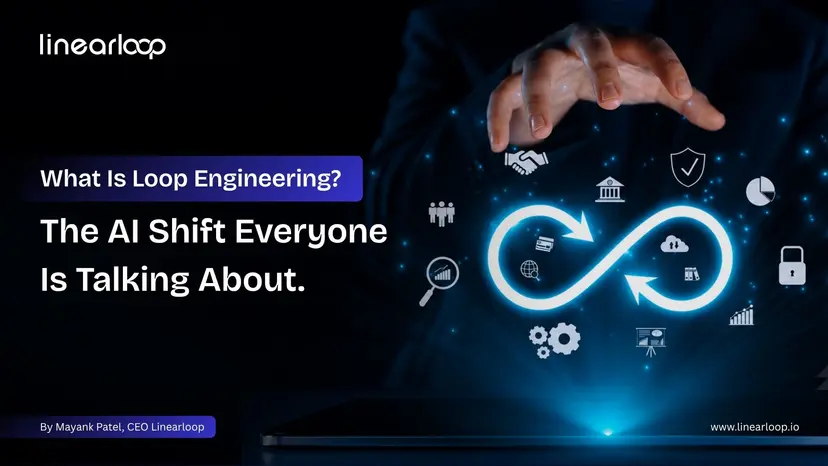
In the second week of June 2026, a twelve-word post rewired how the developer world thinks about AI.
Peter Steinberger, creator of OpenClaw and one of the most followed engineers on X, wrote: "You shouldn't be prompting coding agents anymore. You should be designing loops that prompt your agents."
Within days, the post had crossed 6.5 million views. Boris Cherny, the engineer who built Claude Code at Anthropic, had said something almost identical on stage the same week: "I don't prompt Claude anymore. I have loops running. They're the ones prompting Claude and figuring out what to do. My job is to write loops."
Two practitioners. Two different companies. The same conclusion. And a term that had been circulating in agentic engineering circles for months suddenly had a name everyone agreed on: loop engineering.
The discourse that followed was split. Half the replies called it the most important reframing of AI-assisted development in years. The other half called it a cron job wearing a hoodie. Both reactions missed the point, which is worth unpacking properly.
Also Read: [2026 Edition] Product Engineering Lifecycle Guide for High-Performing Teams
Loop engineering does not exist in isolation. It is the latest step in a progression that has been building since large language models became useful for software work. Each layer did not replace the one before it. Each one wrapped around it, moving the point of leverage further from the model itself.
Prompt engineering (2022 to 2024) was about the words. Give the model a clear role, break the task into steps, provide worked examples, instruct it to reason before responding. The skill was almost entirely in the phrasing. You sent one instruction, evaluated one response, and refined from there. The model was a tool you held and directed turn by turn.
Context engineering (2025) moved the focus from what you asked to everything the model could see. Conversation history, retrieved documents, tool outputs, agent state, dynamically assembled knowledge. Shopify's Tobi Lütke described it as providing all the context needed for a task to be plausibly solvable by the model. Andrej Karpathy called it the delicate art and science of filling the context window with just the right information for the next step. The prompt became one input within a larger information architecture. Getting the context right mattered more than getting the sentence right.
Harness engineering (early 2026) went a layer further, focusing on the full environment an agent runs inside. Not just what the model sees, but what it can do, what it cannot do, how it handles errors, what feedback signals it receives from the real world. Tests, linters, type checkers, deployment logs. A harness does not just tell the agent what to do. It shapes what the agent can observe and act on, and defines what counts as a recoverable error versus a hard stop.
Loop engineering (June 2026) sits one level above the harness. It is about the iterative cycle itself.
The definition, stripped of all ornamentation: loop engineering is the practice of designing the system that prompts your AI agent, rather than writing each prompt yourself. You define a goal and a stopping condition. The loop discovers work, hands it to the agent, verifies the result against the goal, and repeats until the condition holds or a budget limit is reached. The human steps back. The system drives.
Also Read: Product Engineering vs. Traditional Software Development: Which One Do You Need?
The concept is cleaner when you see its moving parts. A functioning loop has four components, and every serious implementation of the pattern has all four.
A trigger Something starts the loop. It might be a schedule (every morning at 9am, scan for open issues), an event (a pull request opens, a test suite fails, a deployment completes), or a human instruction that kicks off autonomous iteration. Without a trigger, you are still prompting manually. The trigger is what makes the loop run without you initiating it.
A goal Not a vague instruction but a verifiable end state. "Make things better" is not a goal. "All tests pass and no linting errors" is. "Zero open P1 issues" is. The goal needs to be something the system can check against programmatically, not something a human evaluates by feel. This is where most early loop implementations fall apart. The goal was left too loose, and the loop either never stopped or stopped at the wrong place.
Execution The agent receives the task with the relevant context and acts. It writes the fix, drafts the change, runs the query, fills the gap. This is the part most people focus on. It is actually the least interesting part of loop design, because the model handles it. What matters is everything around it.
Verification A separate check evaluates whether the output meets the defined goal. Critically, this verification should not be done by the same agent that did the work. The verifier's job is to ask whether the goal was actually met, not whether the agent tried hard. Tests pass or they do not. The diff is within the allowed scope or it is not. The output scores above the defined threshold or it does not. If verification fails, the loop retries, carrying forward what it learned from the previous attempt.
The shorthand version: discover, plan, execute, verify, repeat. You used to occupy that middle position yourself, reading each output, catching each error, deciding what to prompt next. Loop engineering replaces that with a system that does it without you in the chair.
Also Read: What Is Lean Product Engineering?A Practical Playbook for Architecture, Experiments, and Flow
The concept is not new. Engineers have been running agents inside feedback cycles in some form for years. The underlying idea of an agent acting, observing results, and retrying against a goal predates the term by a significant margin. So why did twelve words posted on a Tuesday in June become the most discussed developer topic in weeks?
Three things converged at the same time.
The agents became capable enough. By mid-2026, coding agents could run autonomously for hours and recover from their own mistakes well enough that the bottleneck genuinely shifted. When a single agent run might last an hour and touch dozens of files, the highest-leverage thing you can do is not write a sharper prompt. It is design a loop that keeps the agent productive, verified, and on-goal across that entire run, including while you sleep. That was not true in 2024. It became true in 2026.
The cost curves changed. Loop engineering is inherently more expensive than a single prompt, because each iteration consumes tokens. The sharp and sustained drop in model costs through 2025 and into 2026 made the economics work for a far wider range of tasks. Loops that would have been prohibitively expensive eighteen months ago now make commercial sense for routine engineering work.
The tooling caught up. A year ago, building a reliable loop meant maintaining a custom pile of bash scripts and orchestration logic that only the person who wrote it could debug. As of mid-2026, the building blocks ship natively inside Claude Code, OpenAI Codex, and most serious agent platforms. Worktrees for parallel agent runs. Scheduling primitives. Built-in goal commands that evaluate a stopping condition after every iteration. The infrastructure barrier dropped far enough that the conversation moved from whether loops were possible to how to design them well.
Those three conditions arriving together is what gave the term traction fast enough to reach millions of views within a week.
The hype is not wrong about the core thing. Loop engineering does represent a genuine shift in where the leverage lives when working with AI agents. If you are building software with AI assistance in 2026, the design of the system around the model matters more than the model you put inside it.
The productivity change is real. Teams running well-designed loops report nightly runs that find failing tests, attempt fixes, run the suite again, and leave reviewed pull requests by morning, with no human in the cycle until the review step. The same tasks that previously required an engineer's active attention for hours run unattended and leave structured work at the other end.
The skill shift is also real. The developers getting the most out of the agentic era right now are not necessarily the best prompt writers. They are the people who can define what "done" looks like in a form a system can evaluate, design the verification layer that enforces that definition, and build the memory and state management that let the loop carry context across iterations. That is a different skill set to prompt crafting, and it is closer to system design than to natural language.
Prompt engineering did not die. It became one component inside a loop. You still need clear goals, well-structured context, and constrained output formats at the prompt level. The loop does not make those decisions for you. What it removes is the human from the repetitive middle of the cycle: the re-prompting, the error-catching, the incremental iteration that burns engineering time when it does not have to.
The "cron job in a hoodie" criticism misses the distinction that matters. A cron job runs the same fixed instruction on a schedule. A loop evaluates the current state, decides what work needs doing, acts on it, and checks whether the result holds. The discovering and the verifying are where the genuine novelty sits. A cron job always runs the same thing. A loop runs what the situation requires.
The risk picture is also underplayed in most coverage. An unattended loop making mistakes makes them at speed and at scale. The teams burning money and generating technical debt with loops are the ones who invested in execution without investing equally in verification. A loop without a rigorous stopping condition and a capable verifier is not an autonomous system. It is a runaway cost event with good PR.
Also Read: Product Engineering Guide: How Businesses Build Scalable Products
Loop engineering is the fourth layer in a progression that keeps moving outward from the model itself. The model is no longer the constraint. The system design around it is.
For engineering teams, the practical question is not whether to use loop engineering but which tasks are worth looping. The pattern works consistently well for anything repeated or high-volume with a measurable stopping condition: nightly validation runs, automated bug triage, dependency updates, test coverage gaps, documentation updates, PR review responses. It works poorly for open-ended architectural decisions where the definition of done is inherently a human judgement.
For organisations evaluating their AI engineering capability, the relevant question has shifted too. It is no longer whether the team can use AI tools. It is whether the team has the system design knowledge to build loops that compound, the verification discipline to make those loops trustworthy, and the architectural judgement to know which work should be in a loop and which should not.
That is a different bar, and most organisations have not caught up to it yet.
The term will evolve. Something will follow it. But the shift loop engineering names, from prompting a model to designing the system around one, from being the loop to building it, is the direction everything is moving in. The question worth asking now is not whether to pay attention to it. It is how far behind you can afford to be.
Linearloop builds AI-led digital products for ambitious teams. If you want to understand what this shift means for your product engineering practice, [start a conversation with us.]