We're officially a Great Place To Work® certified company, India | 2026–27

Mayank Patel
Feb 11, 2026
6 min read
Last updated Feb 11, 2026
AI budgets are expanding, pilots are multiplying, GenAI demos look promising, yet production impact remains thin. Models degrade after deployment. Features behave differently between training and inference. Cloud storage scales, but trusted datasets are hard to locate. Engineering time shifts from improving models to cleaning and reconciling data. The symptoms look like execution gaps, but the friction runs deeper.
In many enterprises, the bottleneck sits beneath the AI stack. Data lakes built for ingestion scale and storage efficiency were never architected for reproducibility, lineage enforcement, or AI-grade governance. Over time, ingestion outpaced discipline, pipelines multiplied without contracts, metadata decayed, and ownership blurred. The result is slow, compounding drag on experimentation speed, model reliability, and executive confidence.
This blog directly audits that structural misalignment to examine how storage-first architecture quietly constrains intelligence-first ambition.
Read more: Why AI Adoption Breaks Down in High-Performing Engineering Teams
Across AI-first enterprises, the pattern is consistent. Significant capital went into building centralised data lakes between 2016 and 2021 to consolidate ingestion, reduce storage costs, and support analytics at scale. Then the AI acceleration wave arrived, where machine learning use cases expanded, GenAI entered the roadmap, and executive expectations shifted from dashboards to intelligent systems. The assumption was straightforward: If the data already lives in a central lake, scaling AI should be a natural extension.
It hasn’t played out that way. Instead, AI teams encounter fragmented datasets, inconsistent feature definitions, unclear ownership boundaries, and weak lineage visibility the moment they attempt to operationalise models. What looked like a scalable foundation for analytics reveals structural gaps under AI workloads. Experimentation cycles stretch, reproducibility becomes fragile, and production deployment slows down despite modern tooling.
The uncomfortable reality is that AI ambition has outpaced data discipline in many organisations. Storage scaled faster than governance. Ingestion scaled faster than contracts. Centralisation scaled faster than accountability. The architecture was optimised for accumulation, and that mismatch is now surfacing under the weight of AI expectations.
Read more: Why Executives Don’t Trust AI and How to Fix It
Data lakes emerged as a response to exploding data volumes and rising storage costs, offering a flexible, centralised way to ingest everything without forcing rigid schemas upfront. Their design priorities were scale, flexibility, and cost efficiency.
The primary objective was to store massive volumes of structured and unstructured data cheaply, often in object storage, without enforcing strong data modeling discipline at ingestion time. Optimisation centred on scale and cost.
Schema-on-read enabled teams to defer structural decisions until query time, accelerating experimentation and analytics exploration. However, this flexibility was never intended to enforce contracts, ownership clarity, or deterministic transformations, all of which AI systems depend on for reproducibility and consistent model behaviour across environments.
Data lakes centralised ingestion pipelines but rarely enforced domain-level accountability, meaning datasets accumulated faster than stewardship matured. Centralisation reduced silos at the storage layer, yet it did not define who owned data quality, semantic alignment, or lifecycle management, gaps that become critical under AI workloads.
Read more: Batch AI vs Real-Time AI: Choosing the Right Architecture
Traditional data lakes tolerate ambiguity because analytics can absorb inconsistency; AI systems cannot. Once you move from descriptive dashboards to predictive or generative models, tolerance for loose schemas, undocumented transformations, and inconsistent definitions collapses. AI workloads demand determinism, traceability, and structural discipline that most storage-first lake designs were never built to enforce.
Read more: CTO Guide to AI Strategy: Build vs Buy vs Fine-Tune Decisions
Architectural misalignment rarely announces itself as failure. It surfaces as friction that teams normalise over time. Delivery slows slightly, experimentation feels heavier, and confidence in outputs erodes gradually. Since nothing crashes dramatically, leaders attribute the drag to complexity, hiring gaps, or prioritisation.
Read more: 10 Best AI Agent Development Companies in Global Market (2026 Guide)
Data lakes decay gradually as ingestion expands faster than discipline. New sources are added without formal contracts, transformations are layered without documentation, metadata standards are inconsistently applied, and ownership boundaries remain implied rather than enforced. Since storage is cheap and ingestion is technically straightforward, accumulation becomes the default behaviour, while curation, validation, and lifecycle management lag behind. Over time, the lake holds more data than the organisation can confidently interpret.
Entropy compounds when pipeline sprawl meets weak governance. Multiple teams build parallel ingestion flows, feature engineering scripts diverge, and no single system enforces version control or semantic alignment across domains. What was once a centralised repository slowly turns into a fragmented ecosystem of loosely connected datasets, where discoverability declines, trust erodes, and every new AI initiative must first navigate structural ambiguity before delivering intelligence.
Read more: Who are AI Agencies
Analytics can tolerate inconsistency because human analysts interpret anomalies, adjust queries, and compensate for imperfect data, but AI systems cannot. Machine learning models assume stable feature definitions, reproducible datasets, and deterministic transformations, and when those assumptions break inside a loosely governed lake, performance degradation appears as model drift, unexplained variance, or unstable predictions. Teams waste cycles tuning hyperparameters or retraining models when the underlying issue is that the input data shifted silently without structural controls.
The impact becomes sharper with generative AI and retrieval-augmented systems, where an uncurated corpus, inconsistent metadata, and weak access controls directly influence output quality and compliance risk. If the lake contains duplicated documents, outdated records, or poorly classified sensitive data, large language models amplify those weaknesses at scale, producing hallucinations, biased responses, or policy violations. In analytics, ambiguity reduces clarity; in AI, it erodes trust in automation itself.
Read more: How to Build AI Agents with Ruby
When data architecture stays misaligned with AI ambition, costs compound beneath the surface. Storage and compute scale predictably, but engineering effort shifts toward cleaning, reconciling, and validating data rather than improving models. Experimentation slows, deployments stall, and the effective cost per AI use case rises without appearing in a single line item. What seems like operational drag is structural inefficiency embedded into the platform.
Strategically, hesitation follows instability. When model outputs are inconsistent and lineage is unclear, leaders delay automation, reduce scope, or avoid scaling entirely. Decision velocity declines, confidence weakens, and AI investment loses momentum. The gap widens quietly as disciplined competitors move faster on foundations built for intelligence.
Read more: What is an AI Agent
Most data strategies were built around accumulation that centralizes everything, stores it cheaply, and defers structure until someone needs it. That approach reduces friction at ingestion, but it transfers complexity downstream. AI systems expose that transfer immediately because they depend on stable definitions, reproducibility, and ownership discipline.
| Dimension | Storage-centric thinking | Product-centric data architecture |
| Core objective | Optimises for volume and cost efficiency, assuming downstream teams will impose structure later. | Optimises for usable, reliable datasets that are production-ready for AI and operational use. |
| Ownership | Infrastructure is centralised, but accountability for data quality and semantics remains diffuse. | Each dataset has a defined domain owner accountable for quality, contracts, and lifecycle. |
| Schema & contracts | Schema-on-read allows flexibility but does not enforce upstream discipline. | Contracts are enforced at ingestion, defining structure and expectations before data scales. |
| Reproducibility | Dataset changes are implicit, versioning is weak, and lineage is fragmented. | Versioned datasets and traceable transformations support deterministic ML workflows. |
| Governance | Compliance and validation are reactive and layered after ingestion. | Governance is embedded into pipelines through automated validation and access controls. |
| AI readiness | Suitable for exploratory analytics but unstable under ML and GenAI demands. | Engineered to support consistent features, lineage clarity, and scalable intelligent systems. |
AI readiness is achieved by enforcing structural discipline at the data layer so that models can rely on stable, traceable, and governed inputs. The difference between experimentation friction and scalable intelligence often comes down to whether the architecture enforces explicit guarantees or tolerates ambiguity.
Read more: Maximizing Business Impact with LangChain and LLMs
Before approving additional AI budgets, expanding GenAI pilots, or hiring more ML engineers, leadership should pressure-test whether the data foundation can sustain deterministic, governed, and scalable intelligence.
The following questions are structural indicators of whether your architecture supports compounding AI impact or quietly constrains it.
Read more: AI in Supply Chain: Use Cases and Applications with Examples
AI rarely collapses overnight when the data foundation is weak. It slows down, becomes unpredictable, and gradually loses executive trust. The constraint is seldom model capability or talent. It is structural ambiguity in the data layer that compounds under intelligent workloads. Storage-first architecture supports accumulation; AI demands contracts, reproducibility, ownership, and embedded governance.
Before scaling further, decide whether your platform is optimised for volume or for intelligence that compounds reliably. That choice determines whether AI becomes a durable advantage or a persistent drag. If you are reassessing your data foundation, Linearloop partners with engineering and leadership teams to diagnose structural gaps and design AI-ready data architectures built for reproducibility, governance, and scalable impact.

Multimodal AI Agents: Reading Documents, Images, and Screens in Production
Most agent projects start with text. The scoping conversation is clean, the API is clean, and the demo works on the first try.
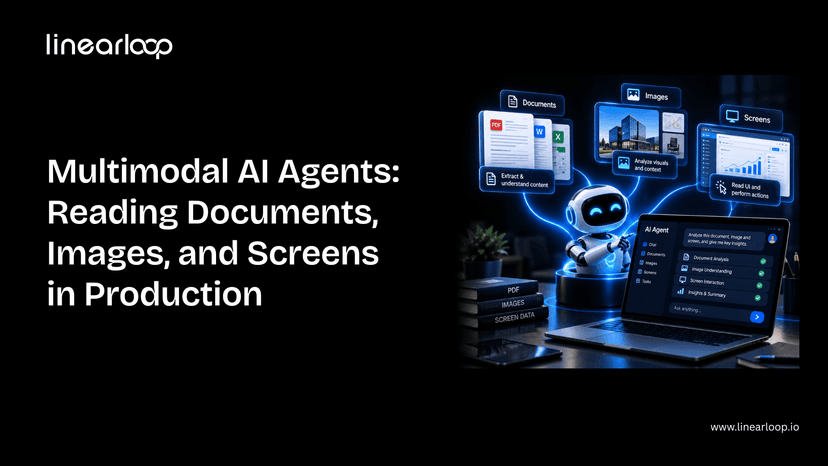
Then the real inputs show up: a scanned invoice, a photo of a damaged part, a legacy dashboard with no API at all. That's where a text-only agent stops being useful, and where multimodal AI agent systems that can read documents, images, and screens, not just process text, start earning their cost.
This guide covers what's actually different about building one of these for production: the components involved, the seven-step build process, where it breaks, and what it costs. It assumes you're already familiar with the core agent loop; if not, start with how to build an AI agent first.
Whether you're a CTO scoping a document-heavy workflow, a product leader evaluating whether this is worth the investment, or an engineer about to build one, this is the structure to work through.
Not every workflow needs multimodal capability. Here's where the two diverge.
| Dimension | Single-Modal (Text) Agent | Multimodal Agent |
Input types | Text only | Text + scanned documents + images + screens |
Data source | Clean APIs, structured fields | Unstructured: scans, photos, UI screenshots |
Failure mode | Misunderstands intent | Misreads a document or misidentifies a UI element |
Evaluation burden | Standard task-level testing | Must test against messy, low-quality real inputs |
Cost per call | Lower (text tokens only) | Higher (image/document tokens) |
Best fit | Structured workflows with existing data feeds | Invoice/PO processing, visual inspection, legacy UI automation |
If your workflow already has clean structured data, a single-modal agent is simpler and cheaper. Multimodal is worth the added complexity specifically when the source of truth is a document, image, or screen with no clean alternative.
Each of these shares a pattern: the data already exists; it's just not in a form a normal integration can reach.
Don't default to "vision + text + everything." Each modality should map to a real input your agent will encounter.
| Component | What it does |
Vision-capable model | Reads images, scanned pages, and screenshots alongside text |
OCR fallback layer | Catches text a vision model misses dense tables, poor scans, handwriting |
Document parser | Converts extracted content into structured fields your systems can use |
Screen interaction layer | Lets the agent click, type, and navigate a UI it can only see, not query |
Confidence scoring | Flags low-certainty extractions for human review instead of guessing |
Evaluation harness | Tests accuracy specifically on scanned, low-quality, and handwritten input |
This is the same discipline as scoping the core loop in how to build an AI agent, just with a wider read step. Getting the extracted output into a form your other systems can actually use is as much a data infrastructure question as a model one; our AI data stack architecture guide covers how to structure that layer properly.
If you're scoping a document- or screen-reading agent and want a second opinion on architecture before you build, talk to our AI development team.
Frontier models read printed text and clean diagrams near-perfectly. Accuracy drops meaningfully on handwriting, cluttered images, and low-contrast scans.
Test against your worst real documents, not your cleanest ones. This is the same build-vs-buy-vs-fine-tune calculation covered in our CTO guide to AI strategy, applied specifically to vision.
Vision models are good, not infallible. A cheap OCR pass as a secondary check catches errors a pure vision call misses, especially on dense tables and forms.
Define upfront which result wins when OCR and the vision model disagree; this decision is easy to skip during a demo and expensive to skip in production.
A UI redesign breaks an agent built against fixed coordinates or a memorized layout.
Build for the agent to re-orient from what it currently sees, not what it saw last time. This is the layer most teams underestimate, because it works perfectly until the first UI update ships. It's the same reliability challenge covered in our piece on agentic AI and autonomous web systems — an agent has to keep working as its environment changes, not just on day one.
Every extracted field should carry a confidence signal. Route low-confidence extractions to a human instead of letting the agent guess and move on.
This is the multimodal equivalent of the human-in-the-loop checkpoint any production agent needs. The failure mode here is a wrong answer delivered with total confidence.
The evaluation-set trap is worse here than for text agents. An agent tuned only against clean sample scans will look great in review and fail on the crumpled invoice a real user photographs with their phone.
This is exactly the kind of gap shadow traffic testing is built to catch before an agent touches real work, validating behavior against live-like conditions before it's trusted with production traffic.
Image and document input costs meaningfully more per call than text. Cache aggressively, downscale images where resolution doesn't affect accuracy, and route simple extractions to smaller, cheaper models.
Before committing to a larger build, weigh the expected savings against build cost using an AI ROI framework; multimodal projects are easy to over-scope without one.
None of these are unique to multimodal agents — they're the same category of gap covered in why DevOps mental models fail for MLOps in production AI, just with a wider set of inputs to account for.
| Step | What to Get Right |
Define modalities | Map each modality to a real input, not a wishlist |
Choose the model | Test against your worst documents, not your best |
Add OCR fallback | Define which result wins on disagreement |
Design for screen drift | Agent re-orients from current state, not memory |
Add confidence scoring | Low confidence routes to a human, not a guess |
Evaluate on ugly inputs | Avoid the clean-sample evaluation trap |
Budget for cost | Cache, downscale, and route to cheaper models where possible |
Multimodal capability doesn't change the fundamentals of building a good agent — it changes what "good input" means and where the failure modes hide. Get the evaluation and confidence-scoring layers right, and the rest is an extension of the same discipline that makes any agent production-ready.
If you're weighing whether to build this in-house or bring in a partner, our guide on what to look for in AI consulting services is a good starting point.
Have a document, image, or screen-reading use case in mind? Contact Linearloop's AI team for a no-pressure scoping conversation.

Aarav Mehta
Sep 24, 20266 min read
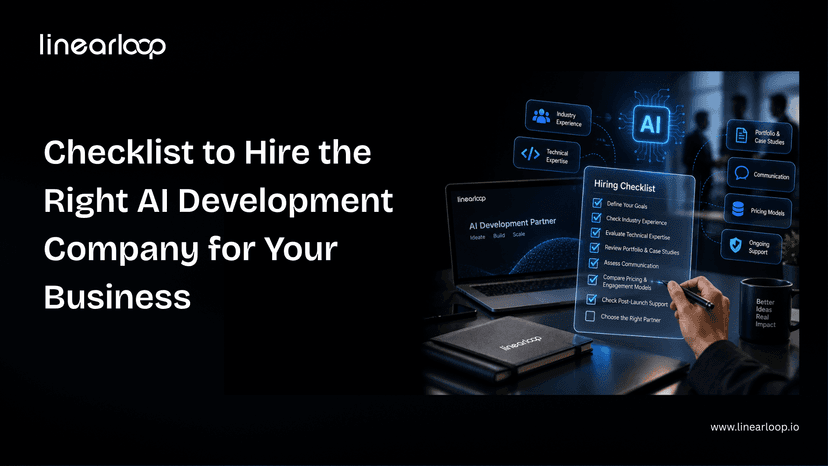
Checklist to Hire the Right AI Development Company for Your Business
AI has moved from an experimental line item to a core part of how businesses compete. Companies now use it to forecast demand, automate support, personalize products, and cut manual work out of everyday operations.
The harder problem isn't whether to adopt AI it's who to trust with it. Hundreds of vendors claim expertise in machine learning, natural language processing, and generative AI, but claims and delivery are two very different things.
Choose the wrong AI development company and you end up with a stalled pilot, a system nobody on your team can maintain, or a model that never reaches production. Choose the right one, and AI becomes a real driver of efficiency and revenue.
This checklist walks through what actually separates a capable AI partner from one that just sounds capable. Whether you're a founder scoping your first pilot, a CTO comparing vendors for an enterprise rollout, or a product leader trying to sanity-check a proposal, this is the structure to work through before you sign anything.
The technology rarely fails on its own. Projects fail when the team behind them lacks the process to turn a model into something reliable, secure, and maintainable in production.
A strong partner connects AI development services to a real business outcome, architects for scale from day one, and integrates cleanly with the systems you already run. A weaker one treats every engagement as a one-off experiment which is exactly why so many AI initiatives never make it past the proof-of-concept stage. Our breakdown of why enterprise AI fails and how to fix it goes deeper into the specific failure patterns.
Working with an experienced artificial intelligence development company doesn't just reduce technical risk — it reduces the risk of spending months on something that never ships.
Not every software partner is equipped to run an AI project. Here's where the two typically diverge.
| Dimension | General Software Vendor | Dedicated AI Development Company |
Core skill set | Application development, integrations | ML engineering, data science, MLOps |
Handling of data | Treats data as static input | Builds pipelines for training, retraining, drift monitoring |
Production readiness | Ships a working feature | Ships a monitored, retrainable system |
Compliance depth | General security practices | Model-specific: bias testing, explainability, data lineage |
Post-launch plan | Bug fixes and feature requests | Model monitoring, retraining, performance tracking |
Typical failure mode | Feature works but doesn't scale | — (this is the profile you want) |
If your project is primarily an integration or a standard web/mobile build, a general vendor may be the right fit. If it depends on a model that has to keep performing after launch, you need the right column.
Start with the problem, not the technology. Are you trying to reduce churn, catch fraud earlier, automate a manual workflow, or personalize recommendations? Vague goals produce vague proposals, and vague proposals are hard to evaluate against each other.
A clear problem statement also makes it much easier to tell whether a vendor's AI development services actually match your use case rather than a generic pitch retrofitted to sound relevant.
Look for range, not just a single specialty. A team that can move across machine learning, NLP, computer vision, and generative AI can adapt as your project evolves.
Ask for real examples: datasets they've worked with, frameworks they've deployed, and problems similar to yours that they've actually solved not just technologies listed on a slide. If you're still narrowing down what "expertise" should even mean for your use case, our guide on what to look for in AI consulting services is a useful gut-check before you get to a shortlist.
Building a model is one thing. Building one that respects the constraints of your industry is another — healthcare needs partners familiar with patient data regulations, retail needs demand forecasting and personalization experience, financial services needs a different risk posture entirely.
Ask for case studies or references from businesses like yours. A machine learning development company that has already solved a version of your problem is a much safer bet than one starting from zero.
AI projects need more than a single "AI person." Look for a mix of data scientists, ML engineers, solution architects, and DevOps specialists who know how to hand work off to each other.
Ask how they run the development cycle and whether the roles are actually staffed or just listed in a capabilities deck. A fragmented team is one of the most common reasons projects stall mid-build — and it's also why talent scarcity is pushing more companies toward augmented teams rather than trying to hire every specialist in-house.
The tools a company relies on tell you a lot about how they'll support you long-term.
| Layer | Example Tools |
Cloud | AWS, Azure, Google Cloud |
Frameworks | TensorFlow, PyTorch, Scikit-learn |
MLOps | MLflow, Kubeflow, DataRobot |
A partner working with modern, well-documented tools can move faster and hand off cleaner systems than one relying on outdated or overly custom infrastructure. Most AI projects don't actually fail at the model they fail at the data layer underneath it. Our AI data stack architecture guide covers what a production-ready stack needs before a single model gets trained.
Ask directly: how is data stored, who can access it, and how is the model's behavior tested for bias? A company offering serious AI development services should be able to speak to GDPR, HIPAA, or whatever standard applies to your industry without hesitation.
If security and data residency are a real concern which they usually are once regulated data enters the picture our guide to deploying private LLMs securely walks through the trade-offs between hosted and private deployment. If a vendor is vague about security or avoids the compliance conversation entirely, treat that as a warning sign, not a technicality to sort out later.
Most failed engagements trace back to poor communication, not poor technology. Ask how the team runs updates regular standups, sprint reviews, shared dashboards and whether their working hours realistically overlap with yours.
A partner that communicates clearly from the first call is far more likely to flag problems early instead of letting them compound.
Fixed-price, time-and-materials, and dedicated-team models all have different trade-offs depending on how well-defined your project is. Our comparison of time and materials vs. fixed-price models breaks down when each one actually makes sense.
Rather than anchoring on the lowest quote, weigh what's included: ongoing support, scalability, and the engineering quality behind the number. Cheap AI development outsourcing that produces a system you have to rebuild in a year isn't actually cheap.
A model's job doesn't end at launch — data drifts, usage patterns shift, and accuracy degrades without monitoring and retraining. Ask how the company handles model drift, performance tracking, and infrastructure scaling once the system is live.
This is also where it's worth asking how success will actually be measured. Our executive's guide to measuring AI ROI is a good reference for the metrics that matter once a model is in production rather than in a demo.
Even with a strong checklist, it helps to know the traps businesses commonly fall into:
| Point | What to Check |
Goals | Clear business problem and measurable outcomes |
Technical Expertise | Range across ML, NLP, CV, generative AI |
Industry Experience | Case studies in your sector |
Team Structure | Data scientists, engineers, architects, DevOps |
Tech Stack | Current frameworks, cloud platforms, MLOps tools |
Compliance | GDPR, HIPAA, bias testing, ethical AI |
Communication | Transparent updates, collaborative workflow |
Pricing | Value-focused, not just lowest bid |
Support | Monitoring, retraining, scaling after launch |
Red Flags | Vague answers, weak security, poor responsiveness |
Hiring the right AI development company comes down to evidence over promises: a clear problem statement, proven technical range, a real team behind the work, and a track record of shipping to production rather than just prototyping.
None of these ten points are hard to check. What separates businesses that get a working AI system from those that don't is usually just whether they actually asked.
If you're evaluating partners for your next AI initiative, talk to the team at Linearloop about your specific goals. We're happy to walk through how we'd approach them, no pitch deck required.
Aarav Mehta
Sep 14, 20266 min read