We're officially a Great Place To Work® certified company, India | 2026–27

Mayank Patel
Jan 8, 2025
5 min read
Last updated Dec 23, 2025
Ruby offers an excellent launch pad to develop AI agents. Known for its simplicity and developer-friendly syntax, Ruby enables you to create highly sophisticated AI agents without the burden of overly complex code.
AI agents come in various forms, each with different levels of sophistication and decision-making capabilities. Some common types include:
AI agents are finding diverse applications across various industries:
While often associated with web development, Ruby offers compelling advantages for AI agent development, especially for beginners:
NOTE: In Ruby, gems are like small add-ons or tools that you can plug into your code.
Before you start building your AI agents, you'll need to set up your development environment. Here are the essential tools and libraries:
Setting up your development environment means installing Ruby, then using RubyGems to install the needed libraries. A very simple way to check if everything is installed properly is to open your terminal or command prompt and type ruby -v to check the version of Ruby installed.
Building an AI agent, regardless of the language, generally follows a structured process:
The first important step is to define the problem domain in which your AI agent will work. What precisely will it do? For example, will it be an agent to recommend interesting articles to the users or just a simple agent to automate some repetitive task? Having defined the problem, you need to define the objectives of the agent. What precisely are the goals that the agent should accomplish in that domain? Goals should be measurable and clearly define what a success for the agent is.
An important decision you have to make here is whether you take a rule-based approach or a learning-based approach. Rule-based agents follow a set of predefined rules to make a decision. They excel in problems for which the decision logic is well-defined and very clear. On the other hand, learning-based agents learn from data in making decisions. This approach is better for more complex problems in which the rules are not very clear. You will also want to pay attention to the structure of the inputs of the agent, how it gathers information, the outputs, the actions it takes, and the decision processes that connect them.
This is where you would begin to implement the core logic for your AI agent in Ruby. It's far easier to do so since Ruby syntax is clear. You will call upon the installed libraries to handle either the data processing or the implementation of machine learning algorithms—provided you have chosen a learning-based approach—or define the rules for your rule-based agent. Numo::NArray can be used in manipulating numerical data, while TensorFlow.rb may be used to build and train a neural network.
This means feeding your learning-based agent a lot of training data. The data will help the agent learn patterns and fine-tune its algorithms. After training—be it whatever type of agent—testing becomes an important step. You need to test how the agent performs under various scenarios, ensuring it behaves in a manner expected of it; that its goals as set are achieved.
Building AI agents with Ruby, like any development endeavor, comes with its own set of challenges:
Building AI agents can be intimidating at first, but Ruby makes it a pretty approachable goal with its friendly syntax and burgeoning ecosystem of powerful libraries. The future of intelligent solutions is in your hands, and you will be able to embark confidently into this new exciting era equipped with the right approach and an ideal partner in your endeavor.
Whether it is tapping into the potential of AI agents for business process simplification or developing next-generation applications, Linearloop is there to help you move forward. Discover how our software development expertise and emerging technologies can accelerate your AI initiatives and guide you through the exciting landscape of intelligent automation with confidence.

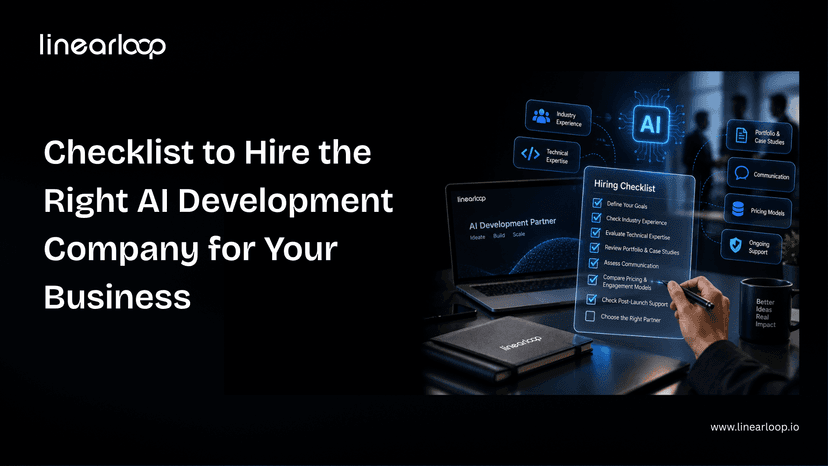
Checklist to Hire the Right AI Development Company for Your Business
AI has moved from an experimental line item to a core part of how businesses compete. Companies now use it to forecast demand, automate support, personalize products, and cut manual work out of everyday operations.
The harder problem isn't whether to adopt AI it's who to trust with it. Hundreds of vendors claim expertise in machine learning, natural language processing, and generative AI, but claims and delivery are two very different things.
Choose the wrong AI development company and you end up with a stalled pilot, a system nobody on your team can maintain, or a model that never reaches production. Choose the right one, and AI becomes a real driver of efficiency and revenue.
This checklist walks through what actually separates a capable AI partner from one that just sounds capable. Whether you're a founder scoping your first pilot, a CTO comparing vendors for an enterprise rollout, or a product leader trying to sanity-check a proposal, this is the structure to work through before you sign anything.
The technology rarely fails on its own. Projects fail when the team behind them lacks the process to turn a model into something reliable, secure, and maintainable in production.
A strong partner connects AI development services to a real business outcome, architects for scale from day one, and integrates cleanly with the systems you already run. A weaker one treats every engagement as a one-off experiment which is exactly why so many AI initiatives never make it past the proof-of-concept stage. Our breakdown of why enterprise AI fails and how to fix it goes deeper into the specific failure patterns.
Working with an experienced artificial intelligence development company doesn't just reduce technical risk — it reduces the risk of spending months on something that never ships.
Not every software partner is equipped to run an AI project. Here's where the two typically diverge.
| Dimension | General Software Vendor | Dedicated AI Development Company |
Core skill set | Application development, integrations | ML engineering, data science, MLOps |
Handling of data | Treats data as static input | Builds pipelines for training, retraining, drift monitoring |
Production readiness | Ships a working feature | Ships a monitored, retrainable system |
Compliance depth | General security practices | Model-specific: bias testing, explainability, data lineage |
Post-launch plan | Bug fixes and feature requests | Model monitoring, retraining, performance tracking |
Typical failure mode | Feature works but doesn't scale | — (this is the profile you want) |
If your project is primarily an integration or a standard web/mobile build, a general vendor may be the right fit. If it depends on a model that has to keep performing after launch, you need the right column.
Start with the problem, not the technology. Are you trying to reduce churn, catch fraud earlier, automate a manual workflow, or personalize recommendations? Vague goals produce vague proposals, and vague proposals are hard to evaluate against each other.
A clear problem statement also makes it much easier to tell whether a vendor's AI development services actually match your use case rather than a generic pitch retrofitted to sound relevant.
Look for range, not just a single specialty. A team that can move across machine learning, NLP, computer vision, and generative AI can adapt as your project evolves.
Ask for real examples: datasets they've worked with, frameworks they've deployed, and problems similar to yours that they've actually solved not just technologies listed on a slide. If you're still narrowing down what "expertise" should even mean for your use case, our guide on what to look for in AI consulting services is a useful gut-check before you get to a shortlist.
Building a model is one thing. Building one that respects the constraints of your industry is another — healthcare needs partners familiar with patient data regulations, retail needs demand forecasting and personalization experience, financial services needs a different risk posture entirely.
Ask for case studies or references from businesses like yours. A machine learning development company that has already solved a version of your problem is a much safer bet than one starting from zero.
AI projects need more than a single "AI person." Look for a mix of data scientists, ML engineers, solution architects, and DevOps specialists who know how to hand work off to each other.
Ask how they run the development cycle and whether the roles are actually staffed or just listed in a capabilities deck. A fragmented team is one of the most common reasons projects stall mid-build — and it's also why talent scarcity is pushing more companies toward augmented teams rather than trying to hire every specialist in-house.
The tools a company relies on tell you a lot about how they'll support you long-term.
| Layer | Example Tools |
Cloud | AWS, Azure, Google Cloud |
Frameworks | TensorFlow, PyTorch, Scikit-learn |
MLOps | MLflow, Kubeflow, DataRobot |
A partner working with modern, well-documented tools can move faster and hand off cleaner systems than one relying on outdated or overly custom infrastructure. Most AI projects don't actually fail at the model they fail at the data layer underneath it. Our AI data stack architecture guide covers what a production-ready stack needs before a single model gets trained.
Ask directly: how is data stored, who can access it, and how is the model's behavior tested for bias? A company offering serious AI development services should be able to speak to GDPR, HIPAA, or whatever standard applies to your industry without hesitation.
If security and data residency are a real concern which they usually are once regulated data enters the picture our guide to deploying private LLMs securely walks through the trade-offs between hosted and private deployment. If a vendor is vague about security or avoids the compliance conversation entirely, treat that as a warning sign, not a technicality to sort out later.
Most failed engagements trace back to poor communication, not poor technology. Ask how the team runs updates regular standups, sprint reviews, shared dashboards and whether their working hours realistically overlap with yours.
A partner that communicates clearly from the first call is far more likely to flag problems early instead of letting them compound.
Fixed-price, time-and-materials, and dedicated-team models all have different trade-offs depending on how well-defined your project is. Our comparison of time and materials vs. fixed-price models breaks down when each one actually makes sense.
Rather than anchoring on the lowest quote, weigh what's included: ongoing support, scalability, and the engineering quality behind the number. Cheap AI development outsourcing that produces a system you have to rebuild in a year isn't actually cheap.
A model's job doesn't end at launch — data drifts, usage patterns shift, and accuracy degrades without monitoring and retraining. Ask how the company handles model drift, performance tracking, and infrastructure scaling once the system is live.
This is also where it's worth asking how success will actually be measured. Our executive's guide to measuring AI ROI is a good reference for the metrics that matter once a model is in production rather than in a demo.
Even with a strong checklist, it helps to know the traps businesses commonly fall into:
| Point | What to Check |
Goals | Clear business problem and measurable outcomes |
Technical Expertise | Range across ML, NLP, CV, generative AI |
Industry Experience | Case studies in your sector |
Team Structure | Data scientists, engineers, architects, DevOps |
Tech Stack | Current frameworks, cloud platforms, MLOps tools |
Compliance | GDPR, HIPAA, bias testing, ethical AI |
Communication | Transparent updates, collaborative workflow |
Pricing | Value-focused, not just lowest bid |
Support | Monitoring, retraining, scaling after launch |
Red Flags | Vague answers, weak security, poor responsiveness |
Hiring the right AI development company comes down to evidence over promises: a clear problem statement, proven technical range, a real team behind the work, and a track record of shipping to production rather than just prototyping.
None of these ten points are hard to check. What separates businesses that get a working AI system from those that don't is usually just whether they actually asked.
If you're evaluating partners for your next AI initiative, talk to the team at Linearloop about your specific goals. We're happy to walk through how we'd approach them, no pitch deck required.

Aarav Mehta
Sep 14, 20266 min read
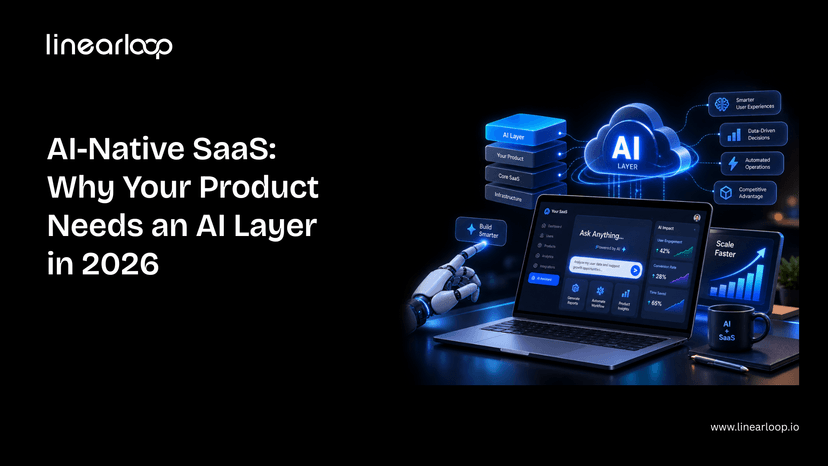
AI-Native SaaS: Why Your Product Needs an AI Layer in 2026
AI is quickly moving from an optional feature to a core part of modern SaaS products. But simply adding a chatbot, content generator, or AI assistant does not make a product AI-native.
An AI-native SaaS product uses AI as part of its core architecture and workflows. It can understand context, work with product data, make recommendations, automate decisions, and increasingly execute multi-step tasks on behalf of users.
This guide explains the difference between AI-enabled and AI-native SaaS, the three levels of an AI layer, how to introduce AI without rebuilding your existing product, expected development costs and timelines, and how to monetize AI features without creating a margin problem.
Whether you're a SaaS founder, CTO, or product leader, you'll learn how to identify the right workflow for AI, build trust into the experience, and turn AI from a feature into a meaningful product advantage.
An AI-native SaaS product is software designed around AI capabilities as part of its core workflow rather than treating AI as an optional feature.
Traditional SaaS products generally rely on users to find information, interpret it, make decisions, and perform actions themselves. AI-native products can take over some of these steps.
For example, instead of asking a sales manager to review hundreds of customer records, an AI-native CRM manually could analyze those records, identify high-value opportunities, explain why they matter, and recommend the next action.
The key difference isn't simply whether a product uses AI.
It's how deeply AI is integrated into the product experience and architecture.
Also Read: AI Chatbot Product Development: Features, Cost & Process
AI-enabled SaaS adds AI capabilities to an existing product.
Examples include:
The core product still works in essentially the same way without those features.
AI-native SaaS, on the other hand, uses AI throughout important parts of the workflow.
AI may:
A useful practical test is:
If you removed the AI tomorrow, would the product still perform essentially the same job, just with more manual work?
If yes, the product is likely AI-enabled.
If removing AI would fundamentally change the product's core workflow or value proposition, it is much closer to AI-native.
Dimension | AI-Enabled | AI-Native |
Where AI sits | Next to the core workflow | Inside the core workflow |
Role of AI | Helps with individual tasks | Influences and executes core workflows |
Data usage | Often limited to a specific feature | Connected to broader product context |
User interaction | User asks AI to help | AI can proactively recommend or act |
If AI is removed | Product largely works the same | Core workflows may lose significant value |
Typical example | "Summarize this report" | Automatically analyze, explain, and act on reports |
Build approach | Add AI features to existing product | Design workflows around AI capabilities |
Pricing | Usually bundled | Often requires usage-based or premium pricing |
Long-term advantage | Easier for competitors to copy | More deeply integrated into the product |
An AI layer is the intelligence layer that connects your SaaS application's data, workflows, users, and AI models.
Instead of AI existing as one isolated feature, the AI layer can interact with different parts of the application.
A typical AI layer may include:
This is why an AI layer is more valuable than simply adding an AI feature.
A feature answers a specific request.
An AI layer can understand context, make decisions, and participate in multiple workflows across the product.
Also Read: AI Product Development Lifecycle: From Discovery to Deployment
AI adoption in SaaS generally develops in stages. You don't have to jump directly from a traditional SaaS product to fully autonomous agents.
At the first level, AI helps users complete individual tasks.
Examples include:
The user remains fully in control.
They ask the AI to perform a task, review the result, and decide what happens next.
This is usually the fastest and lowest-risk starting point for AI SaaS development.
The second level goes beyond individual AI prompts.
The AI understands more context about the user and the application and can interact with business systems.
For example, a customer support platform could allow a user to ask:
"Which customers have unresolved high-priority issues?"
Instead of simply generating text, the AI could:
This is where an AI layer starts becoming deeply integrated into the SaaS workflow.
At the third level, AI can execute multi-step workflows within defined boundaries.
An AI agent might:
For example, an AI sales agent could identify a qualified lead, research the account, prepare a personalized outreach email, update the CRM, and schedule a follow-up—while requiring human approval before sending the message.
This is where agentic AI SaaS can create significant operational leverage.
If you're new to the concept, understanding what an AI agent is can help before you scope a production agentic workflow.
However, Level 3 also requires stronger governance, permissions, monitoring, testing, and failure handling.
You don't necessarily need to start here.
For most SaaS companies, a focused Level 1 or Level 2 workflow is a better starting point.
Also Read: How to Build an AI Agent in 2026 (Step-by-Step Guide)
One of the biggest misconceptions about AI transformation is that companies need to rebuild their entire SaaS platform.
In most cases, they don't.
AI can often be introduced through APIs, integrations, retrieval systems, and services that sit alongside the existing application architecture.
Here's a practical approach.
Don't try to make your entire product AI-powered at once.
Identify one workflow with:
The best first AI workflow is usually one where AI can produce a clear improvement in speed, accuracy, or productivity.
AI needs context to provide useful answers.
For many SaaS products, this means connecting AI to existing application data through APIs and retrieval systems.
You may need to evaluate:
For many use cases, RAG (Retrieval-Augmented Generation) can provide relevant information to an existing AI model without requiring you to train a model from scratch.
The choice between RAG and fine-tuning should depend on your accuracy, data, security, cost, and compliance requirements.
AI output can be wrong.
That's why AI product development should focus on trust as much as the interface.
Depending on the use case, consider:
Users should understand what the AI did and have an easy way to correct it.
Your first AI implementation doesn't need to transform the entire product.
A focused AI copilot for one workflow may be enough to validate:
Once the workflow proves its value, expand into additional use cases.
Don't necessarily release the AI feature to every customer on day one.
Start with a subset of users and measure:
This data gives you a much stronger foundation for the wider rollout.
AI can create variable infrastructure and model costs.
If you give customers unlimited access without understanding usage patterns, a highly active customer can cost significantly more to serve than a low-usage customer.
Decide early whether AI will be:
Pricing should be designed alongside the AI experience rather than added after launch.
AI-native transformation is not a one-time feature launch.
Once the first workflow proves successful, look for the next opportunity where AI can reduce manual work or improve decision-making.
Over time, these individual workflows can become a connected AI layer across the SaaS platform.
There is no single price for building an AI layer.
The cost depends on the complexity of the workflow, AI model, data infrastructure, integrations, security requirements, and level of autonomy.
As an indicative planning range, SaaS companies might see:
AI Implementation | Indicative Development Cost |
Basic AI assistant or feature | $15,000–$40,000 |
Contextual AI copilot | $40,000–$100,000 |
Advanced AI workflow | $60,000–$150,000+ |
Agentic AI system | $75,000–$200,000+ |
Platform-wide AI transformation | Custom scope |
These are not fixed project quotes. Actual AI SaaS development costs can vary substantially depending on your existing architecture and requirements.
A simple content-generation feature requires much less engineering than an autonomous multi-step agent.
Using an existing foundation model through an API generally has a lower initial development cost than developing or training a custom model.
Clean, structured, accessible data makes AI integration easier.
Poorly organized or siloed data can significantly increase development effort.
Every external system the AI needs to access can add development and testing requirements.
Examples include:
Enterprise AI applications may require:
These requirements increase the scope but can be essential for production adoption.
Production AI requires more than simply connecting an API.
Teams need to evaluate:
This ongoing evaluation is part of building a reliable AI-powered SaaS platform.
Before committing to a larger AI investment, it is also worth evaluating the expected business value with an AI ROI framework, rather than looking only at engineering costs.
Development time depends on the scope.
A focused AI feature can often be developed in a few weeks to a couple of months, while a broader AI transformation can take six months to a year or longer, particularly when multiple workflows and integrations are involved.
A practical 90-day starting roadmap could look like this:
If you're planning the broader SaaS build alongside the AI layer, our SaaS product development checklist can help you cover the product, technology, testing, and launch considerations outside the AI component.
Building an AI feature is only half the challenge.
The next question is:
How should you charge for it?
AI features are different from traditional SaaS features because they can create variable costs based on usage.
A customer who sends thousands of AI requests may cost significantly more to serve than one who sends only a few.
AI is included within existing subscription tiers.
This works well when AI usage is predictable and relatively inexpensive.
Customers pay according to consumption.
This could be based on:
Advanced AI capabilities are reserved for higher subscription tiers.
This can be effective when AI provides significant additional value.
Customers pay an additional fee to activate AI capabilities.
This works particularly well when AI represents a distinct value proposition.
Whatever pricing model you choose, understand your maximum acceptable AI cost per customer.
Ideally, enforce usage limits and cost controls in your product rather than relying on manual monitoring.
The goal is to make AI an expansion-revenue opportunity, not an uncontrolled infrastructure expense.
Also Read: Top AI Product Development Companies in USA
AI adoption is changing what users expect from software.
Users increasingly expect software to do more than display information.
They want products that can:
AI makes these experiences possible at scale.
A standalone AI feature can often be copied quickly.
An AI layer deeply connected to your product's data, workflows, permissions, and user experience is much harder to replicate.
The competitive advantage comes from the combination of AI + proprietary data + workflow integration + user context.
The SaaS market is moving beyond AI that simply generates text.
Modern AI systems can increasingly use tools, access data, reason through tasks, and execute workflows.
This shift makes agentic AI development particularly relevant for SaaS companies looking to automate operational processes.
It's also part of the broader AI product development lifecycle, where AI capabilities increasingly become integrated into the product rather than treated as isolated features.
Existing SaaS products can often introduce AI incrementally.
You can start with one workflow, validate the results, and expand the AI layer over time.
That makes AI transformation much more manageable than a complete platform rewrite.
The SaaS products that maintain their competitive advantage in the coming years won't necessarily be the ones with the longest list of AI features.
They'll be the products where AI becomes part of how the product actually works.
That's the difference between adding an AI feature and building an AI-native SaaS product.
You don't need to rebuild your entire platform to start.
Begin with one high-value workflow. Connect AI to the right data. Build trust and human oversight into the experience. Measure the results. Then expand into the next workflow.
Done correctly, an AI layer can improve user productivity, increase automation, create new pricing opportunities, and make your SaaS product significantly harder to replace.
If you're ready to explore how AI could fit into your existing SaaS platform, talk to our team about what an AI layer could look like for your product.
Aarav Mehta
Sep 3, 20266 min read