We're officially a Great Place To Work® certified company, India | 2026–27

Mayank Patel
Jan 27, 2026
6 min read
Last updated Jan 27, 2026

Real-time AI has quietly become a default choice in modern artificial intelligence development services. If a system can respond instantly, teams assume it must be better. So, faster feels smarter, and lower latency looks like progress. But most of the time, this assumption is architectural, pushing teams into complexity they didn’t sign up for.
Batch AI, by contrast, is increasingly treated as a compromise. Something you use until you mature into real-time. That framing is wrong. Batch systems trade immediacy for context, accuracy, and operational stability, while real-time systems trade context for speed and carry permanent costs in infrastructure, reliability, and cognitive load. These shape how systems fail, how teams operate, and how much the organisation pays to stay online.
This isn’t a comparison of which approach is more advanced. It’s a decision about where latency actually creates business value and where it quietly becomes a liability.
Also Read: CTO Guide to AI Strategy: Build vs Buy vs Fine-Tune Decisions
The industry has started treating real-time AI as a baseline rather than a deliberate choice. If a system reacts instantly, it is assumed to be more advanced, more competitive, and more intelligent. This thinking usually comes from product pressure, investor narratives, or vendor messaging that frames latency reduction as automatic progress.
In practice, real-time becomes the default long before teams understand the operational cost. Streaming pipelines get added early. Low-latency inference paths are built before decision quality is proven. Teams optimise for response time without proving that response time is what actually drives outcomes. Speed becomes a proxy for value, even when the business impact is marginal.
This default is dangerous because it inverts the decision process. Instead of asking whether delay destroys value, teams ask how quickly they can respond. That shift locks organisations into expensive, fragile systems that are hard to roll back. Real-time stops being a tool and becomes an assumption, and assumptions are where architecture quietly goes wrong.
Real-time AI and batch AI are often compared at the surface level as speed versus delay. That comparison misses how systems behave under load, failure, and scale. Below is the system-level separation that teams usually realise only after they’ve shipped.
| Dimension | Batch AI | Real-time AI |
| Latency tolerance | Designed to absorb delay without loss of value. Decisions are not time-critical. | Assumes delay destroys value. Decisions must happen in line. |
| Data completeness | Operates on full or near-complete datasets with richer context. | Works with partial, noisy, or evolving signals at decision time. |
| Decision accuracy | Optimised for correctness and consistency over speed. | Trades context and certainty for immediacy. |
| Infrastructure model | Periodic compute, predictable workloads, and easier cost control. | Always-on pipelines, hot paths, non-linear cost growth. |
| Failure behaviour | Fails quietly and recoverably. Missed runs can be retried. | Fails loudly. Errors propagate instantly to users or systems. |
| Coupling | Loosely coupled to upstream systems and events. | Tightly coupled to live inputs and dependencies. |
| Operational overhead | Easier debugging, clearer post-mortems, lower on-call load. | Harder observability, complex incident analysis, and higher fatigue. |
| Learning loops | Strong offline evaluation and model improvement cycles. | Weaker feedback unless explicitly engineered. |
Real-time AI becomes complex only in narrow conditions. It is not about responsiveness for its own sake. It is about situations where delay irreversibly destroys value, and no offline correction can recover the outcome. Outside of these cases, batch systems are usually safer, cheaper, and more accurate.
Real-time AI is justified when the decision must be made in the execution path itself. Fraud prevention after a transaction settles is useless. Security enforcement after access is granted is a failure. Routing decisions after traffic has already spiked are too late. In these cases, latency is the decision boundary. If the system cannot act immediately, the decision loses all meaning.
Real-time AI also wins when the underlying signals lose relevance almost instantly. User intent mid-session, live traffic surges, system anomalies, or fast-moving market conditions all change faster than batch cycles can track. Batch systems in these environments optimise against stale reality. Real-time systems, even with imperfect data, outperform simply because they are acting on the present rather than analysing the past.
Also Read: 10 Best AI Agent Development Companies in Global Market (2026 Guide)
Real-time AI rarely fails in capability, economics, and operations. The cost compounds across infrastructure, accuracy, and team bandwidth and it grows non-linearly as systems scale.
Real-time systems cannot pause. Streaming ingestion, hot-inference paths, low-latency storage, and aggressive autoscaling remain active regardless of traffic quality. To avoid missed decisions, teams over-provision capacity and duplicate pipelines for safety. Observability also becomes mandatory, not optional, adding persistent telemetry and alerting overhead. The result is a permanently “hot” system where costs scale with readiness.
Speed reduces context. Real-time inference operates on incomplete signals, shorter feature windows, and noisier inputs. Features that improve decision quality often arrive too late to be used. Batch systems, by contrast, see the full state of the world before acting. In many domains, batch AI produces more correct outcomes simply because it has more information, even if it responds later.
Real-time AI tightens the coupling between data, models, and execution paths. Failures propagate instantly. Retries amplify load. Small upstream issues turn into user-facing incidents. Debugging becomes harder because state changes continuously and cannot be replayed cleanly. What looks like a speed upgrade often becomes a reliability problem that increases on-call load and slows teams down over time.
Real-time AI stops being an advantage when speed is added without necessity. In these cases, the system becomes more expensive, harder to operate, and slower to evolve while delivering little incremental business value.
Many decisions do not require immediate execution. Scoring, optimisation, ranking, forecasting, and reporting often retain their value even when delayed by minutes or hours. Making these paths real-time adds permanent infrastructure and operational cost without improving outcomes. The system responds faster, but nothing meaningful improves. This is overengineering disguised as progress.
When teams optimise for low latency first, learning usually suffers. Offline evaluation becomes harder. Feature richness is sacrificed for speed. Feedback loops weaken because decisions cannot be revisited or analysed cleanly. Over time, models stagnate while complexity increases. The system moves quickly but learns slowly, and that trade-off compounds against the business.
Teams rarely choose real-time AI because the use case demands it. They choose it because organisational and external forces make speed feel safer than restraint. The decision happens before the system earns the complexity.
Choosing between real-time and batch AI should not be a design preference or a tooling decision. It should be a risk and value assessment. The framework below is meant to be applied before architecture is committed and cost is locked in.
Mature teams rarely choose between batch and real-time in isolation. They separate learning from intervention. Batch AI is used to understand patterns, train models, and define decision boundaries. Real-time AI is limited to executing those boundaries when timing is critical. This keeps speed where it matters and stability everywhere else.
In this model, batch systems do the heavy lifting. They evaluate outcomes, refine features, set thresholds, and surface risk. Real-time systems consume these outputs as constraints. The online path stays narrow, predictable, and cheap to operate.
Hybrid architectures also reduce blast radius. When real-time components degrade, batch-driven defaults can take over without halting the system. Teams retain the ability to learn, iterate, and roll back decisions without tearing down infrastructure. Speed becomes an optimisation at the edge.
Real-time AI is a constraint you accept when delay makes failure unavoidable. Used deliberately, it creates real value. Used casually, it inflates cost, weakens reliability, and slows learning. The strongest systems are the ones that respond at the right speed, with the right context, and with failure modes they can live with.
For CTOs and platform leaders, the real job is not choosing between batch and real-time. It is deciding where speed is existential and where correctness, reversibility, and stability matter more. That clarity shows up in architecture, cost control, and team health over time.
At Linearloop, we help teams design artificial intelligence development services that make these trade-offs explicit, so real-time is used where it earns its place, and batch systems do the work they are best at. If you’re rethinking how AI decisions run in production, that’s the conversation worth having.

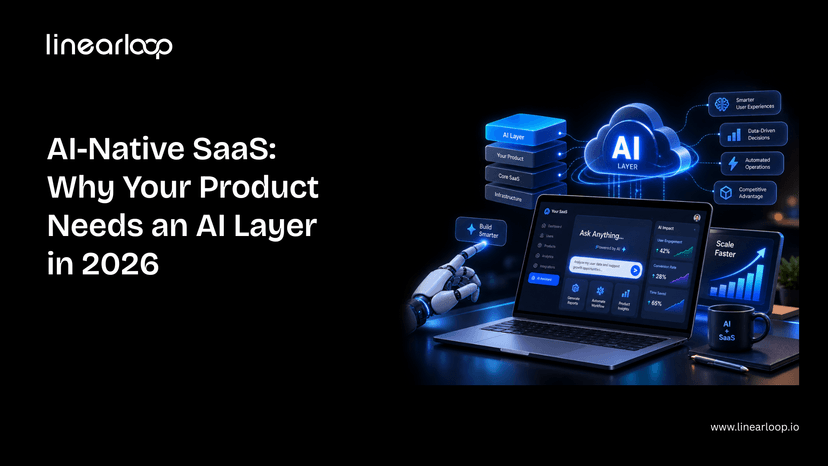
AI-Native SaaS: Why Your Product Needs an AI Layer in 2026
AI is quickly moving from an optional feature to a core part of modern SaaS products. But simply adding a chatbot, content generator, or AI assistant does not make a product AI-native.
An AI-native SaaS product uses AI as part of its core architecture and workflows. It can understand context, work with product data, make recommendations, automate decisions, and increasingly execute multi-step tasks on behalf of users.
This guide explains the difference between AI-enabled and AI-native SaaS, the three levels of an AI layer, how to introduce AI without rebuilding your existing product, expected development costs and timelines, and how to monetize AI features without creating a margin problem.
Whether you're a SaaS founder, CTO, or product leader, you'll learn how to identify the right workflow for AI, build trust into the experience, and turn AI from a feature into a meaningful product advantage.
An AI-native SaaS product is software designed around AI capabilities as part of its core workflow rather than treating AI as an optional feature.
Traditional SaaS products generally rely on users to find information, interpret it, make decisions, and perform actions themselves. AI-native products can take over some of these steps.
For example, instead of asking a sales manager to review hundreds of customer records, an AI-native CRM manually could analyze those records, identify high-value opportunities, explain why they matter, and recommend the next action.
The key difference isn't simply whether a product uses AI.
It's how deeply AI is integrated into the product experience and architecture.
Also Read: AI Chatbot Product Development: Features, Cost & Process
AI-enabled SaaS adds AI capabilities to an existing product.
Examples include:
The core product still works in essentially the same way without those features.
AI-native SaaS, on the other hand, uses AI throughout important parts of the workflow.
AI may:
A useful practical test is:
If you removed the AI tomorrow, would the product still perform essentially the same job, just with more manual work?
If yes, the product is likely AI-enabled.
If removing AI would fundamentally change the product's core workflow or value proposition, it is much closer to AI-native.
Dimension | AI-Enabled | AI-Native |
Where AI sits | Next to the core workflow | Inside the core workflow |
Role of AI | Helps with individual tasks | Influences and executes core workflows |
Data usage | Often limited to a specific feature | Connected to broader product context |
User interaction | User asks AI to help | AI can proactively recommend or act |
If AI is removed | Product largely works the same | Core workflows may lose significant value |
Typical example | "Summarize this report" | Automatically analyze, explain, and act on reports |
Build approach | Add AI features to existing product | Design workflows around AI capabilities |
Pricing | Usually bundled | Often requires usage-based or premium pricing |
Long-term advantage | Easier for competitors to copy | More deeply integrated into the product |
An AI layer is the intelligence layer that connects your SaaS application's data, workflows, users, and AI models.
Instead of AI existing as one isolated feature, the AI layer can interact with different parts of the application.
A typical AI layer may include:
This is why an AI layer is more valuable than simply adding an AI feature.
A feature answers a specific request.
An AI layer can understand context, make decisions, and participate in multiple workflows across the product.
Also Read: AI Product Development Lifecycle: From Discovery to Deployment
AI adoption in SaaS generally develops in stages. You don't have to jump directly from a traditional SaaS product to fully autonomous agents.
At the first level, AI helps users complete individual tasks.
Examples include:
The user remains fully in control.
They ask the AI to perform a task, review the result, and decide what happens next.
This is usually the fastest and lowest-risk starting point for AI SaaS development.
The second level goes beyond individual AI prompts.
The AI understands more context about the user and the application and can interact with business systems.
For example, a customer support platform could allow a user to ask:
"Which customers have unresolved high-priority issues?"
Instead of simply generating text, the AI could:
This is where an AI layer starts becoming deeply integrated into the SaaS workflow.
At the third level, AI can execute multi-step workflows within defined boundaries.
An AI agent might:
For example, an AI sales agent could identify a qualified lead, research the account, prepare a personalized outreach email, update the CRM, and schedule a follow-up—while requiring human approval before sending the message.
This is where agentic AI SaaS can create significant operational leverage.
If you're new to the concept, understanding what an AI agent is can help before you scope a production agentic workflow.
However, Level 3 also requires stronger governance, permissions, monitoring, testing, and failure handling.
You don't necessarily need to start here.
For most SaaS companies, a focused Level 1 or Level 2 workflow is a better starting point.
Also Read: How to Build an AI Agent in 2026 (Step-by-Step Guide)
One of the biggest misconceptions about AI transformation is that companies need to rebuild their entire SaaS platform.
In most cases, they don't.
AI can often be introduced through APIs, integrations, retrieval systems, and services that sit alongside the existing application architecture.
Here's a practical approach.
Don't try to make your entire product AI-powered at once.
Identify one workflow with:
The best first AI workflow is usually one where AI can produce a clear improvement in speed, accuracy, or productivity.
AI needs context to provide useful answers.
For many SaaS products, this means connecting AI to existing application data through APIs and retrieval systems.
You may need to evaluate:
For many use cases, RAG (Retrieval-Augmented Generation) can provide relevant information to an existing AI model without requiring you to train a model from scratch.
The choice between RAG and fine-tuning should depend on your accuracy, data, security, cost, and compliance requirements.
AI output can be wrong.
That's why AI product development should focus on trust as much as the interface.
Depending on the use case, consider:
Users should understand what the AI did and have an easy way to correct it.
Your first AI implementation doesn't need to transform the entire product.
A focused AI copilot for one workflow may be enough to validate:
Once the workflow proves its value, expand into additional use cases.
Don't necessarily release the AI feature to every customer on day one.
Start with a subset of users and measure:
This data gives you a much stronger foundation for the wider rollout.
AI can create variable infrastructure and model costs.
If you give customers unlimited access without understanding usage patterns, a highly active customer can cost significantly more to serve than a low-usage customer.
Decide early whether AI will be:
Pricing should be designed alongside the AI experience rather than added after launch.
AI-native transformation is not a one-time feature launch.
Once the first workflow proves successful, look for the next opportunity where AI can reduce manual work or improve decision-making.
Over time, these individual workflows can become a connected AI layer across the SaaS platform.
There is no single price for building an AI layer.
The cost depends on the complexity of the workflow, AI model, data infrastructure, integrations, security requirements, and level of autonomy.
As an indicative planning range, SaaS companies might see:
AI Implementation | Indicative Development Cost |
Basic AI assistant or feature | $15,000–$40,000 |
Contextual AI copilot | $40,000–$100,000 |
Advanced AI workflow | $60,000–$150,000+ |
Agentic AI system | $75,000–$200,000+ |
Platform-wide AI transformation | Custom scope |
These are not fixed project quotes. Actual AI SaaS development costs can vary substantially depending on your existing architecture and requirements.
A simple content-generation feature requires much less engineering than an autonomous multi-step agent.
Using an existing foundation model through an API generally has a lower initial development cost than developing or training a custom model.
Clean, structured, accessible data makes AI integration easier.
Poorly organized or siloed data can significantly increase development effort.
Every external system the AI needs to access can add development and testing requirements.
Examples include:
Enterprise AI applications may require:
These requirements increase the scope but can be essential for production adoption.
Production AI requires more than simply connecting an API.
Teams need to evaluate:
This ongoing evaluation is part of building a reliable AI-powered SaaS platform.
Before committing to a larger AI investment, it is also worth evaluating the expected business value with an AI ROI framework, rather than looking only at engineering costs.
Development time depends on the scope.
A focused AI feature can often be developed in a few weeks to a couple of months, while a broader AI transformation can take six months to a year or longer, particularly when multiple workflows and integrations are involved.
A practical 90-day starting roadmap could look like this:
If you're planning the broader SaaS build alongside the AI layer, our SaaS product development checklist can help you cover the product, technology, testing, and launch considerations outside the AI component.
Building an AI feature is only half the challenge.
The next question is:
How should you charge for it?
AI features are different from traditional SaaS features because they can create variable costs based on usage.
A customer who sends thousands of AI requests may cost significantly more to serve than one who sends only a few.
AI is included within existing subscription tiers.
This works well when AI usage is predictable and relatively inexpensive.
Customers pay according to consumption.
This could be based on:
Advanced AI capabilities are reserved for higher subscription tiers.
This can be effective when AI provides significant additional value.
Customers pay an additional fee to activate AI capabilities.
This works particularly well when AI represents a distinct value proposition.
Whatever pricing model you choose, understand your maximum acceptable AI cost per customer.
Ideally, enforce usage limits and cost controls in your product rather than relying on manual monitoring.
The goal is to make AI an expansion-revenue opportunity, not an uncontrolled infrastructure expense.
Also Read: Top AI Product Development Companies in USA
AI adoption is changing what users expect from software.
Users increasingly expect software to do more than display information.
They want products that can:
AI makes these experiences possible at scale.
A standalone AI feature can often be copied quickly.
An AI layer deeply connected to your product's data, workflows, permissions, and user experience is much harder to replicate.
The competitive advantage comes from the combination of AI + proprietary data + workflow integration + user context.
The SaaS market is moving beyond AI that simply generates text.
Modern AI systems can increasingly use tools, access data, reason through tasks, and execute workflows.
This shift makes agentic AI development particularly relevant for SaaS companies looking to automate operational processes.
It's also part of the broader AI product development lifecycle, where AI capabilities increasingly become integrated into the product rather than treated as isolated features.
Existing SaaS products can often introduce AI incrementally.
You can start with one workflow, validate the results, and expand the AI layer over time.
That makes AI transformation much more manageable than a complete platform rewrite.
The SaaS products that maintain their competitive advantage in the coming years won't necessarily be the ones with the longest list of AI features.
They'll be the products where AI becomes part of how the product actually works.
That's the difference between adding an AI feature and building an AI-native SaaS product.
You don't need to rebuild your entire platform to start.
Begin with one high-value workflow. Connect AI to the right data. Build trust and human oversight into the experience. Measure the results. Then expand into the next workflow.
Done correctly, an AI layer can improve user productivity, increase automation, create new pricing opportunities, and make your SaaS product significantly harder to replace.
If you're ready to explore how AI could fit into your existing SaaS platform, talk to our team about what an AI layer could look like for your product.

Aarav Mehta
Sep 3, 20266 min read

AI Chatbot Product Development: Features, Cost & Process
Every business with a website has considered a chatbot at some point.
Far fewer end up with one that actually reduces support tickets or drives revenue.
The difference usually comes down to three things: picking the right type of chatbot for the job, building in the features that matter, and budgeting realistically for what it actually costs.
This guide covers all three, plus the step-by-step process for AI chatbot development, from first scoping conversation to a bot running in production.
AI chatbot development is the process of building a conversational system that understands what a user wants and responds, or acts, accordingly.
That's a broader definition than it sounds.
A basic FAQ bot and a chatbot that can check an order, process a return, and escalate to a human are both "chatbots," but they're built completely differently.
Modern AI chatbot development sits at the intersection of natural language understanding, AI/ML development, and standard product engineering. It's not just a script wired to a website widget.
Not every chatbot needs the same underlying technology. Here are the main types businesses actually build.
These follow fixed if-this-then-that logic. Type "hours," get the store hours. Type anything else, and it often fails.
Example: A restaurant's website bot that answers "Are you open today?" and "Do you take reservations?" from a fixed script.
These use natural language processing to understand intent, not just keywords. "I need to send this back" and "how do I return an item" both route correctly.
Example: A retail support bot that understands varied phrasing and pulls the right help article or order status.
Built on large language models, these can hold open-ended conversations and generate original responses instead of picking from pre-written ones.
Example: A SaaS product's in-app assistant that explains features conversationally, drawing on product documentation in real time.
These go beyond answering. They take multi-step actions: verifying a customer, checking a database, and completing a task, all in one exchange.
Example: A banking bot that authenticates a user, checks their balance, and files a dispute without human handoff. Our breakdown of AI agent development companies covers this category in more depth.
If you're building the agent yourself rather than evaluating a partner, our step-by-step guide on how to build an AI agent walks through the process in detail.
The same underlying technology, delivered through speech instead of text. Think IVR systems or voice assistants embedded in an app.
Example: A healthcare appointment line that lets patients reschedule by voice instead of navigating a phone tree.
Most production chatbots today are actually hybrids: rule-based flows for common paths, with an AI layer as fallback for anything unscripted.
Example: A customer service bot that handles routine questions with fixed logic, then hands ambiguous ones to an LLM-backed layer.
Talk to Linearloop's AI team and we'll help you match the chatbot type to the actual job it needs to do.
Type matters, but so does what's actually built into it. These are the features that separate a chatbot people use from one they abandon.
When people search for AI chatbot development services, they're usually picturing more than just "someone writes the bot."
A full engagement typically covers discovery and scoping, defining exactly what the bot needs to handle before any building starts.
It covers conversation design, mapping out how the bot should respond across both expected and edge-case inputs.
It covers model selection and integration, choosing between rule-based logic, an NLP layer, or an LLM based on the use case.
It covers knowledge base setup, often using retrieval so the bot answers from your actual content instead of generic training data.
And it covers testing, deployment, and ongoing monitoring, the same discipline used across broader AI development work, not a one-off script.
A chatbot is often just the first AI product a company ships. For a broader view of vetted partners, see our list of top AI product development companies in the USA.
There's no single number here, but the ranges are fairly consistent across the market.
Rule-based chatbots typically run $2,000 to $15,000. Fast to build, cheap to maintain, limited to scripted paths.
NLP-powered AI chatbots typically run $10,000 to $35,000. This covers intent recognition, broader phrasing tolerance, and basic integrations.
Agentic or enterprise-grade chatbots typically run $35,000 to $150,000+. Multi-step actions, deep system integrations, and compliance requirements push costs up fast.
A few factors move a project up or down within these ranges.
Integrations are usually the biggest swing factor. A standalone website bot is cheap; a bot wired into your CRM, payment processor, and helpdesk is not.
Knowledge base and retrieval setup adds real cost, especially if the bot needs to answer accurately from a large or evolving body of company content.
Compliance requirements add cost. HIPAA, GDPR, and PCI-DSS all add both time and specialized expertise for chatbots in healthcare, finance, or any business handling regulated data.
Maintenance isn't optional, and it isn't free. Budget roughly 15 to 20% of the original build cost annually for updates, retraining, and monitoring.
Development location changes the number substantially. Teams in India often deliver the same scope at a meaningfully lower cost than North American or Western European agencies, without a quality trade-off.
Ranges only go so far. Contact Linearloop for a scoped estimate based on your actual requirements.
Here's how a chatbot actually gets built, from idea to something running in production.
Step 1: Define the job. What specific task is this chatbot solving? Vague scope is the single biggest cause of budget overruns.
Step 2: Choose the right type. Match the chatbot type from earlier in this guide to the actual complexity of the job. Don't default to the most advanced option out of habit.
Step 3: Design the conversation flows. Map out expected paths and, just as importantly, what happens when the user goes off-script.
Step 4: Select and integrate the model. For AI-powered bots, this is where the build vs. buy vs. fine-tune decision gets made.
Step 5: Connect the knowledge base. If the bot needs to answer from company-specific content, this stage sets up retrieval without requiring you to rebuild your entire data infrastructure. This approach can also be useful when enabling AI without modernizing the entire data stack
Step 6: Wire up integrations. CRM, helpdesk, payment systems: whatever the bot needs to actually take action, not just talk.
Step 7: Test rigorously. Accuracy, safety, and edge cases all get checked before launch. Skipping this step is exactly why enterprise AI projects fail after a promising demo.
Step 8: Deploy and monitor. Launch is the start of the lifecycle, not the end. This stage mirrors the broader product engineering lifecycle applied to a conversational product.
India has become one of the strongest markets for AI chatbot development, and not just on price.
The cost advantage is real. Teams in India typically deliver the same scope at a meaningfully lower cost than North American or Western European agencies.
But the bigger reason companies choose an AI chatbot development company in India is the depth of AI/ML talent built up over the past decade of outsourced software delivery.
If you're evaluating partners, it's worth knowing what to look for in AI consulting services before committing to one.
Linearloop operates as an AI chatbot development company in India, with delivery teams built specifically around conversational AI, integrations, and the evaluation work that keeps a chatbot reliable after launch.
The same team also works as an AI Development Company in USA, pairing US-based strategy with India-based engineering delivery.
Ready to scope your chatbot project? Talk to Linearloop's AI team for a no-pressure conversation about type, features, and budget.
AI chatbot development isn't one product. It's a spectrum, from a $2,000 FAQ bot to a $150,000 agentic assistant handling regulated transactions.
The right choice depends entirely on the job the bot needs to do, not on which option sounds the most impressive.
Get the type right, build in the features that actually matter, and budget for the full lifecycle, not just the initial build, and a chatbot becomes a genuine business asset instead of an abandoned widget.
Whether you handle it in-house or bring in an outside team, that's exactly what Linearloop's AI chatbot development services are built to do: match the chatbot to the job, ship it properly, and keep it working after launch.
If you're scoping a chatbot project and want a straightforward read on type, features, and cost, talk to Linearloop's AI engineering team.
Aarav Mehta
Aug 31, 20265 min read