We're officially a Great Place To Work® certified company, India | 2026–27

Mayank Patel
Oct 17, 2022
6 min read
Last updated Apr 14, 2025
We have discussed the comparison between various technologies in our previous blogs like React vs Node & many more. Following the same approach today we will get to know about the difference between TypeScript & JavaScript.
Firstly, we will learn both concepts individually and later will do an analysis of their differences. So those who are searching for TypeScript vs JavaScript should stay here and read the entire blog.
Additionally, developers who are new in the industry may get to know about TypeScript as a new programming language and it has gained lots of appreciation since the time of its foundation in 2012.
Moreover, If you think TypeScript is a standalone programming language, you are wrong.
Basically, TypeScript is the Superset of JavaScript. Confused with Superset? Let us explain this to you.
Superset refers to an extension in the programming language in terms of features and capabilities. Or in a simpler way you can say, codes written in JavaScript will perform the same in TypeScript.
So, for those who are aware of JavaScript, TypeScript will not be a big game for them. Linearloop is a well-known web development company in India & USA and we work following TypeScript & JavaScript.
Let’s go for TypeScript vs JavaScript individually:
JavaScript is quite popular and we do not need to explain much. The scripting language is a prototype-based, client-side, cross-platform language. Brendan Eich created the concept in 1995.
Moreover, JavaScript is widely used for front-end development. With this scripting language, we get a robust, interactive, appealing, and dynamic interface for the website.
Furthermore, we can perform all kinds of checks here because of being dynamically typed.
And because of being dynamically typed, it enhances the efficiency of the developers by allowing them to write fewer codes. This means with JavaScript; projects get completed conveniently. Apart from that, dynamically typed programming languages are usually more flexible in nature.
Another feature of JavaScript is its no demand for additional resources for the execution because one can execute the same on the web browser itself. And the relaxing thing, you can debug the errors at once in spite of following the longer route.
Being a leading and well-established web development company in USA & India, we keep following the latest approach to technology. So, we know that multiple updations are done to JavaScript. And in the present time, you can create mind-blowing games following the scripting language.
Do you know JavaScript has a huge and active community along with detailed documentation that helps developers during need? Apart from that, it has libraries and frameworks that ease the developer’s job.
As we have stated above, JavaScript allows developers to write less code and it is so because it supports client-side APIs. And this reason makes the programming language the preferred choice of the developers.
Developers do not consider JavaScript as an Object-Oriented Programming Language but they will be surprised to know that it offers strong support for the same. So, guys, we have briefly mentioned the concepts of JavaScript and hope you have understood the same.
Moreover, if you have any doubts regarding JavaScript, feel free to connect. Also, if you are looking to hire JavaScript developers in India or USA, we are your exclusive service partner.
Also Read: A Look at the Future of Fintech in Africa with the Rise of Decentralized Finance (DeFi)
Originally, TypeScript was developed by Microsoft in the year 2010 as an internal product but they made it public in 2012 on GitHub. Being the strict superset of JavaScript, any program written in JS will run as a TypeScript program too.
The approach of TypeScript is different from JavaScript because it is statically typed. It audits the behavior of code or variables before you execute the code. Here you can declare the value even without specifying its type of it.
It is so because TypeScript automatically generates the type for that particular variable by default. And this phenomenon is called type interference which acts as a built-in feature for other programming languages such as Scala and Kotlin.
We exist in the industry for more than a decade and we have successfully delivered many projects across the globe in TypeScript. Using our dynamic years of experience, and best practices, we have explained the concept in detail.
Also, if you are looking to hire TypeScript developers, feel free to contact us.
Year of release
Programming Language
Typed
Execution
Learning Curve
Community
Documentation
Project Type
We have seen the traditional comparison between Typescript and JavaScript. Now considering the current time, we need to understand the concepts as well. See, technologies are continuously updating hence we need to figure out the performance of TypeScript and JavaScript in 2022.
People who think learning any of these concepts will help them for both, are wrong. TypeScript is not the replacement for JS. Yes, those who are experienced with JS, can learn TypeScript quickly.
If you are working on a bigger requirement, go with TypeScript. And for smaller projects, we will recommend using JavaScript. Also, if you have a new team always start with JS and if you are satisfied with the JS experience of your team, then you might go for TypeScript as well.
Furthermore, TypeScript popularity in 2022 is not hidden. According to the reports, TypeScript is one of the 20 languages that has taken the biggest jump as it jumped a whopping 4.64% points.
TypeScript in 2021 was listed by 30.19% of respondents and now in 2022, it has reached to 34.83%.
By being in the industry for more than a decade we believe learning is always worthwhile. Also, as you have seen the popularity of TypeScript is keep on rising and when you learn any leading or growing technology, it always boosts your career.
Developers are quite aware of the fact; JS takes a lot of time for execution and is the slowest language whereas TypeScript executes quickly.
If we keep only performance as a parameter, TypeScript is better than JavaScript because it runs faster from the aspect of speed as well as scaling of the devices.
Related Blogs :
NestJS vs ExpressJS: Which Framework To Choose?
When should you go with JS:
The question of adoption is very common. And here we are mentioning the conditions in which you should go with JavaScript. Developers should select JS, when
When should you go with TS (TypeScript):
If the project has the following features, opt for TS:
TypeScript vs JavaScript code example
Code is written in JavaScript:
function getPassword(clearTextPassword) {
	if(clearTextPassword) {
    	return 'password';
	}
	return '********';
}
let password = getPassword('false'); // "password"
Code is written in JavaScript:
function getPassword(clearTextPassword: boolean) : string {
if(clearTextPassword) {
    	return 'password';
}
return '********';
}We have explained the best guide for TypeScript and JavaScript. Linearloop is an established eCommerce development company in USA and has delivered many projects implementing JS and TS.
Also, you can connect with us to hire TypeScript or JavaScript developers in India and USA. Furthermore, if any doubt comes up either for JavaScript or Typescript, feel free to get in touch.
Learning can never be harmful so if you are eager to learn TypeScript, go for it. Keep Learning and Enjoy Learning!


Top 10 Web Application Development Companies in India & USA (2026)
Digital transformation is no longer a roadmap item. It is how you ship faster, scale reliably, and stay competitive. At the centre of that shift are web applications that need to be secure, scalable, and built to evolve as your business grows. Choosing a web application development partner now is less about writing code and more about execution discipline. You need teams that understand architecture trade-offs, product context, and long-term maintainability.
This blog helps you evaluate what actually matters when selecting a development partner, highlights the trends shaping web application development in 2026, and presents a curated list of the top web application development companies in India and the USA that consistently deliver real-world outcomes.
Modern web applications sit at the intersection of product logic, distributed systems, security, and user experience. When projects involve APIs, cloud infrastructure, microservices, and real-time data, execution gaps quickly emerge. That is why many teams outgrow ad-hoc development or purely in-house builds.
Expert and custom web application development companies help you move with confidence by bringing structure to both architecture and delivery.
Below is a curated list of web application development companies that consistently deliver under real-world constraints. These teams stand out because of how they approach architecture, execution, and long-term reliability.
Each company on this list demonstrates a strong balance of technical depth, product thinking, and delivery discipline. The focus here is not on rankings, but on capability. Let’s dive in.
Linearloop, one of the leading web application development companies, is built with a clear bias toward long-term reliability and scale. The team approaches development as a product and systems problem. That means architecture, performance, security, and future change are considered before features are shipped. This discipline shows up in how their platforms hold up as traffic, complexity, and business requirements grow.
Unlike vendors that start with code, Linearloop starts with context. Business goals, user behaviour, and scalability constraints shape technical decisions from day one. With delivery teams across India and the USA, they combine execution depth with senior oversight, making them a strong fit for teams that need both speed and architectural clarity.
Best suited for: Startups, SaaS companies, and digital-first enterprises that want web applications built to scale, integrate cleanly, and evolve without constant rework.
Tata Consultancy Services, another progressive web app development company, is built for scale, delivering large, mission-critical web platforms where security, compliance, and operational stability matter as much as functionality. TCS typically operates in environments where systems must integrate with legacy infrastructure, handle massive user volumes, and meet strict regulatory requirements.
Its strength lies in execution at enterprise depth. TCS brings structured delivery models, strong governance, and global delivery capabilities, making it a reliable partner for organisations running complex, multi-region digital platforms across regulated industries.
| Pros | Cons |
| Proven ability to deliver at a massive scale | Slower decision-making for smaller projects |
| Strong compliance and security posture | Less flexible for rapid experimentation |
Best suited for: Large enterprises and government organisations that needLess flexible for rapid experimentation secure, compliant, and highly scalable web platforms with predictable delivery and long-term operational support.
Infosys is a global technology and consulting leader known for modern web and enterprise application development supported by digital strategy, cloud integration, and scalable engineering. With decades of experience guiding digital transformation, Infosys builds complex, high-performance platforms that help enterprises modernize legacy systems and deliver measurable business value.
Infosys combines deep technical expertise with structured delivery frameworks and agile execution across cloud, integration, and custom development. Their offerings span full-stack web application development, modernization, maintenance, and integration with next-generation platforms, often accelerated by automation and AI-enabled tooling.
| Pros | Cons |
| Proven global delivery and scale across industries. | Can be pricier than midsize specialist firms. |
| Agile and structured execution frameworks. | Not always ideal for small budget or early-stage products |
Best suited for: Large enterprises and organisations seeking a full-scope web application partner capable of handling complex digital transformation, modernization, and scalable engineering across global markets.
Accenture operates at the intersection of strategy, technology, and execution. Their web application work is typically part of larger digital transformation programs, where architecture decisions, platform choices, and delivery models are tightly aligned to business objectives rather than isolated feature delivery.
Being a leading web application development company, they are strongest when complexity is high. Large teams, legacy systems, regulatory constraints, and multi-market rollouts are where Accenture’s operating model performs best. The trade-off is speed and flexibility, but for organisations prioritising scale, governance, and predictability, that balance is often intentional.
| Pros | Cons |
| Strong alignment between business strategy and execution | Higher cost compared to specialist development firms |
| Proven experience with large-scale, complex systems | Slower iteration cycles for smaller or fast-moving teams |
Best suited for: Large enterprises and global organizations that need web applications built as part of broader transformation initiatives, with strong emphasis on scale, governance, and long-term stability.
ThoughtWorks is known for bringing engineering discipline and architectural clarity to complex web application builds. Their work is grounded in modern software practices, with a strong emphasis on clean code, automation, and systems that are designed to evolve without constant rework. For teams operating at scale, this focus reduces long-term technical risk.
Rather than optimising for speed alone, ThoughtWorks prioritizes sustainability. Their delivery model blends agile execution with deep architectural thinking, making them a strong fit for organizations that treat web applications as long-term platforms rather than short-term projects.
| Pros | Cons |
| High engineering standards and code quality | Premium pricing compared to smaller firms |
| Strong architectural and system design capability | May be heavy for small or fast MVP builds |
Best suited for: Enterprises and large digital teams that need future-ready web applications built with strong architectural foundations and long-term maintainability in mind.
Cognizant is a global technology consulting and services leader that engineers modern, scalable applications for complex enterprise environments. Their application services span end-to-end development, modernization, and ongoing optimization, helping teams build secure, resilient platforms that support long-term digital growth rather than one-off projects.
They bring strong integration capabilities across enterprise systems and a focus on digital transformation, making them a fit for organisations that need mature engineering practices, deep domain experience, and proven delivery frameworks. Cognizant also holds recognitions like Everest Group’s leader placement for application development services, reflecting depth in AI-native and large-scale application builds.
| Pros | Cons |
| Recognised leader in application services, including AI-native development. | Higher engagement costs compared to boutique specialists. |
| End-to-end services from design to optimization. | Less focus on niche or early-stage product experimentation. |
Best suited for: Large organizations and enterprises seeking a full-stack partner capable of handling complex application ecosystems, deep system integration, and digital modernization at scale.
EPAM Systems is built for complex engineering environments where scale, performance, and compliance are non-negotiable. Their strength lies in solving hard platform problems across fintech, healthcare, and SaaS, where systems must handle high traffic, strict security requirements, and evolving business logic.
Rather than operating as a feature factory, EPAM brings a strong product-engineering mindset. Their teams focus on clean architecture, automation, and performance from day one, making them a reliable partner for organisations modernising legacy systems or building large-scale digital platforms.
| Pros | Cons |
| Strong engineering and architectural depth | Higher cost compared to boutique agencies |
| Deep domain expertise in regulated industries | Engagements can feel heavy for simple builds |
Best suited for: Large enterprises and mature SaaS companies that need a highly reliable web application development partner for complex, performance-critical, and regulated environments.
HCLTech operates at enterprise scale, where web applications must integrate with legacy systems, meet strict security standards, and perform reliably across regions. Their strength lies in modernizing large, complex platforms without disrupting business continuity.
Rather than treating development as a standalone activity, HCLTech combines cloud-native architecture, DevOps automation, and governance-driven execution. This makes them a dependable partner for organizations modernizing mission-critical applications under regulatory and operational constraints.
| Pros | Cons |
| Strong security and compliance posture | Higher engagement cost compared to boutique firms |
| Deep experience with complex legacy systems | Slower iteration cycles for experimental products |
Best suited for: Large enterprises and regulated organisations that need secure, scalable web applications with strong governance, cloud modernisation, and long-term operational reliability.
Mindtree, now part of LTIMindtree, combines human-centred design with engineering strength to build web applications that balance usability with performance. They have deep experience across industries, including retail, financial services, travel, and media, helping global enterprises modernize digital products and scale engineering delivery.
Their approach blends user experience focus with robust backend architecture, enabling responsive, secure, and maintainable web systems. Mindtree’s global delivery footprint and experience in application development make it a reliable choice for complex, business-critical web platforms.
| Pros | Cons |
| Robust support for cloud and digital transformation. | Less emphasis on pure startup-stage engagements. |
| Mature agile and delivery frameworks. | Delivery timelines can vary across regions. |
Best suited for: Enterprises and mid-sized organisations seeking a full-stack development partner that combines human-centred design, scalable architecture, and reliable delivery for complex web applications.
Konstant Infosolutions is a delivery-focused web application development company with a long history of operating across diverse industries. Their strength lies in executing end-to-end web projects at scale, combining engineering capacity with repeatable delivery processes. With a large portfolio and cross-domain exposure, Konstant is built to handle projects that require speed, volume, and predictable execution.
The team focuses on building functional, maintainable web applications with a strong emphasis on usability and platform stability. Konstant’s model works well for businesses that need reliable implementation across varying levels of complexity, supported by a sizeable development team and structured workflows rather than bespoke, experimentation-heavy builds.
| Pros | Cons |
| Broad industry experience | Approach may feel standardised for niche products |
| Handles complex and high-volume builds | Not ideal for highly experimental or R&D-heavy work |
Best suited for: Businesses looking for a reliable web application development partner to execute medium-to-large projects efficiently, especially when speed, scale, and predictable delivery matter more than deep product-led experimentation.
Also Read: Best Nodejs Frameworks for Web apps 2024
| Feature | India | USA |
| Cost Efficiency | High | Moderate |
| Talent Pool | Large & Skilled | Specialized Experts |
| Innovation Focus | Rapid Growth | Deep Product Thinking |
| Delivery Model | Hybrid Options | Onshore Focus |
Web application development in 2026 is less about adopting shiny tools and more about building systems that scale, adapt, and stay resilient under real-world pressure. Forward-looking teams are investing in trends that reduce long-term risk and increase execution speed.
Choosing the best web application development partner is a long-term decision. The quality of that choice shows up not just at launch, but months later when requirements change, traffic grows, and trade-offs become unavoidable. The right partner brings structure, clarity, and predictability to that journey.
In 2026, web applications are no longer supporting systems. They are the product. Whether you are building a new SaaS platform or modernizing a legacy stack, choosing the right development partner shapes how well your platform scales and adapts over time.
The companies listed here represent some of the best custom web development company in USA and India, each bringing different strengths across engineering depth, execution discipline, and product thinking.
If you are looking for a partner that combines scalable architecture, reliable delivery, and long-term product focus, Linearloop works with teams to build web applications designed to grow with the business.

Mayank Patel
Jan 8, 20266 min read
Top 8 Features in Angular 18 That You Can't Miss
Angular is a leading front-end framework developed by Google and recently its Angular 18 was released on 22 May 2024. Angular version 18 introduces many new features that boost the web app performance and robustness.
The developers can easily install the latest Angular CLI version by entering the command ng update @angular/.
Here you can explore the Angular 18 release date and its mind-blowing features. Although Angular 18 includes multiple features, its ability to improve performance with zone less change detection and better signal debugging has particularly caught the attention of developers.
In current version of Angular, developers get flexible routing options with function-based redirects to simplify the dataflow in a new input function.
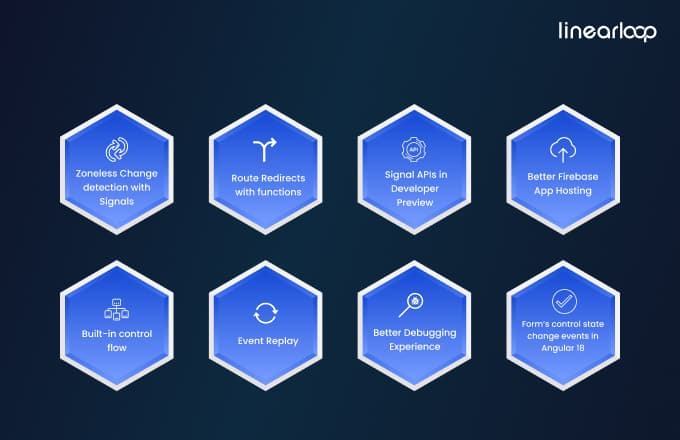
Explore the main Angular 18 features, which include finalized functionalities from earlier versions and various new additions:
Angular 18 stands out from its predecessors by enabling robust Firebase hosting with enhanced server-side rendering and new form control state change events. This version also stabilizes existing features from Angular 17 and introduces exciting new functionalities.
Discover Angular 18’s latest functionalities and updates. It includes compiler optimizations, smooth web component integration, advanced debugging tools, and many more. Here’s a closer look at these updates:
bootstrapApplication(AppComponent, {

  providers: [

    // It will help to enable Zoneless Change Detection

    provideExperimentalZonelessChangeDetection(),

  ],

});const routes: Routes = [
{ path: "Home", component: HomeComponent },
{
path: "old-user-page",
redirectTo: ({ queryParams }) => {
const errorHandler = inject(ErrorHandler);
const userIdParam = queryParams['userId'];
if (userIdParam !== undefined) {
return `/user/${userIdParam}`;
} else {
errorHandler.handleError(new Error('Attempted navigation to user page without user ID.'));
return `/not-found`;
}
},
},
{ path: "user/:userId", component: OtherComponent },
];bootstrapApplication(App, {
providers: [
provideClientHydration(withEventReplay()),
],
});const nameControl = new FormControl<string|null>('name', Validators.required);
nameControl.events.subscribe(event => {
if (event.type === 'valueChange') {
console.log('Value changed to:', event.value);
} else if (event.type === 'statusChange') {
console.log('Control status changed to:', event. Status);
}
});Also Read: React vs Angular: Which is better for Front-end Development?
Angular 18 is a major release that introduces different types of new features, improvements, and optimizations. It doesn’t matter whether you are an experienced Angular developer or a beginner, this version has something new to offer for everyone.
This release is packed with tools and enhancements aimed at boosting productivity and performance. With Angular 18, developers can now enjoy faster builds, improved performance, and a more user-friendly development experience.
Do you want single-page web apps, progressive web apps, enterprise apps, etc.? Then don’t worry Linearloop is a perfect place for you. Our experienced team of developers uses the latest version of Angular to deliver a tailored solution that meets your specific requirements.
Mayank Patel
Jun 5, 20245 min read