We're officially a Great Place To Work® certified company, India | 2026–27

Mayank Patel
Dec 14, 2023
4 min read
Last updated Jul 1, 2024
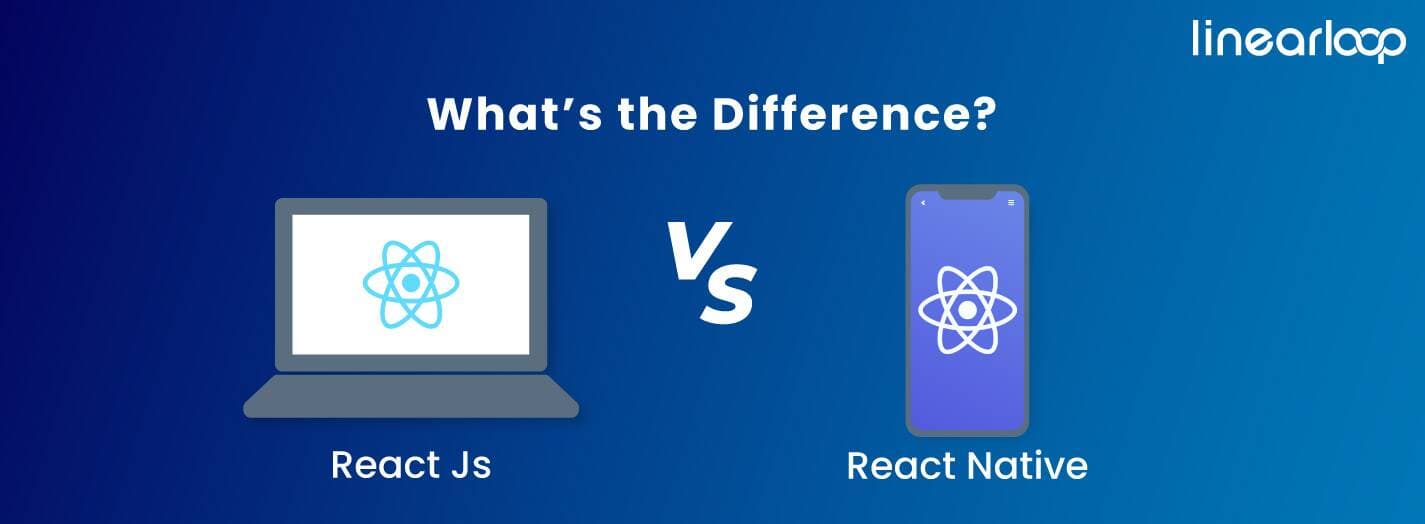
Knowing the difference between technologies helps programmers to implement the right one. So today we have brought the comparison between ReactJS and React Native.
Both of the technologies are developed by Facebook and they have gained immense popularity in a short time.
To create the structure of an web application, React.js is used which is a JS (JavaScipt) library of reusable components. And React Native supports developing native mobile applications using reusable components.
At Linearloop, we develop work on both technologies and we are in the position to put light on React vs React Native. Moreover, we will explore the React vs React Native salary of the developers.
Both of the technologies are heavily being used at the corporate level for the development of web and mobile-based applications. Knowing the difference between React.js and React Native will improve the quality of your code.
One of the unique features of ReactJS is its capability to deliver the fast speed of the application through DOM (Document Object Model). Do you know how it happens?
Reactjs builds an in-memory DS (Data Structure) cache that contains the final differences after which it updates the displayed DOM of the browser.
Moreover, programmers think that the entire page of the code will get rendered after the change is made but in reality, only the modified part of the code is rendered.
And because of this specific feature, Reactjs is favored to develop mobile applications, compared to other leading technologies of the era.
ReactJS follows component-based architecture that saves time that further enhances the overall development speed. Furthermore, the architectural model uses the single pieces of the large UI and then converts them into individual (independent) micro-systems.
You can understand it very well with an example. We know that Facebook is behind the foundation of ReactJS. Suppose, the section of messenger needs some changes. In such a case, only the required component will be re-used rather than the entire UI.
Because of server-side rendering, Reactjs enhances the search results across various search engines. It attracts more users and contributes enough for engaging organic traffic.
In this case, content and images are already rendered by the bot of Google, as a result of which the speed of indexing and caching increases. It excels in the overall performance of the website from the perspective of SEO.
Moreover, if the web page is directly indexed by Google, the load time decreases. The concept enhances the user experience. Also, both indexing methods enhance the ranking on search engines.
Whenever we discuss any technology, the community size is always considered. It helps developers throughout the development process by solving their doubts.
In Reactjs, we have a huge community of technocrats who are experienced enough to solve your queries. The large community empowers the technology, as a result of which it becomes the most recommended option for development.
We are a well-known ReactJS development company in India and using our best practices, we have mentioned its best features. As the blog is about React vs React Native so in the coming section, we will discuss the same.
The most exciting and unique feature of React Native is its ability to generate code specific to the platform. Whenever a programmer decides on the app or web development, the React Native technology automatically detects the platform for execution.
With this feature, developers favor the technology because it is known to generate accurate code depending on the platform.
The concept is easy for front-end developers because React Native involves JavaScript Additionally, the front-end developers are well versed in the utilization of JavaScript in the form of platform APIs, native user-interface elements, designing patterns, etc.
Hence, the learning curve for front-end developers is easier here and they can create the applications without putting much effort. Moreover, even if you are a non-programmer, you can build the applications effortlessly.
React Native technology comes with a hot reloading feature as a result of which the development time reduces. It gives flexibility to the developers to reload mobile apps automatically.
And when any technology saves time by pacing the development process, it gains the attention of IT companies.
We are also one of the experienced React Native app development companies in India and we have already developed lots of mobile apps using the technology.
To make the user experience smoother and more satisfying React Native comes with component UI Libraries. The ready-to-use libraries improve the overall performance of the website by easing the development process.
Being an experienced and leading React Native Mobile App Development Company in India, we have discussed the features of Reactjs and React Native.
Now, depending upon certain elements, we are mentioning some major differences between these frameworks.
| Features | ReactJs | React Native |
| Purpose | Building web applications. | Building mobile applications (iOS and Android) |
| Platform | Browser (Web) | Mobile Platforms (iOS and Android) |
| Release Year | 2013 | 2015 |
| Language | JavaScript, JSX | JavaScript, JSX, Java, C++ |
| Rendering | It renders HTML in the browser using the DOM. | It renders native mobile components. |
| Components | Web components (div, span, and many more) | Native components (View, Text, Image, and many more) |
| Styling | CSS, CSS-in-JS, styled-components. | Stylesheets (similar to CSS but in JS) and StyleSheet API. |
| Performance | Optimized for web performance. | Provides near-native performance. |
| Setup and Configuration | It usually uses tools like Webpack and Babel. | It Uses Metro bundler for bundling and requires Xcode for iOS & Android Studio for Android. |
| Libraries and Tools | ReactJs offers extensive libraries that can be used for web development. | React Native provides specialized libraries for mobile app development like React Navigation, and NativeBase. |
| Third-Party Plugin Support | It offers a wide range of plugins for web functionality. | It provides plugins for accessing device-specific features like camera, GPS, and many more. |
| Code Reusability | You can get reusable components across web applications. | You can get reusable components across both iOS and Android platforms. |
| Development Environment | Browser-based debugging tools like Chrome DevTools. | It provides various device emulators, simulators, and physical devices for debugging. |
| Community and Ecosystem | ReactJs has a Large and mature community with extensive documentation and tutorials. | React Native has a growing community that focuses on mobile development. |
| Learning Curve | It is moderate especially if you are familiar with JavaScript. | It is moderate to high especially when you are dealing with native modules. |
| Hot Reloading | ReactJs provides support for hot reloading so that you can have fast development cycles. | React Native offers hot reloading and fast refresh for rapid development. |
| State Management | It uses state management libraries like Redux and Context API. | In React Native same libraries like Redux, and Context API can be used. |
| Navigation | ReactJs uses React Router for navigation. | It uses libraries like React Navigation or React Native Navigation. |
| Testing | Tools like Jest, and Enzyme for unit and integration testing. | Jest, Detox for unit and integration testing specific to mobile. |
| Accessibility | It has web accessibility standards (ARIA). | It has mobile accessibility standards and accessibility APIs. |
| Deployment | ReactJs web solutions can be deployed on web servers and hosting platforms. | React Native apps can be deployed on app stores (Apple App Store, Google Play Store). |
ReactJs and React Native both are developed by Facebook but serve different purposes and are used to build solutions for various platforms. The main difference is that ReactJs can be used to build web applications while React Native is designed to build mobile applications for iOS and Android.
ReactJS works within the browser and utilizes the DOM (Document Object Model) to render HTML elements which makes it an ideal choice for web-based interfaces. It uses CSS for styling and is supported by a vast ecosystem of web development tools and libraries.
While React Native renders native mobile components to provide a more authentic mobile experience. Instead of HTML, React Native uses components like View, Text, and Image to build the user interface. Styling in React Native is simple and it can be done using a JavaScript-based stylesheet system. It is similar to CSS which is specifically customized for mobile design.
Both frameworks share some of the same core principles and utilize JavaScript. Their applications and environments are different which makes them a very suitable choice for different development needs.
Utilizing our best practices we have transparently analyzed the concepts of Reactjs and React Native. We have experts on both technologies.
So, whether you are looking for a ReactJS development company in India or React Native App Development Company in India, we are your exclusive service partner.
So guys, if any doubt comes, feel free to connect. Moreover, we will keep bringing such topics to add more flavors to your bucket of knowledge. Keep browsing!


Top 10 Web Application Development Companies in India & USA (2026)
Digital transformation is no longer a roadmap item. It is how you ship faster, scale reliably, and stay competitive. At the centre of that shift are web applications that need to be secure, scalable, and built to evolve as your business grows. Choosing a web application development partner now is less about writing code and more about execution discipline. You need teams that understand architecture trade-offs, product context, and long-term maintainability.
This blog helps you evaluate what actually matters when selecting a development partner, highlights the trends shaping web application development in 2026, and presents a curated list of the top web application development companies in India and the USA that consistently deliver real-world outcomes.
Modern web applications sit at the intersection of product logic, distributed systems, security, and user experience. When projects involve APIs, cloud infrastructure, microservices, and real-time data, execution gaps quickly emerge. That is why many teams outgrow ad-hoc development or purely in-house builds.
Expert and custom web application development companies help you move with confidence by bringing structure to both architecture and delivery.
Below is a curated list of web application development companies that consistently deliver under real-world constraints. These teams stand out because of how they approach architecture, execution, and long-term reliability.
Each company on this list demonstrates a strong balance of technical depth, product thinking, and delivery discipline. The focus here is not on rankings, but on capability. Let’s dive in.
Linearloop, one of the leading web application development companies, is built with a clear bias toward long-term reliability and scale. The team approaches development as a product and systems problem. That means architecture, performance, security, and future change are considered before features are shipped. This discipline shows up in how their platforms hold up as traffic, complexity, and business requirements grow.
Unlike vendors that start with code, Linearloop starts with context. Business goals, user behaviour, and scalability constraints shape technical decisions from day one. With delivery teams across India and the USA, they combine execution depth with senior oversight, making them a strong fit for teams that need both speed and architectural clarity.
Best suited for: Startups, SaaS companies, and digital-first enterprises that want web applications built to scale, integrate cleanly, and evolve without constant rework.
Tata Consultancy Services, another progressive web app development company, is built for scale, delivering large, mission-critical web platforms where security, compliance, and operational stability matter as much as functionality. TCS typically operates in environments where systems must integrate with legacy infrastructure, handle massive user volumes, and meet strict regulatory requirements.
Its strength lies in execution at enterprise depth. TCS brings structured delivery models, strong governance, and global delivery capabilities, making it a reliable partner for organisations running complex, multi-region digital platforms across regulated industries.
| Pros | Cons |
| Proven ability to deliver at a massive scale | Slower decision-making for smaller projects |
| Strong compliance and security posture | Less flexible for rapid experimentation |
Best suited for: Large enterprises and government organisations that needLess flexible for rapid experimentation secure, compliant, and highly scalable web platforms with predictable delivery and long-term operational support.
Infosys is a global technology and consulting leader known for modern web and enterprise application development supported by digital strategy, cloud integration, and scalable engineering. With decades of experience guiding digital transformation, Infosys builds complex, high-performance platforms that help enterprises modernize legacy systems and deliver measurable business value.
Infosys combines deep technical expertise with structured delivery frameworks and agile execution across cloud, integration, and custom development. Their offerings span full-stack web application development, modernization, maintenance, and integration with next-generation platforms, often accelerated by automation and AI-enabled tooling.
| Pros | Cons |
| Proven global delivery and scale across industries. | Can be pricier than midsize specialist firms. |
| Agile and structured execution frameworks. | Not always ideal for small budget or early-stage products |
Best suited for: Large enterprises and organisations seeking a full-scope web application partner capable of handling complex digital transformation, modernization, and scalable engineering across global markets.
Accenture operates at the intersection of strategy, technology, and execution. Their web application work is typically part of larger digital transformation programs, where architecture decisions, platform choices, and delivery models are tightly aligned to business objectives rather than isolated feature delivery.
Being a leading web application development company, they are strongest when complexity is high. Large teams, legacy systems, regulatory constraints, and multi-market rollouts are where Accenture’s operating model performs best. The trade-off is speed and flexibility, but for organisations prioritising scale, governance, and predictability, that balance is often intentional.
| Pros | Cons |
| Strong alignment between business strategy and execution | Higher cost compared to specialist development firms |
| Proven experience with large-scale, complex systems | Slower iteration cycles for smaller or fast-moving teams |
Best suited for: Large enterprises and global organizations that need web applications built as part of broader transformation initiatives, with strong emphasis on scale, governance, and long-term stability.
ThoughtWorks is known for bringing engineering discipline and architectural clarity to complex web application builds. Their work is grounded in modern software practices, with a strong emphasis on clean code, automation, and systems that are designed to evolve without constant rework. For teams operating at scale, this focus reduces long-term technical risk.
Rather than optimising for speed alone, ThoughtWorks prioritizes sustainability. Their delivery model blends agile execution with deep architectural thinking, making them a strong fit for organizations that treat web applications as long-term platforms rather than short-term projects.
| Pros | Cons |
| High engineering standards and code quality | Premium pricing compared to smaller firms |
| Strong architectural and system design capability | May be heavy for small or fast MVP builds |
Best suited for: Enterprises and large digital teams that need future-ready web applications built with strong architectural foundations and long-term maintainability in mind.
Cognizant is a global technology consulting and services leader that engineers modern, scalable applications for complex enterprise environments. Their application services span end-to-end development, modernization, and ongoing optimization, helping teams build secure, resilient platforms that support long-term digital growth rather than one-off projects.
They bring strong integration capabilities across enterprise systems and a focus on digital transformation, making them a fit for organisations that need mature engineering practices, deep domain experience, and proven delivery frameworks. Cognizant also holds recognitions like Everest Group’s leader placement for application development services, reflecting depth in AI-native and large-scale application builds.
| Pros | Cons |
| Recognised leader in application services, including AI-native development. | Higher engagement costs compared to boutique specialists. |
| End-to-end services from design to optimization. | Less focus on niche or early-stage product experimentation. |
Best suited for: Large organizations and enterprises seeking a full-stack partner capable of handling complex application ecosystems, deep system integration, and digital modernization at scale.
EPAM Systems is built for complex engineering environments where scale, performance, and compliance are non-negotiable. Their strength lies in solving hard platform problems across fintech, healthcare, and SaaS, where systems must handle high traffic, strict security requirements, and evolving business logic.
Rather than operating as a feature factory, EPAM brings a strong product-engineering mindset. Their teams focus on clean architecture, automation, and performance from day one, making them a reliable partner for organisations modernising legacy systems or building large-scale digital platforms.
| Pros | Cons |
| Strong engineering and architectural depth | Higher cost compared to boutique agencies |
| Deep domain expertise in regulated industries | Engagements can feel heavy for simple builds |
Best suited for: Large enterprises and mature SaaS companies that need a highly reliable web application development partner for complex, performance-critical, and regulated environments.
HCLTech operates at enterprise scale, where web applications must integrate with legacy systems, meet strict security standards, and perform reliably across regions. Their strength lies in modernizing large, complex platforms without disrupting business continuity.
Rather than treating development as a standalone activity, HCLTech combines cloud-native architecture, DevOps automation, and governance-driven execution. This makes them a dependable partner for organizations modernizing mission-critical applications under regulatory and operational constraints.
| Pros | Cons |
| Strong security and compliance posture | Higher engagement cost compared to boutique firms |
| Deep experience with complex legacy systems | Slower iteration cycles for experimental products |
Best suited for: Large enterprises and regulated organisations that need secure, scalable web applications with strong governance, cloud modernisation, and long-term operational reliability.
Mindtree, now part of LTIMindtree, combines human-centred design with engineering strength to build web applications that balance usability with performance. They have deep experience across industries, including retail, financial services, travel, and media, helping global enterprises modernize digital products and scale engineering delivery.
Their approach blends user experience focus with robust backend architecture, enabling responsive, secure, and maintainable web systems. Mindtree’s global delivery footprint and experience in application development make it a reliable choice for complex, business-critical web platforms.
| Pros | Cons |
| Robust support for cloud and digital transformation. | Less emphasis on pure startup-stage engagements. |
| Mature agile and delivery frameworks. | Delivery timelines can vary across regions. |
Best suited for: Enterprises and mid-sized organisations seeking a full-stack development partner that combines human-centred design, scalable architecture, and reliable delivery for complex web applications.
Konstant Infosolutions is a delivery-focused web application development company with a long history of operating across diverse industries. Their strength lies in executing end-to-end web projects at scale, combining engineering capacity with repeatable delivery processes. With a large portfolio and cross-domain exposure, Konstant is built to handle projects that require speed, volume, and predictable execution.
The team focuses on building functional, maintainable web applications with a strong emphasis on usability and platform stability. Konstant’s model works well for businesses that need reliable implementation across varying levels of complexity, supported by a sizeable development team and structured workflows rather than bespoke, experimentation-heavy builds.
| Pros | Cons |
| Broad industry experience | Approach may feel standardised for niche products |
| Handles complex and high-volume builds | Not ideal for highly experimental or R&D-heavy work |
Best suited for: Businesses looking for a reliable web application development partner to execute medium-to-large projects efficiently, especially when speed, scale, and predictable delivery matter more than deep product-led experimentation.
Also Read: Best Nodejs Frameworks for Web apps 2024
| Feature | India | USA |
| Cost Efficiency | High | Moderate |
| Talent Pool | Large & Skilled | Specialized Experts |
| Innovation Focus | Rapid Growth | Deep Product Thinking |
| Delivery Model | Hybrid Options | Onshore Focus |
Web application development in 2026 is less about adopting shiny tools and more about building systems that scale, adapt, and stay resilient under real-world pressure. Forward-looking teams are investing in trends that reduce long-term risk and increase execution speed.
Choosing the best web application development partner is a long-term decision. The quality of that choice shows up not just at launch, but months later when requirements change, traffic grows, and trade-offs become unavoidable. The right partner brings structure, clarity, and predictability to that journey.
In 2026, web applications are no longer supporting systems. They are the product. Whether you are building a new SaaS platform or modernizing a legacy stack, choosing the right development partner shapes how well your platform scales and adapts over time.
The companies listed here represent some of the best custom web development company in USA and India, each bringing different strengths across engineering depth, execution discipline, and product thinking.
If you are looking for a partner that combines scalable architecture, reliable delivery, and long-term product focus, Linearloop works with teams to build web applications designed to grow with the business.

Mayank Patel
Jan 8, 20266 min read
Top 8 Features in Angular 18 That You Can't Miss
Angular is a leading front-end framework developed by Google and recently its Angular 18 was released on 22 May 2024. Angular version 18 introduces many new features that boost the web app performance and robustness.
The developers can easily install the latest Angular CLI version by entering the command ng update @angular/.
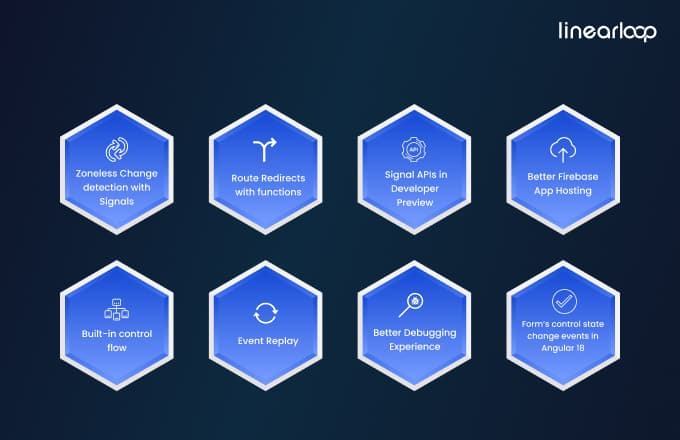
Here you can explore the Angular 18 release date and its mind-blowing features. Although Angular 18 includes multiple features, its ability to improve performance with zone less change detection and better signal debugging has particularly caught the attention of developers.
In current version of Angular, developers get flexible routing options with function-based redirects to simplify the dataflow in a new input function.
Explore the main Angular 18 features, which include finalized functionalities from earlier versions and various new additions:
Angular 18 stands out from its predecessors by enabling robust Firebase hosting with enhanced server-side rendering and new form control state change events. This version also stabilizes existing features from Angular 17 and introduces exciting new functionalities.
Discover Angular 18’s latest functionalities and updates. It includes compiler optimizations, smooth web component integration, advanced debugging tools, and many more. Here’s a closer look at these updates:
bootstrapApplication(AppComponent, {

  providers: [

    // It will help to enable Zoneless Change Detection

    provideExperimentalZonelessChangeDetection(),

  ],

});const routes: Routes = [
{ path: "Home", component: HomeComponent },
{
path: "old-user-page",
redirectTo: ({ queryParams }) => {
const errorHandler = inject(ErrorHandler);
const userIdParam = queryParams['userId'];
if (userIdParam !== undefined) {
return `/user/${userIdParam}`;
} else {
errorHandler.handleError(new Error('Attempted navigation to user page without user ID.'));
return `/not-found`;
}
},
},
{ path: "user/:userId", component: OtherComponent },
];bootstrapApplication(App, {
providers: [
provideClientHydration(withEventReplay()),
],
});const nameControl = new FormControl<string|null>('name', Validators.required);
nameControl.events.subscribe(event => {
if (event.type === 'valueChange') {
console.log('Value changed to:', event.value);
} else if (event.type === 'statusChange') {
console.log('Control status changed to:', event. Status);
}
});Also Read: React vs Angular: Which is better for Front-end Development?
Angular 18 is a major release that introduces different types of new features, improvements, and optimizations. It doesn’t matter whether you are an experienced Angular developer or a beginner, this version has something new to offer for everyone.
This release is packed with tools and enhancements aimed at boosting productivity and performance. With Angular 18, developers can now enjoy faster builds, improved performance, and a more user-friendly development experience.
Do you want single-page web apps, progressive web apps, enterprise apps, etc.? Then don’t worry Linearloop is a perfect place for you. Our experienced team of developers uses the latest version of Angular to deliver a tailored solution that meets your specific requirements.
Mayank Patel
Jun 5, 20245 min read