We're officially a Great Place To Work® certified company, India | 2026–27

Mayank Patel
Feb 2, 2026
5 min read
Last updated Feb 2, 2026
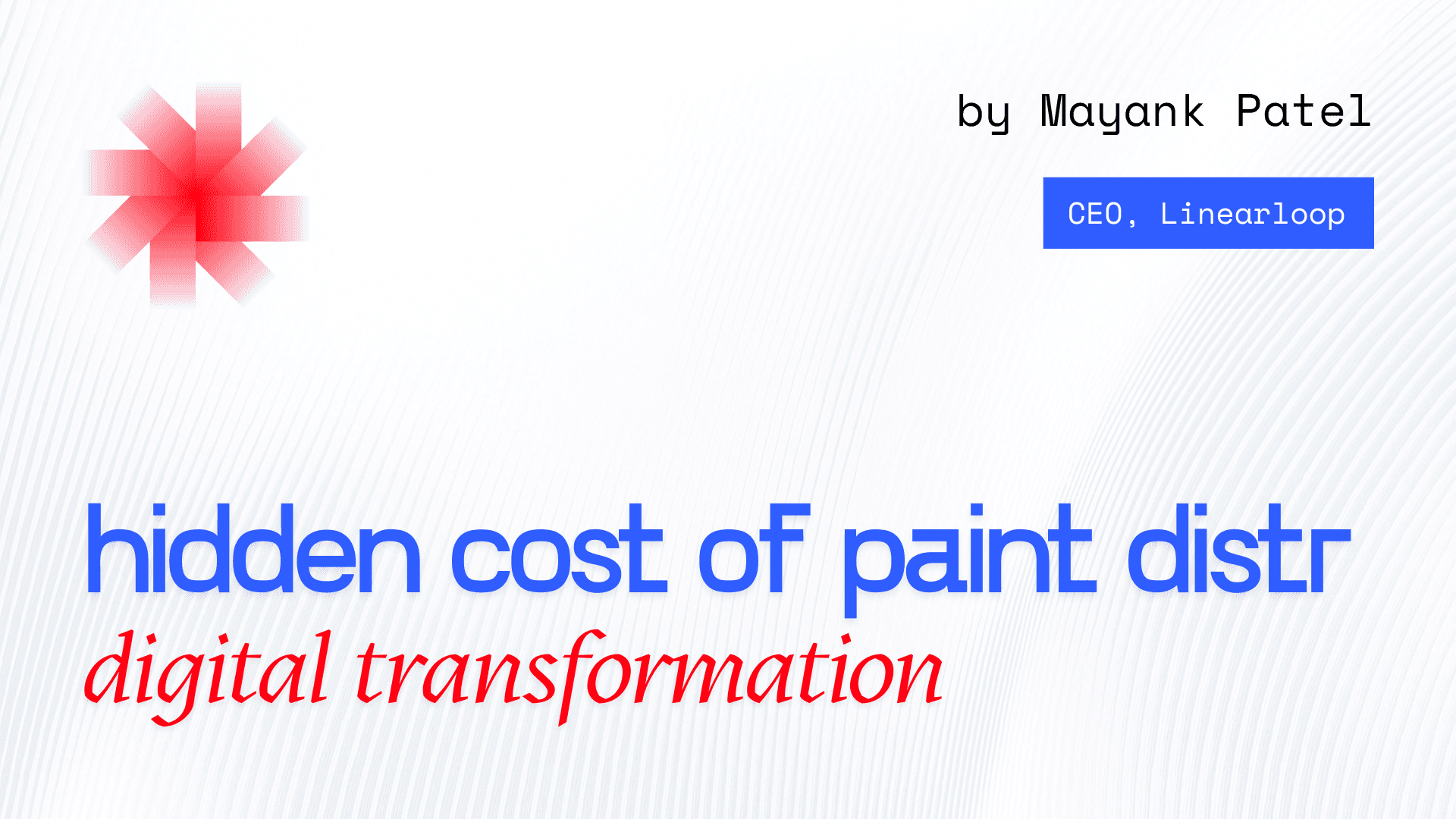
Paint manufacturers lose money in the space that no dashboard owns after the product leaves the plant and before it reaches the dealer. This stretch looks operationally healthy on paper, yet quietly drains margins, blocks working capital, and compounds risk quarter after quarter.
Most leadership teams sense this leakage but can’t pinpoint it. Primary sales look strong, schemes appear to work, and inventory is moving. But what’s missing is visibility into how the system actually behaves once it exits internal control. Decisions are made on inferred data, delayed signals, and assumptions carried forward month after month.
This is not a sales execution issue, and it’s not fixable with more pressure or more incentives. It’s a system design problem. Without digital transformation across the factory-to-dealer chain, manufacturers continue optimising what they can see, while losing millions in the part of the business they can’t.
Most leadership dashboards are internally consistent and externally blind. They track what the organisation controls, not what the business depends on. The moment product leaves the factory, signal quality drops sharply. Digital transformation efforts often stop at ERP completion, leaving the most value-critical layer of the business unobserved.
Primary growth feels like progress because it is visible, immediate, and measurable. Dispatch numbers rise, revenue is booked, and targets appear on track. But in the absence of digital transformation beyond invoicing, these signals say more about internal momentum than external health.
Inventory absorbs uncertainty when the system lacks signal. In paint manufacturing, it becomes the default buffer for poor visibility, delayed feedback, and planning assumptions that can’t be validated. Without digital transformation across the factory-to-dealer layer, inventory doesn’t just move, it quietly locks capital and erodes margins.
Demand varies by shade, region, season, and application. Central plans flatten this complexity into averages. The result is predictable: the wrong SKUs reach the wrong markets. Excess stock builds not because demand is weak, but because planning operates without real consumption data.
Once inventory sits in the channel, it stops looking like a problem. It remains off the manufacturer’s books but continues to tie up cash, invite discounting, and increase return risk. Without digital transformation to track ageing and movement beyond dispatch, this leakage compounds silently over time.
Also Read: Why AI Adoption Breaks Down in High-Performing Engineering Teams
Trade schemes are often treated as growth levers. In reality, they are signal distorters when the system lacks downstream visibility. They amplify primary movement without improving consumption insight. Without digital transformation across the channel, schemes create volume and the cost shows up later in margins.
Schemes are structured around volume thresholds and dispatch timing. This naturally encourages stock loading ahead of actual demand. Sales numbers improve immediately, but the system learns nothing about real consumption. The signal becomes noise, repeated quarter after quarter.
Discounts, free goods, and slab incentives accumulate quietly across the channel. Because their impact is spread across invoices and periods, the erosion is hard to isolate. Without digital transformation linking schemes to sell-through, manufacturers fund artificial growth while weakening unit economics.
Most planning decisions are made without direct visibility into what actually sells at the dealer level. Once invoicing is complete, data quality drops sharply and assumptions take over. Dispatch is mistaken for demand, and digital transformation efforts that stop at ERP only reinforce this blind spot.
Since real sell-through is invisible, forecasting never improves. Inventory ages unnoticed, schemes mask weak consumption, and credit exposure grows quietly. By the time the stress becomes visible, the cost has already been absorbed by the system.
What this blind spot creates:
Revenue looks healthy when invoices are raised on time. Risk builds later, quietly, inside the channel. In paint distribution, long and informal credit cycles are normalised. What appears as growth on the P&L often represents capital tied up in the channel.
Informal credit extensions accumulate through exceptions, relationships, and delayed settlements. These rarely appear as explicit risks because they fall outside standard reporting. As volumes rise, so does exposure, without any corresponding signal to slow the system down.
The impact surfaces with a lag. Margins compress, cash flows tighten, and collections suddenly become a priority. By then, the exposure is already embedded. The issue is the absence of visibility that allows credit risk to scale unnoticed.
Also Read: Why DevOps Mental Models Fail for MLOps in Production AI
Returns and write-offs are often treated as operational failures. In reality, they are delayed signals of upstream design problems. Paint is sensitive to time, storage, and handling, and when inventory sits too long or moves without demand alignment, loss becomes inevitable. The issue is the system that allowed stress to accumulate unnoticed.
These losses surface late because visibility arrives late. By the time stock is returned, damaged, or written down, planning cycles have already repeated the same assumptions. Ageing inventory is the predictable outcome of operating without continuous feedback from the channel.
Scale increases complexity faster than it increases control. More SKUs, regions, distributors, and schemes multiply decision paths, but the underlying visibility remains unchanged. What worked at smaller volumes becomes fragile at scale, because assumptions are repeated across a much larger system.
Experience cannot compensate for missing signals. Intuition fills gaps early on, but as the system grows, those gaps widen. Without structural visibility into downstream behaviour, scale doesn’t dilute risk. Instead, it amplifies it, turning small inefficiencies into material losses.
When leadership has visibility beyond dispatch, decisions stop being reactive. The system shifts from pushing volume to responding to demand. This is about better signals that close the loop between planning, execution, and outcomes.
Therefore, the paint manufacturers don’t lose money because teams underperform or demand fluctuates. They lose money because large parts of the distribution system operate without visibility. Once the product leaves the factory, decisions are made on partial signals, delayed feedback, and assumptions that never get corrected.
This leakage isn’t accidental. It is the predictable outcome of managing a complex channel without end-to-end control. Until leadership can see how inventory, incentives, credit, and consumption interact across the full chain, growth will continue to look strong while margins quietly weaken.
At Linearloop, we help manufacturers treat distribution as a system that’s measurable, observable, and controllable. When you can see the full chain, you stop the leakage before it starts.


How Digitized Loyalty Programs Drive Secondary Sales Growth
Secondary sales look healthy on paper until you inspect distributor godowns stacked with slow-moving SKUs, retailers ordering inconsistently, and schemes failing to translate into real retail movement. You push inventory downstream, but you don’t control what actually moves. Visibility is fragmented, incentives leak, and you end up funding trade programs without measurable behavioural change.
The real issue is retailer motivation and data opacity. When secondary sales stall, it’s usually because your incentive systems are manual, delayed, and disconnected from SKU-level strategy. You’re pushing supply when you should be engineering demand at the retail node.
This blog breaks down how digitized loyalty programs convert passive retailers into performance-driven participants.
Read more: How Brands Use Digitized Loyalty Programs to Control Secondary Sales
You see primary numbers rising, but retail shelves tell a different story. Distributors are billed, stock moves out of your warehouse, yet reorder cycles slow down and certain SKUs barely rotate. Secondary sales stall when inventory sits at the distributor level and retailers place reactive, margin-driven orders instead of intentional, brand-aligned ones.
Secondary sales are the movement of goods from distributors to retailers, and this is where real market penetration occurs. When this layer weakens, it exposes deeper issues: push-heavy schemes, poor SKU visibility, delayed incentives, and zero behavioural tracking. You cannot optimise what you cannot measure, and most traditional trade programs don’t measure retailer intent or engagement.
This is the gap. Secondary sales don’t stall because of weak distribution infrastructure; they stall because retailer behaviour isn’t engineered. Fixing this requires a system that tracks, rewards, and influences purchase patterns in real time—something manual schemes were never built to handle.
Read more: The Hidden Cost of Trade Discount on Business Growth
Your trade schemes exist, but they’re invisible at the execution level. Points are tracked in spreadsheets, claims are reconciled manually, rewards are delayed, and you have no real-time insight into which retailer moved which SKU. By the time you review performance, the campaign window has already closed. Incentives become cost centres instead of growth levers.
A digitized loyalty program replaces that fragmentation with a structured, technology-led system that tracks secondary purchases in real time. Retailers earn points through invoice uploads, SKU scans, app-based tracking, or integrated distributor billing systems. Every transaction is recorded, validated, and linked to performance dashboards. Rewards are transparent, measurable, and redeemable without manual intervention.
This shifts loyalty from static schemes to dynamic behaviour management. You don’t just announce incentives; you monitor participation, adjust SKU-level rewards, and influence reorder patterns based on live data. Digitization turns trade marketing from assumption-driven to performance-driven.
Read more: Why SKU-Based Catalogs Fail for Base + Tint Business Model
You rely on distributor push to drive numbers, but retailers don’t prioritise what you invoice. They prioritise what benefits them. When incentives are invisible or delayed, they default to margin, availability, or competitor schemes. Push creates temporary movement. It does not create preference. If you want consistent secondary acceleration, you must engineer retailer pull.
Digitized loyalty programs shift control from distributor-driven supply to retailer-driven demand. Here’s how:
Read more: Why Paint Field Sales Productivity Breaks and How to Fix It
Your inventory imbalances don’t happen at the warehouse level; they happen at the SKU level. A few fast-moving products rotate aggressively while new launches and strategic SKUs stagnate at distributor points. You respond with blanket schemes or extra discounts, but that approach treats all SKUs equally and dilutes margin without correcting behaviour. The issue isn’t demand; it’s misaligned incentives.
Digitized loyalty programs give you SKU-level control. You can assign differentiated point values, run time-bound boosters for specific categories, and incentivise new product adoption without disturbing overall pricing. You track movement in real time, identify slow rotations early, and adjust campaigns instantly instead of waiting for quarterly reviews. This allows you to optimise inventory deliberately, not reactively, and align secondary sales with strategic product priorities.
Read more: The Hidden Cost of Paint Distribution: Factory to Dealer Losses
You cannot scale what you cannot see. In most secondary networks, you rely on distributor reports, delayed reconciliations, and fragmented Excel sheets that tell you what moved. You don’t know which retailer is active, which SKU is slowing down, or where engagement is dropping off until performance has already declined. That delay costs you growth.
Digitized loyalty programs give you real-time visibility at retailer, SKU, and geography level. You track participation rates, reorder frequency, basket size shifts, and campaign responsiveness as they happen. You segment retailers based on behaviour. Data stops being retrospective reporting and becomes an active control layer that turns secondary sales into measurable, optimisable growth.
Read more: How to Work Agile in Project Engineering
Your schemes fail when retailers stop trusting them. Points go missing, claims take weeks to process, and redemption feels uncertain. When incentives are opaque, participation drops. Retailers disengage quietly and shift focus to brands that deliver faster, clearer benefits. Delayed gratification weakens behavioural momentum.
Digitized loyalty programs remove that friction. You give retailers real-time visibility into earned points, clear redemption pathways, and predictable reward timelines. Automated validation reduces disputes and eliminates manual claim dependency. When retailers trust the system, they engage consistently. Transparency builds confidence, and confidence sustains reorder behaviour across cycles.
Read more: How High-Impact Product Engineering Sprints Actually Move the Business
Secondary sales complexity increases when your channel is fragmented, your SKU portfolio is wide, and retailer influence directly determines market share. If your distribution relies on thousands of small retailers or trade influencers, manual schemes won’t scale. Digitized loyalty delivers maximum impact where behavioural control at the last-mile level directly drives revenue.
You see the strongest results in industries like:
Read more: 8 B2B Marketplace SEO Strategies to Dominate Google Rankings
If you run a digitized loyalty program, you must track behavioural and velocity metrics. Measurement is what converts incentives into a controllable growth engine.
| Metric | What You Should Measure |
| Active retailer participation rate | Track the percentage of enrolled retailers who transact within a defined period. Low participation signals weak engagement or poor incentive design. |
| Order frequency uplift | Measure how often retailers reorder after joining the program compared to baseline cycles. Increased frequency indicates sustained behavioural change. |
| Average basket value growth | Monitor changes in order size per retailer. Growth here reflects effective SKU bundling and incentive alignment. |
| SKU penetration rate | Track adoption of targeted or slow-moving SKUs across participating retailers. This reveals inventory optimisation impact. |
| Redemption rate | Measure how many earned points convert into redeemed rewards. High redemption reflects trust and program relevance. |
| Repeat cycle time | Analyse the time gap between consecutive orders. Shorter cycles signal stronger retailer pull. |
| Campaign responsiveness rate | Track participation in time-bound or booster campaigns. This shows how effectively you can influence behaviour in real time. |
Most loyalty programs fail because of poor design and weak execution discipline. You introduce incentives, but you don’t simplify structure, align distributor systems, or communicate clearly at the retailer level. When friction increases, participation drops. If you want secondary acceleration, you must eliminate structural weaknesses early.
Here are the most common mistakes that weaken loyalty programs:
Read more: Managing Bulk Pricing and Logistics for Construction B2B Marketplaces
Therefore, secondary sales scale when you engineer retailer behaviour with visibility and control. Manual schemes create spikes. Digitized loyalty creates sustained momentum at the SKU and retailer level. When you track engagement in real time and optimise incentives dynamically, secondary movement becomes predictable.
If you want trade programs to act as growth systems, you need clean integrations, behavioural design, and measurable control. Linearloop helps you build and deploy digitized loyalty architectures that integrate with your distribution stack and turn secondary sales into engineered growth.

Mayank Patel
Feb 16, 20265 min read

How Brands Use Digitized Loyalty Programs to Control Secondary Sales
Secondary sales are where most brands lose control quietly. You invest in trade schemes, push volumes into the channel, and yet what actually moves from distributor to retailer, and from retailer to customer, remains slow, uneven, and hard to predict. Billing looks healthy on paper, but shelves don’t turn at the same pace. When secondary sales stall, the response is usually more incentives, more schemes, and more spend, without ever fixing the real issue.
The problem isn’t loyalty itself. It’s how loyalty is executed. Traditional programs operate as periodic campaigns, reward outcomes too late, and offer little visibility into daily channel behaviour. By the time rewards are calculated, decisions have already been made, and habits are already formed. Brands end up reacting to secondary sales instead of shaping them.
This blog shows how digitized loyalty programs shift loyalty from a cost centre into a control layer, one that influences retailer behaviour in real time, creates predictable reorder patterns, and gives brands visibility into downstream demand.
Read more: Hidden Cost of Trade Discounts on Business Growth
Traditional loyalty programs fail at secondary sales because they reward results after the fact. Incentives are calculated quarterly, reconciled manually, and paid out long after the retailer has made stocking and push decisions. By then, the program is no longer influencing anything. It is simply accounting for the past. Secondary sales, however, are driven by daily habits: What gets reordered, what gets pushed, and what gets ignored.
Most schemes also apply incentives too broadly. Volume-based rewards treat all retailers the same, regardless of SKU mix, frequency, or consistency. This creates short-term spikes rather than steady movement, encouraging channel stuffing rather than genuine demand. Brands end up funding peaks that disrupt inventory and forecasting, while the underlying secondary flow remains weak.
Finally, traditional programs operate in the dark. There is little to no visibility into downstream actions between billing cycles. Brands cannot tell which behaviours moved secondary sales and which incentives were wasted. Without feedback loops, loyalty becomes a recurring expense.
Read more: Why Paint Field Sales Breaks Productivity Breaks and How to Fix It
Primary billing measures what leaves the brand or distributor warehouse, not what actually moves in the market. Once stock enters the channel, brands lose direct visibility and control. Retailers reorder based on cash flow, shelf pressure, and local demand. This creates a structural gap in which reported sales appear strong, while secondary demand remains inconsistent and unpredictable.
This gap widens with scale. More distributors, more retailers, and longer replenishment cycles further dilute intent. Brands respond by pushing harder at the top of the funnel, assuming billing will eventually translate into demand. It rarely does. Without a system that influences behaviour beyond invoicing, primary sales and secondary demand continue to drift apart.
Read more: The Hidden Cost of Paint Distribution: Factory to Dealer Losses
Digitization changes loyalty from a periodic scheme into a continuous execution layer. Instead of announcing programs and waiting for results, brands can influence channel behaviour as it happens. Loyalty stops being a reward mechanism and becomes infrastructure, always on, measurable, and directly tied to downstream movement.
Also read: Why Executives Don’t Trust AI and How to Fix It
Digitized loyalty programs drive secondary sales by influencing the exact moments where downstream decisions are made. Instead of pushing volume from the top, they shape how often retailers reorder, which products they prioritise, and how consistently stock moves off shelves. Secondary sales improve not because rewards are bigger, but because behaviour changes are immediate and repeatable.
Also read: Why AI Adoption Breaks Down in High-Performing Engineering Teams =
Digitized loyalty gives sales and revenue leaders something traditional schemes never could leverage. Instead of pushing harder through distributors or adding more schemes, leaders gain a system that continuously influences downstream behaviour. The result is better outcomes from the same trade spend, with far less guesswork and far more control.
Digitization exposes which incentives actually move secondary sales and which simply consume budget. Rewards shift away from blanket payouts toward actions that drive consistent movement. This allows leaders to redeploy the same trade spends more precisely, reducing waste, improving scheme efficiency, and generating measurable returns without increasing overall incentive budgets.
Digitized loyalty influences retailer decisions without adding sales pressure or enforcement. Behavioural incentives guide reorder frequency, SKU focus, and consistency naturally, through visibility and immediacy. Leaders gain indirect control over downstream execution, reducing dependency on field interventions while still shaping how the channel prioritises the brand at the point of action.
Read more: Why DevOps Mental Models Fail for MLOps in Production AI
Secondary sales volatility doesn’t just affect revenue. It breaks planning. When loyalty programs push irregular demand spikes, operations teams are forced into reactive forecasting, excess safety stock, and last-minute corrections. Digitized loyalty changes this by turning downstream behaviour into an early signal.
Digitized loyalty captures transaction-level activity across the channel, revealing slowdowns and accelerations before they surface in inventory reports. Demand planners gain visibility into emerging patterns early enough to adjust production, distribution, and replenishment. This reduces stockouts, limits excess inventory, and stabilises working capital across the network.
When incentives reward consistency rather than spikes, secondary sales smooth out over time. Ops teams see fewer end-of-period surges and fewer mid-cycle drop-offs. Forecast accuracy improves because demand reflects real consumption, not scheme-driven distortions, making planning cycles more reliable and less reactive.
Read more: Batch AI vs Real AI: Choosing the Right Architecture
Digitizing loyalty does not automatically fix it. Most failures happen when brands digitize the mechanics while leaving the logic untouched. The result is a faster, more visible version of the same problems that already exist, just with better dashboards.
Read more: CTO Guide to AI Strategy: Build vs Buy vs Fine-Tune Decisions
Designing for secondary sales is not about adding more rewards. It is about sequencing decisions correctly, so behaviour changes first and volume follows. A loyalty program that works is built step by step, with execution outcomes driving every design choice.
Start by identifying the actions that actually create downstream demand, reorder frequency, SKU mix, consistency, and range expansion. If the behaviour does not change secondary movement, it should not be incentivised. This step sets the direction for the entire program.
Design rewards to trigger immediately when the right behaviour occurs. Avoid waiting for end-of-cycle targets or volume milestones. When incentives reinforce actions in real time, retailers adjust decisions while it still matters.
Retailers must see where they stand when they are reordering or reviewing stock. Progress tracking, thresholds, and nudges should surface inside the flow of execution. Visibility drives prioritisation without additional sales pressure.
Track which behaviours are responding and which are not. Use this data to refine incentive logic mid-cycle instead of waiting for scheme closure. Programs that learn outperform programs that repeat.
Reward steady movement over time rather than end-period surges. Consistency improves secondary sales quality, stabilises demand, and makes loyalty a long-term control layer instead of a short-term push mechanism.
Read more: How to Use Shadow Traffic to Validate Real-World Reliability
Secondary sales don’t break because incentives are missing. They break because execution stops at the billing stage. When loyalty is structured as a periodic scheme, it reacts to outcomes rather than influencing daily channel decisions.
Digitized loyalty works when it operates as an always-on execution layer. It ties incentives to behaviour in real time, creates visibility beyond invoices, and stabilises downstream demand where it actually forms.
If secondary sales feel unpredictable despite heavy trade spend, the fix isn’t another scheme. It’s a tighter execution. Linearloop helps brands turn digitized loyalty into a control layer across sales, ops, and planning, so secondary sales become deliberate.
Mayank Patel
Feb 10, 20266 min read