We're officially a Great Place To Work® certified company, India | 2026–27

Mayank Patel
Jan 8, 2026
6 min read
Last updated Jan 8, 2026

Digital transformation is no longer a roadmap item. It is how you ship faster, scale reliably, and stay competitive. At the centre of that shift are web applications that need to be secure, scalable, and built to evolve as your business grows. Choosing a web application development partner now is less about writing code and more about execution discipline. You need teams that understand architecture trade-offs, product context, and long-term maintainability.
This blog helps you evaluate what actually matters when selecting a development partner, highlights the trends shaping web application development in 2026, and presents a curated list of the top web application development companies in India and the USA that consistently deliver real-world outcomes.
Modern web applications sit at the intersection of product logic, distributed systems, security, and user experience. When projects involve APIs, cloud infrastructure, microservices, and real-time data, execution gaps quickly emerge. That is why many teams outgrow ad-hoc development or purely in-house builds.
Expert and custom web application development companies help you move with confidence by bringing structure to both architecture and delivery.
Below is a curated list of web application development companies that consistently deliver under real-world constraints. These teams stand out because of how they approach architecture, execution, and long-term reliability.
Each company on this list demonstrates a strong balance of technical depth, product thinking, and delivery discipline. The focus here is not on rankings, but on capability. Let’s dive in.
Linearloop, one of the leading web application development companies, is built with a clear bias toward long-term reliability and scale. The team approaches development as a product and systems problem. That means architecture, performance, security, and future change are considered before features are shipped. This discipline shows up in how their platforms hold up as traffic, complexity, and business requirements grow.
Unlike vendors that start with code, Linearloop starts with context. Business goals, user behaviour, and scalability constraints shape technical decisions from day one. With delivery teams across India and the USA, they combine execution depth with senior oversight, making them a strong fit for teams that need both speed and architectural clarity.
Best suited for: Startups, SaaS companies, and digital-first enterprises that want web applications built to scale, integrate cleanly, and evolve without constant rework.
Tata Consultancy Services, another progressive web app development company, is built for scale, delivering large, mission-critical web platforms where security, compliance, and operational stability matter as much as functionality. TCS typically operates in environments where systems must integrate with legacy infrastructure, handle massive user volumes, and meet strict regulatory requirements.
Its strength lies in execution at enterprise depth. TCS brings structured delivery models, strong governance, and global delivery capabilities, making it a reliable partner for organisations running complex, multi-region digital platforms across regulated industries.
| Pros | Cons |
| Proven ability to deliver at a massive scale | Slower decision-making for smaller projects |
| Strong compliance and security posture | Less flexible for rapid experimentation |
Best suited for: Large enterprises and government organisations that needLess flexible for rapid experimentation secure, compliant, and highly scalable web platforms with predictable delivery and long-term operational support.
Infosys is a global technology and consulting leader known for modern web and enterprise application development supported by digital strategy, cloud integration, and scalable engineering. With decades of experience guiding digital transformation, Infosys builds complex, high-performance platforms that help enterprises modernize legacy systems and deliver measurable business value.
Infosys combines deep technical expertise with structured delivery frameworks and agile execution across cloud, integration, and custom development. Their offerings span full-stack web application development, modernization, maintenance, and integration with next-generation platforms, often accelerated by automation and AI-enabled tooling.
| Pros | Cons |
| Proven global delivery and scale across industries. | Can be pricier than midsize specialist firms. |
| Agile and structured execution frameworks. | Not always ideal for small budget or early-stage products |
Best suited for: Large enterprises and organisations seeking a full-scope web application partner capable of handling complex digital transformation, modernization, and scalable engineering across global markets.
Accenture operates at the intersection of strategy, technology, and execution. Their web application work is typically part of larger digital transformation programs, where architecture decisions, platform choices, and delivery models are tightly aligned to business objectives rather than isolated feature delivery.
Being a leading web application development company, they are strongest when complexity is high. Large teams, legacy systems, regulatory constraints, and multi-market rollouts are where Accenture’s operating model performs best. The trade-off is speed and flexibility, but for organisations prioritising scale, governance, and predictability, that balance is often intentional.
| Pros | Cons |
| Strong alignment between business strategy and execution | Higher cost compared to specialist development firms |
| Proven experience with large-scale, complex systems | Slower iteration cycles for smaller or fast-moving teams |
Best suited for: Large enterprises and global organizations that need web applications built as part of broader transformation initiatives, with strong emphasis on scale, governance, and long-term stability.
ThoughtWorks is known for bringing engineering discipline and architectural clarity to complex web application builds. Their work is grounded in modern software practices, with a strong emphasis on clean code, automation, and systems that are designed to evolve without constant rework. For teams operating at scale, this focus reduces long-term technical risk.
Rather than optimising for speed alone, ThoughtWorks prioritizes sustainability. Their delivery model blends agile execution with deep architectural thinking, making them a strong fit for organizations that treat web applications as long-term platforms rather than short-term projects.
| Pros | Cons |
| High engineering standards and code quality | Premium pricing compared to smaller firms |
| Strong architectural and system design capability | May be heavy for small or fast MVP builds |
Best suited for: Enterprises and large digital teams that need future-ready web applications built with strong architectural foundations and long-term maintainability in mind.
Cognizant is a global technology consulting and services leader that engineers modern, scalable applications for complex enterprise environments. Their application services span end-to-end development, modernization, and ongoing optimization, helping teams build secure, resilient platforms that support long-term digital growth rather than one-off projects.
They bring strong integration capabilities across enterprise systems and a focus on digital transformation, making them a fit for organisations that need mature engineering practices, deep domain experience, and proven delivery frameworks. Cognizant also holds recognitions like Everest Group’s leader placement for application development services, reflecting depth in AI-native and large-scale application builds.
| Pros | Cons |
| Recognised leader in application services, including AI-native development. | Higher engagement costs compared to boutique specialists. |
| End-to-end services from design to optimization. | Less focus on niche or early-stage product experimentation. |
Best suited for: Large organizations and enterprises seeking a full-stack partner capable of handling complex application ecosystems, deep system integration, and digital modernization at scale.
EPAM Systems is built for complex engineering environments where scale, performance, and compliance are non-negotiable. Their strength lies in solving hard platform problems across fintech, healthcare, and SaaS, where systems must handle high traffic, strict security requirements, and evolving business logic.
Rather than operating as a feature factory, EPAM brings a strong product-engineering mindset. Their teams focus on clean architecture, automation, and performance from day one, making them a reliable partner for organisations modernising legacy systems or building large-scale digital platforms.
| Pros | Cons |
| Strong engineering and architectural depth | Higher cost compared to boutique agencies |
| Deep domain expertise in regulated industries | Engagements can feel heavy for simple builds |
Best suited for: Large enterprises and mature SaaS companies that need a highly reliable web application development partner for complex, performance-critical, and regulated environments.
HCLTech operates at enterprise scale, where web applications must integrate with legacy systems, meet strict security standards, and perform reliably across regions. Their strength lies in modernizing large, complex platforms without disrupting business continuity.
Rather than treating development as a standalone activity, HCLTech combines cloud-native architecture, DevOps automation, and governance-driven execution. This makes them a dependable partner for organizations modernizing mission-critical applications under regulatory and operational constraints.
| Pros | Cons |
| Strong security and compliance posture | Higher engagement cost compared to boutique firms |
| Deep experience with complex legacy systems | Slower iteration cycles for experimental products |
Best suited for: Large enterprises and regulated organisations that need secure, scalable web applications with strong governance, cloud modernisation, and long-term operational reliability.
Mindtree, now part of LTIMindtree, combines human-centred design with engineering strength to build web applications that balance usability with performance. They have deep experience across industries, including retail, financial services, travel, and media, helping global enterprises modernize digital products and scale engineering delivery.
Their approach blends user experience focus with robust backend architecture, enabling responsive, secure, and maintainable web systems. Mindtree’s global delivery footprint and experience in application development make it a reliable choice for complex, business-critical web platforms.
| Pros | Cons |
| Robust support for cloud and digital transformation. | Less emphasis on pure startup-stage engagements. |
| Mature agile and delivery frameworks. | Delivery timelines can vary across regions. |
Best suited for: Enterprises and mid-sized organisations seeking a full-stack development partner that combines human-centred design, scalable architecture, and reliable delivery for complex web applications.
Konstant Infosolutions is a delivery-focused web application development company with a long history of operating across diverse industries. Their strength lies in executing end-to-end web projects at scale, combining engineering capacity with repeatable delivery processes. With a large portfolio and cross-domain exposure, Konstant is built to handle projects that require speed, volume, and predictable execution.
The team focuses on building functional, maintainable web applications with a strong emphasis on usability and platform stability. Konstant’s model works well for businesses that need reliable implementation across varying levels of complexity, supported by a sizeable development team and structured workflows rather than bespoke, experimentation-heavy builds.
| Pros | Cons |
| Broad industry experience | Approach may feel standardised for niche products |
| Handles complex and high-volume builds | Not ideal for highly experimental or R&D-heavy work |
Best suited for: Businesses looking for a reliable web application development partner to execute medium-to-large projects efficiently, especially when speed, scale, and predictable delivery matter more than deep product-led experimentation.
Also Read: Best Nodejs Frameworks for Web apps 2024
| Feature | India | USA |
| Cost Efficiency | High | Moderate |
| Talent Pool | Large & Skilled | Specialized Experts |
| Innovation Focus | Rapid Growth | Deep Product Thinking |
| Delivery Model | Hybrid Options | Onshore Focus |
Web application development in 2026 is less about adopting shiny tools and more about building systems that scale, adapt, and stay resilient under real-world pressure. Forward-looking teams are investing in trends that reduce long-term risk and increase execution speed.
Choosing the best web application development partner is a long-term decision. The quality of that choice shows up not just at launch, but months later when requirements change, traffic grows, and trade-offs become unavoidable. The right partner brings structure, clarity, and predictability to that journey.
In 2026, web applications are no longer supporting systems. They are the product. Whether you are building a new SaaS platform or modernizing a legacy stack, choosing the right development partner shapes how well your platform scales and adapts over time.
The companies listed here represent some of the best custom web development company in USA and India, each bringing different strengths across engineering depth, execution discipline, and product thinking.
If you are looking for a partner that combines scalable architecture, reliable delivery, and long-term product focus, Linearloop works with teams to build web applications designed to grow with the business.

Top 8 Features in Angular 18 That You Can't Miss
Angular is a leading front-end framework developed by Google and recently its Angular 18 was released on 22 May 2024. Angular version 18 introduces many new features that boost the web app performance and robustness.
The developers can easily install the latest Angular CLI version by entering the command ng update @angular/.
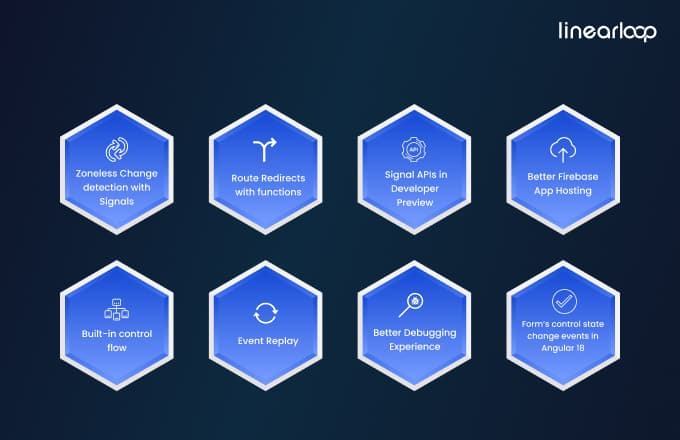
Here you can explore the Angular 18 release date and its mind-blowing features. Although Angular 18 includes multiple features, its ability to improve performance with zone less change detection and better signal debugging has particularly caught the attention of developers.
In current version of Angular, developers get flexible routing options with function-based redirects to simplify the dataflow in a new input function.
Explore the main Angular 18 features, which include finalized functionalities from earlier versions and various new additions:
Angular 18 stands out from its predecessors by enabling robust Firebase hosting with enhanced server-side rendering and new form control state change events. This version also stabilizes existing features from Angular 17 and introduces exciting new functionalities.
Discover Angular 18’s latest functionalities and updates. It includes compiler optimizations, smooth web component integration, advanced debugging tools, and many more. Here’s a closer look at these updates:
bootstrapApplication(AppComponent, {

  providers: [

    // It will help to enable Zoneless Change Detection

    provideExperimentalZonelessChangeDetection(),

  ],

});const routes: Routes = [
{ path: "Home", component: HomeComponent },
{
path: "old-user-page",
redirectTo: ({ queryParams }) => {
const errorHandler = inject(ErrorHandler);
const userIdParam = queryParams['userId'];
if (userIdParam !== undefined) {
return `/user/${userIdParam}`;
} else {
errorHandler.handleError(new Error('Attempted navigation to user page without user ID.'));
return `/not-found`;
}
},
},
{ path: "user/:userId", component: OtherComponent },
];bootstrapApplication(App, {
providers: [
provideClientHydration(withEventReplay()),
],
});const nameControl = new FormControl<string|null>('name', Validators.required);
nameControl.events.subscribe(event => {
if (event.type === 'valueChange') {
console.log('Value changed to:', event.value);
} else if (event.type === 'statusChange') {
console.log('Control status changed to:', event. Status);
}
});Also Read: React vs Angular: Which is better for Front-end Development?
Angular 18 is a major release that introduces different types of new features, improvements, and optimizations. It doesn’t matter whether you are an experienced Angular developer or a beginner, this version has something new to offer for everyone.
This release is packed with tools and enhancements aimed at boosting productivity and performance. With Angular 18, developers can now enjoy faster builds, improved performance, and a more user-friendly development experience.
Do you want single-page web apps, progressive web apps, enterprise apps, etc.? Then don’t worry Linearloop is a perfect place for you. Our experienced team of developers uses the latest version of Angular to deliver a tailored solution that meets your specific requirements.

Mayank Patel
Jun 5, 20245 min read
React and NodeJS: A Powerful Combination for Web Application Development 2024
The present era is all about digital empowerment, digital innovations, and digital experiments. We all can easily estimate the difference between 2000 and 2022. Lots of things were out of scope at that time but in today’s world, nothing surprises us.
Information technology is the collection of various digital products and today we will talk about web application development. React and Node JS are the two leading technologies that have the power to empower your web-app products.
Also, being a leading web app development company in India and USA, we will emphasize both the concepts so that developers could have detailed information about the same.
Also, in the last few years, we all have witnessed a massive transformation in the features of Web App Development.
Whether it is User Interface, Structural & Functional Approach, API Integration, or Server Deployment, everything has taken a turn of 360 degrees with the evolution of new technologies. Hence you must know the perfect combination for the web apps.
Do you know why React and Node JS are best for Web App development projects? It is so because developers get flexibility along with high functionality with low latency.
Further, if you are looking to hire experienced full-stack developers, feel free to contact us. Our experts are well qualified and experienced in React as well as Node JS.
As far as React and Node JS are concerned, with React, we get the flexibility to create engaging User-Interfaces because it is a well-known and goal-driven JavaScript library.
Furthermore, Node JS delivers highly functional, scalable, and result-oriented web applications with low latency.
By combining both of these emerging technologies, we get the flexibility to develop full-stack web applications. Also, if you are looking to become a good full-stack developer in India, you must have command of React as well as Node JS.
In this blog, we will discuss the importance of React and Node JS. Also, we will discuss the benefits of the web application developed with the combination of these two technologies. Meanwhile, if any query comes, don’t hesitate.
React was introduced by Facebook in the year 2015 which is a JS-based open-source front-end framework. The majority of tech giants are using React in order to develop their large-scale web applications.
Being a JS Library the technology offers to build reusable UI elements. One can easily develop large-scale web applications with dynamic views in React. Also, high responsiveness and proper functionality are delivered in the framework.
If we consider the statistics, React is the most demanding front-end framework. React developers prefer the technology because it drives the flexibility to create highly scalable web applications.
Apart from that, React has modular architecture along with a reusable codebase. With minimum effort and time, highly functional applications can be created. Leading applications like Instagram, Whatsapp, Netflix, Uber, Facebook, etc are developed using React.
SEO Friendly: As we know, the ranking of web applications in search engines matters the most. No matter how good your product is, it should appear in SERP (Search Engine Results Pages). Considering this, React is SEO friendly as compared to the rest front-end JS frameworks.
Detailed Documentation: React is available with well-researched and detailed documentation for the ease of developers. One can start learning using the documents and also their support available to help.
Easy to learn: Even if you are a JavaScript developer, you can start working in React because the technology is simple and easy to grasp.
Virtual DOM: Because of Virtual DOM, enhances the performance of web application products.
Being an experienced and leading React development company in India, we have shared detailed information about the technology. So far, we have delivered lots of React-based projects across the world.
Further, if you are looking to hire experienced React developers in India, we are your constant vendor for the same. Let us know if you have any queries about the concept.
Also Read: Hapi vs Express: Best Node.js Framework Comparison
Like React, Node JS is also open-source and runs on a V8 engine. Being a server-side programming language it fastens the process of development and execution. Further Node JS is compatible with multiple platforms.
In order to develop data-intensive applications, Node JS is the preferred framework because it has an event-driven language along with a JavaScript runtime environment.
Depending on the statistical data, approximately 30 million web applications are developed using Node JS.
We are also a Node JS development company in India and USA. Our qualified developers understand your product from the ground level and deliver it most satisfactorily.
Hence if you are looking to hire a software developer in usa, Linearloop is there for you.
Dynamic use: Node JS can be used on the front-side as well as server-side hence it becomes more worthy and developers prefer working.
Scaled Development: With Node JS developers are able to scale in vertical & horizontal directions. As a result, the overall performance of the web application is increased as compared to other JavaScript web applications.
Faster Development: Node JS makes the development process faster and developers can build even complex applications in a shorter time.
We know, you must be thinking about the questions. As we are a professional company in React as well as Node JS, we guarantee you, yes you can use both of them as a full stack development process.
Furthering using Node JS with React, delivers the following extra advantages to your product:
Aren’t all these features beneficial for web application development? Being in the technological era, we must play smart. Using both technologies will not only strengthen your product but also maintain your unique identity.
So guys, if you have any doubt regarding React and Node JS combination, we are a click away to assist. We are always available to support.
Mayank Patel
Jul 28, 20225 min read