We're officially a Great Place To Work® certified company, India | 2026–27

Aarav Mehta
Aug 19, 2026
8 min read
Last updated Aug 27, 2026
AI is no longer the differentiator. What separates companies that ship a working product from companies stuck in pilot purgatory is who they build with — and increasingly, businesses need a partner who can combine AI strategy, product development, engineering, and deployment under one roof rather than a vendor who only touches one piece of that chain.
That's the gap Linearloop is built to close. Rather than treating AI as a bolt-on feature, this list opens with a company that runs AI development services across the full AI product-development lifecycle from AI strategy through product engineering, integration, and scaling — which is a meaningfully different starting point than a firm that only offers model training or data science consulting.
This article is a practical, research-based comparison of the AI product development companies in the USA that founders, CTOs, product leaders, and enterprise teams are evaluating in 2026.
Choosing an AI product development company has become one of the more consequential vendor decisions a business makes, because the gap between "having an AI idea" and "running a usable AI product" is where most teams get stuck. This guide walks through what AI product development actually involves, how we evaluated companies for this list, a side-by-side comparison of ten vetted firms, realistic cost and timeline expectations, the technologies commonly used, what production-readiness actually requires, and a practical framework for making the final decision. It's written for commercial investigation you're not looking for a definition of AI, you're trying to shortlist a partner who can take an idea to a shipped, working product.
AI product development is the discipline of turning an AI capability a model, an agent, a generative AI feature into a usable, reliable product that real customers or employees interact with. It sits at the intersection of AI/ML engineering, product strategy, UX design, data infrastructure, and software engineering.
That's a broader scope than most people assume. AI product development typically spans
Traditional software development is largely deterministic: given the same input, the system produces the same output, and testing focuses on logic and edge cases. AI product development introduces probabilistic behavior, model drift, data dependency, and the need for continuous monitoring and retraining. A traditional app is "done" at launch in a way an AI product never fully is — it needs ongoing evaluation as data and user behavior change, which is why custom AI software development is treated as a distinct discipline rather than a variant of regular app development.
An AI development company may focus narrowly on building or fine-tuning models, running data science experiments, or delivering a proof of concept. An AI product development company carries that work further through UX, full-stack engineering, integration, deployment, and long-term scaling so the output is a shippable product, not just a validated model sitting in a notebook. That distinction matters more than it sounds: a lot of "AI pilots" die precisely because no one owned the product engineering half of the equation.
Most credible AI product development companies offer some combination of the following, though the depth varies significantly by firm.
AI Product Strategy — Defining which business problems are actually worth solving with AI, and what a realistic ROI hypothesis looks like before any build begins.
AI/ML Development — Custom model development, fine-tuning, and classical machine learning for prediction, classification, and optimization problems.
Generative AI & LLM Development — Building applications on top of large language models: copilots, document intelligence, content generation, and retrieval-augmented generation (RAG) systems.
AI Agent Development — Designing agents that can reason over context, call tools, and execute multi-step workflows rather than simply responding to a prompt; this has become specialized enough that many buyers now shortlist firms specifically for AI agent development rather than general AI vendors.
AI Application Development — Turning any of the above into a usable, deployed application with a real interface and real users.
AI Integration — Embedding AI into existing systems: CRMs, ERPs, support platforms, and internal tools, without a rip-and-replace of the underlying stack.
AI MVP Development — Getting a scoped, testable version of an AI product in front of real users quickly; this is close enough in scope to standard MVP development that many teams start there and layer AI in once the core value proposition is validated.
AI SaaS Product Development — Building AI capabilities as a multi-tenant, scalable SaaS product rather than a single-client tool, which typically draws on the same engineering discipline as broader SaaS development.
NLP & Computer Vision — Text understanding, sentiment analysis, document parsing, image classification, and visual inspection use cases.
Predictive Analytics — Forecasting demand, churn, risk, or other business-critical metrics from historical and real-time data.
Recommendation Engines — Personalizing content, products, or actions based on user behavior and context.
AI Product Optimization — Improving latency, accuracy, and cost once a product is live, rather than treating launch as the finish line.
AI Deployment & Scaling — Moving from a working prototype to a system that can handle production traffic, data volume, and uptime expectations.
This is an editorial comparison, not a paid ranking. The companies below were evaluated using publicly available information company websites, verified review platforms, press releases, and independent business databases against the following criteria:
We excluded companies where we could not verify a real connection to AI product development, and we did not include unverifiable claims about pricing, awards, or specific project outcomes unless independently confirmed.
| Company | AI Focus | Key Services | Best For |
AI strategy through product engineering | Generative AI/LLM, AI agents, AI/ML development, SaaS & MVP development, product engineering | Startups and enterprises that need AI strategy and engineering under one team | |
Fingent | Enterprise AI and agentic automation | AI/ML, generative AI, agentic AI, enterprise software modernization | Enterprises modernizing legacy systems with embedded AI |
10Pearls | AI-native digital engineering | AI/ML, product innovation, cloud, AI Launchpad (idea-to-POC) | Mid-market and enterprise teams wanting fast POC-to-production cycles |
Grid Dynamics | Enterprise-scale AI transformation | Generative/agentic AI, data platforms, cloud-native engineering | Fortune 1000 companies needing large-scale, publicly accountable delivery |
HatchWorks AI | AI strategy plus nearshore engineering | AI strategy, AI-powered product development, data pipelines, generative-driven development | Mid-market companies wanting US-based strategy with cost-efficient delivery |
Intellectsoft | AI product engineering for enterprises | AI-native systems, PoC-to-production, cloud, enterprise software | Fortune 500 and growth-stage companies needing architect-led delivery |
Markovate | Generative AI and agentic systems | Generative AI apps, AI agents, MLOps, custom AI models | Companies wanting design-driven, industry-specific generative AI products |
ThirdEye Data | Data science and applied AI | ML/AI development, computer vision, data engineering | Data-heavy enterprises needing AI built on strong data foundations |
Master of Code Global | Conversational and generative AI | AI agents, chatbots, voice AI, conversation design | Consumer brands wanting polished, brand-facing conversational AI |
Thoughtbot | Design-led product development with AI | Product design, generative AI features, full-stack development | Startups wanting a design-first partner integrating AI into a broader product |
Here's a closer look at ten companies teams are actively evaluating in 2026, starting with a firm that positions itself as an AI product development company in USA built around the full lifecycle rather than a single slice of it.
Linearloop operates as an AI product development services provider with delivery teams working across the USA and India, and positions itself around the full AI product lifecycle rather than isolated model work: idea, AI strategy, product discovery, MVP, AI development, product engineering, integration, deployment, and scaling. That framing is the company's clearest differentiator the pitch isn't "we can train a model," it's "we can take your AI idea to a running product and keep it running," regardless of whether the team requesting it sits in the USA, India, or both.
The company's offering includes AI strategy and consulting as a starting point, followed by AI-driven product innovation and AI integration and optimization. On the technical side, the team builds generative AI (LLM) applications, NLP, sentiment analysis, computer vision, time series analysis, recommendation engines, predictive analytics, and lead scoring solutions.
The stated technical stack spans generative AI and large language models, NLP, computer vision, and predictive analytics, delivered on cloud infrastructure such as AWS and Google Cloud. The team has also published detailed engineering guidance on private LLM deployment security — a signal of engineering depth beyond a generic service page.
AI development is paired with broader product engineering: full-stack and backend development, UI/UX, and cloud infrastructure work, along with published thinking on modern AI data stack architecture that underpins how those systems are built. This is the part that often gets skipped by narrower AI vendors, and it's the part that determines whether an AI feature actually becomes a usable product.
The AI work spans healthcare, e-commerce, fintech, and SaaS, with published applications including diagnostic imaging AI, virtual health assistants, and drug discovery support in healthcare.
Founded in 2003 and headquartered in White Plains, New York, Fingent is an ISO 27001–certified custom software development company with more than two decades of enterprise delivery experience and a client list that includes Mastercard, Sony, PwC, and NEC.
Fingent embeds AI across the software development lifecycle rather than treating it as a separate service line including cost estimation, requirements validation, and testing. The company also builds custom agentic AI systems designed to integrate with existing ERP and CRM environments without a full rip-and-replace.
Generative AI, agentic/multi-agent workflows, workflow automation, and enterprise system integration.
Enterprise operations, insurance, and customer service automation, based on Fingent's published case material.
Enterprises that want to modernize legacy systems and embed AI into existing workflows without disrupting core operations.
Founded in 2004 and headquartered in Vienna, Virginia, 10Pearls describes itself as an AI-native digital engineering partner, with a client roster that includes Capital One, PayPal, Adobe, and Johnson & Johnson.
10Pearls runs an "AI Launchpad" model built to move an idea to a proof of concept within roughly 90 days, alongside broader AI integration, cloud modernization, and QA services delivered as part of end-to-end product development.
AI/ML integration, cloud architecture (AWS-certified for resilience), and AI-augmented software testing.
Healthcare, financial services, energy, and education, based on 10Pearls' published client work.
Mid-market and enterprise teams that want a fast, structured path from AI idea to a working proof of concept.
Grid Dynamics (Nasdaq: GDYN) is a publicly traded, AI-first digital engineering and technology consulting company founded in Silicon Valley in 2006, with roughly 5,000 technical professionals and reported FY2025 revenue of $411.8 million.
Grid Dynamics offers AI-readiness consulting, use-case identification, agentic AI infrastructure, and enterprise-scale AI deployment, layered on top of its core platform and product engineering services.
Generative and agentic AI, data and ML platform engineering, computer vision, and IoT/edge AI ("physical AI") for manufacturing and logistics use cases.
Retail, telecommunications, manufacturing, and financial services, with published outcomes spanning AI-powered merchandising, churn prevention, and structured-products automation.
Fortune 1000 enterprises that need the scale, financial transparency, and public accountability of a NASDAQ-listed engineering partner.
Founded in 2016 and headquartered in Atlanta, Georgia, HatchWorks AI combines US-based AI strategy with nearshore engineering delivery across Latin America.
HatchWorks AI's services span AI strategy and roadmapping, AI-ready data foundation work, and building AI-powered products that embed agents and intelligent experiences directly into core workflows supported by its proprietary "Generative-Driven Development" methodology for accelerating the software development lifecycle.
Generative AI, machine learning, natural language processing, and retrieval-augmented generation (RAG) implementation.
Healthcare, financial services, and general enterprise software modernization.
Mid-market companies that want US-based AI strategy paired with cost-efficient nearshore engineering capacity.
Founded in 2007 and headquartered in Palo Alto, California, Intellectsoft is an enterprise software and AI engineering company whose clients include EY, Harley-Davidson, the London Stock Exchange, and Qualcomm.
Intellectsoft frames itself as an "AI transformation and AI product engineering partner," with solution-architect-led delivery that shapes scope, architecture, and integration before development starts, and explicit proof-of-concept-to-production expertise.
AI-native systems engineering, cloud development, and enterprise data architecture.
Fintech, healthcare, construction, and logistics, based on Intellectsoft's published client engagements.
Fortune 500 companies and growth-stage businesses that want senior architect ownership from day one of an AI engagement.
Founded in 2015 and headquartered in San Francisco, Markovate is a design-driven generative AI company led by CEO Rajeev Sharma, with more than 300 solutions delivered and ISO 9001/27001 certification.
Markovate's portfolio covers the full generative AI lifecycle agentic AI development, generative AI applications, AI chatbots, AI consulting, MLOps, and custom AI model development alongside proprietary vertical products like an AI-powered CAD-to-BOM classifier for manufacturing.
Generative AI (including OpenAI and Anthropic model integrations), agentic AI, computer vision, and NLP.
Manufacturing, healthcare, insurance, construction, retail, and fintech.
Companies that want a design-driven partner building industry-specific generative AI products rather than generic chat interfaces.
Founded in 2010 and based in Santa Clara/San Jose, California, ThirdEye Data is a Silicon Valley data science and applied AI firm with a client history that includes Walmart, Microsoft, Amgen, Google, and Intel.
ThirdEye Data's work spans AI strategy building, proof-of-concept development, and production deployment of machine learning and deep learning models, built on a foundation of data engineering and big data infrastructure.
Machine learning, deep learning, computer vision, NLP, and MLOps on Azure, AWS, and Google Cloud.
Manufacturing, utilities, retail, and enterprise operations, including predictive maintenance and anomaly detection use cases.
Data-heavy enterprises that need AI products built on a genuinely solid data engineering foundation rather than AI layered on top of messy data.
Founded in 2004 with development centers across North America and Europe and a San Francisco Bay Area presence, Master of Code Global has delivered more than 1,000 conversational and generative AI projects for brands including T-Mobile, Burberry, and Aveda.
The company specializes in custom AI agents, chatbots, and voice solutions, with services spanning agentic AI development, conversational AI platforms, generative AI, voice engineering, and conversation design supported by a proprietary delivery framework the company says reduces setup effort and speeds up MVP launch.
Large language models, voice AI, and omnichannel conversational integration across messaging platforms, web, and voice assistants.
Retail, telecom, automotive, and consumer brands, with a strong focus on customer-facing experiences.
Consumer-facing brands that need a polished, brand-consistent conversational AI experience rather than a generic chatbot.
Founded in 2003 and based in the United States, Thoughtbot is a design-and-development consultancy that has built products for more than 1,000 clients, including GitHub, Vimeo, Etsy, Disney, and Autodesk.
Thoughtbot integrates AI and machine learning including custom generative AI applications and chatbot/conversational AI — into its broader, design-led product development process, positioning AI as one capability within a larger product strategy and engineering practice rather than the entire offering.
Generative AI application development, NLP, and voice/speech recognition, typically built on a Ruby on Rails or modern web stack.
SaaS, media, healthcare, and nonprofit sectors, based on Thoughtbot's published client work.
Startups and product teams that want a design-first partner who can weave AI into a broader product, rather than an AI-only shop that treats design as an afterthought.
There is no single accurate number here, and any article that gives you one flat figure is guessing. What actually drives AI product development cost includes:
Because of this range of variables, most credible AI product development companies quote custom pricing after a scoping or discovery phase rather than a fixed rate card. If you see a vendor quote a firm number before understanding your data, integrations, and compliance needs, treat that as a caution flag rather than a selling point.
Timelines vary by stage and ambition, and no responsible vendor should promise a fixed delivery date before scoping the work. In general terms:
What extends timelines: unclear success metrics, messy or inaccessible data, a long list of required integrations, and regulatory review cycles. What compresses timelines: a narrowly scoped first use case, clean data, and a partner who pushes back on scope creep rather than agreeing to everything.
Use this as a practical checklist when evaluating vendors:
A working demo and a production-ready AI product are not the same thing. Production readiness typically requires:
This is the layer most "AI pilot" projects skip, and it's usually the reason enterprise AI initiatives stall before reaching production. A serious AI product development company will bring this up before you ask about it.
Choosing an AI product development company isn't really a technology decision. it's a decision about who will still be accountable for your product six months after launch, when the initial excitement has faded and what matters is whether the thing actually works, scales, and keeps earning its place in your stack. The ten companies above each bring a genuinely different strength, from enterprise-scale engineering to design-led product thinking to deep conversational AI expertise, and the right fit depends on your stage, budget, and how much of the AI product lifecycle you need one partner to own.
If what you're looking for is a partner who treats AI strategy and product engineering as one continuous job rather than two separate vendors, that's the specific gap Linearloop was built around, with delivery teams supporting clients across both the USA and India. Whether you're validating your first AI MVP or scaling an existing product into a full enterprise platform, working with an established AI Development Company in USA can help you figure out where to start and take it from there.

Aarav Mehta
AI & Technology Strategist
Aarav Mehta is an AI & Technology Strategist sharing practical insights on artificial intelligence, software development, automation, emerging tech, and digital innovation.
Multimodal AI Agents: Reading Documents, Images, and Screens in Production
Most agent projects start with text. The scoping conversation is clean, the API is clean, and the demo works on the first try.
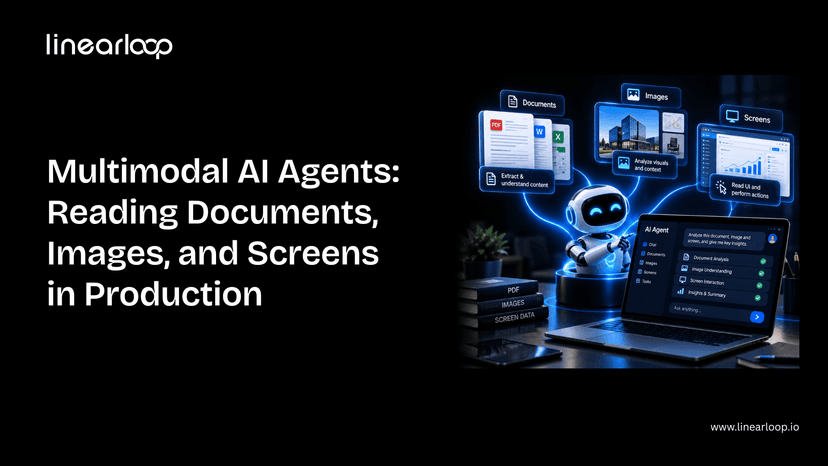
Then the real inputs show up: a scanned invoice, a photo of a damaged part, a legacy dashboard with no API at all. That's where a text-only agent stops being useful, and where multimodal AI agent systems that can read documents, images, and screens, not just process text, start earning their cost.
This guide covers what's actually different about building one of these for production: the components involved, the seven-step build process, where it breaks, and what it costs. It assumes you're already familiar with the core agent loop; if not, start with how to build an AI agent first.
Whether you're a CTO scoping a document-heavy workflow, a product leader evaluating whether this is worth the investment, or an engineer about to build one, this is the structure to work through.
Not every workflow needs multimodal capability. Here's where the two diverge.
| Dimension | Single-Modal (Text) Agent | Multimodal Agent |
Input types | Text only | Text + scanned documents + images + screens |
Data source | Clean APIs, structured fields | Unstructured: scans, photos, UI screenshots |
Failure mode | Misunderstands intent | Misreads a document or misidentifies a UI element |
Evaluation burden | Standard task-level testing | Must test against messy, low-quality real inputs |
Cost per call | Lower (text tokens only) | Higher (image/document tokens) |
Best fit | Structured workflows with existing data feeds | Invoice/PO processing, visual inspection, legacy UI automation |
If your workflow already has clean structured data, a single-modal agent is simpler and cheaper. Multimodal is worth the added complexity specifically when the source of truth is a document, image, or screen with no clean alternative.
Each of these shares a pattern: the data already exists; it's just not in a form a normal integration can reach.
Don't default to "vision + text + everything." Each modality should map to a real input your agent will encounter.
| Component | What it does |
Vision-capable model | Reads images, scanned pages, and screenshots alongside text |
OCR fallback layer | Catches text a vision model misses dense tables, poor scans, handwriting |
Document parser | Converts extracted content into structured fields your systems can use |
Screen interaction layer | Lets the agent click, type, and navigate a UI it can only see, not query |
Confidence scoring | Flags low-certainty extractions for human review instead of guessing |
Evaluation harness | Tests accuracy specifically on scanned, low-quality, and handwritten input |
This is the same discipline as scoping the core loop in how to build an AI agent, just with a wider read step. Getting the extracted output into a form your other systems can actually use is as much a data infrastructure question as a model one; our AI data stack architecture guide covers how to structure that layer properly.
If you're scoping a document- or screen-reading agent and want a second opinion on architecture before you build, talk to our AI development team.
Frontier models read printed text and clean diagrams near-perfectly. Accuracy drops meaningfully on handwriting, cluttered images, and low-contrast scans.
Test against your worst real documents, not your cleanest ones. This is the same build-vs-buy-vs-fine-tune calculation covered in our CTO guide to AI strategy, applied specifically to vision.
Vision models are good, not infallible. A cheap OCR pass as a secondary check catches errors a pure vision call misses, especially on dense tables and forms.
Define upfront which result wins when OCR and the vision model disagree; this decision is easy to skip during a demo and expensive to skip in production.
A UI redesign breaks an agent built against fixed coordinates or a memorized layout.
Build for the agent to re-orient from what it currently sees, not what it saw last time. This is the layer most teams underestimate, because it works perfectly until the first UI update ships. It's the same reliability challenge covered in our piece on agentic AI and autonomous web systems — an agent has to keep working as its environment changes, not just on day one.
Every extracted field should carry a confidence signal. Route low-confidence extractions to a human instead of letting the agent guess and move on.
This is the multimodal equivalent of the human-in-the-loop checkpoint any production agent needs. The failure mode here is a wrong answer delivered with total confidence.
The evaluation-set trap is worse here than for text agents. An agent tuned only against clean sample scans will look great in review and fail on the crumpled invoice a real user photographs with their phone.
This is exactly the kind of gap shadow traffic testing is built to catch before an agent touches real work, validating behavior against live-like conditions before it's trusted with production traffic.
Image and document input costs meaningfully more per call than text. Cache aggressively, downscale images where resolution doesn't affect accuracy, and route simple extractions to smaller, cheaper models.
Before committing to a larger build, weigh the expected savings against build cost using an AI ROI framework; multimodal projects are easy to over-scope without one.
None of these are unique to multimodal agents — they're the same category of gap covered in why DevOps mental models fail for MLOps in production AI, just with a wider set of inputs to account for.
| Step | What to Get Right |
Define modalities | Map each modality to a real input, not a wishlist |
Choose the model | Test against your worst documents, not your best |
Add OCR fallback | Define which result wins on disagreement |
Design for screen drift | Agent re-orients from current state, not memory |
Add confidence scoring | Low confidence routes to a human, not a guess |
Evaluate on ugly inputs | Avoid the clean-sample evaluation trap |
Budget for cost | Cache, downscale, and route to cheaper models where possible |
Multimodal capability doesn't change the fundamentals of building a good agent — it changes what "good input" means and where the failure modes hide. Get the evaluation and confidence-scoring layers right, and the rest is an extension of the same discipline that makes any agent production-ready.
If you're weighing whether to build this in-house or bring in a partner, our guide on what to look for in AI consulting services is a good starting point.
Have a document, image, or screen-reading use case in mind? Contact Linearloop's AI team for a no-pressure scoping conversation.

Aarav Mehta
Sep 24, 20266 min read
Checklist to Hire the Right AI Development Company for Your Business
AI has moved from an experimental line item to a core part of how businesses compete. Companies now use it to forecast demand, automate support, personalize products, and cut manual work out of everyday operations.
The harder problem isn't whether to adopt AI it's who to trust with it. Hundreds of vendors claim expertise in machine learning, natural language processing, and generative AI, but claims and delivery are two very different things.
Choose the wrong AI development company and you end up with a stalled pilot, a system nobody on your team can maintain, or a model that never reaches production. Choose the right one, and AI becomes a real driver of efficiency and revenue.
This checklist walks through what actually separates a capable AI partner from one that just sounds capable. Whether you're a founder scoping your first pilot, a CTO comparing vendors for an enterprise rollout, or a product leader trying to sanity-check a proposal, this is the structure to work through before you sign anything.
The technology rarely fails on its own. Projects fail when the team behind them lacks the process to turn a model into something reliable, secure, and maintainable in production.
A strong partner connects AI development services to a real business outcome, architects for scale from day one, and integrates cleanly with the systems you already run. A weaker one treats every engagement as a one-off experiment which is exactly why so many AI initiatives never make it past the proof-of-concept stage. Our breakdown of why enterprise AI fails and how to fix it goes deeper into the specific failure patterns.
Working with an experienced artificial intelligence development company doesn't just reduce technical risk — it reduces the risk of spending months on something that never ships.
Not every software partner is equipped to run an AI project. Here's where the two typically diverge.
| Dimension | General Software Vendor | Dedicated AI Development Company |
Core skill set | Application development, integrations | ML engineering, data science, MLOps |
Handling of data | Treats data as static input | Builds pipelines for training, retraining, drift monitoring |
Production readiness | Ships a working feature | Ships a monitored, retrainable system |
Compliance depth | General security practices | Model-specific: bias testing, explainability, data lineage |
Post-launch plan | Bug fixes and feature requests | Model monitoring, retraining, performance tracking |
Typical failure mode | Feature works but doesn't scale | — (this is the profile you want) |
If your project is primarily an integration or a standard web/mobile build, a general vendor may be the right fit. If it depends on a model that has to keep performing after launch, you need the right column.
Start with the problem, not the technology. Are you trying to reduce churn, catch fraud earlier, automate a manual workflow, or personalize recommendations? Vague goals produce vague proposals, and vague proposals are hard to evaluate against each other.
A clear problem statement also makes it much easier to tell whether a vendor's AI development services actually match your use case rather than a generic pitch retrofitted to sound relevant.
Look for range, not just a single specialty. A team that can move across machine learning, NLP, computer vision, and generative AI can adapt as your project evolves.
Ask for real examples: datasets they've worked with, frameworks they've deployed, and problems similar to yours that they've actually solved not just technologies listed on a slide. If you're still narrowing down what "expertise" should even mean for your use case, our guide on what to look for in AI consulting services is a useful gut-check before you get to a shortlist.
Building a model is one thing. Building one that respects the constraints of your industry is another — healthcare needs partners familiar with patient data regulations, retail needs demand forecasting and personalization experience, financial services needs a different risk posture entirely.
Ask for case studies or references from businesses like yours. A machine learning development company that has already solved a version of your problem is a much safer bet than one starting from zero.
AI projects need more than a single "AI person." Look for a mix of data scientists, ML engineers, solution architects, and DevOps specialists who know how to hand work off to each other.
Ask how they run the development cycle and whether the roles are actually staffed or just listed in a capabilities deck. A fragmented team is one of the most common reasons projects stall mid-build — and it's also why talent scarcity is pushing more companies toward augmented teams rather than trying to hire every specialist in-house.
The tools a company relies on tell you a lot about how they'll support you long-term.
| Layer | Example Tools |
Cloud | AWS, Azure, Google Cloud |
Frameworks | TensorFlow, PyTorch, Scikit-learn |
MLOps | MLflow, Kubeflow, DataRobot |
A partner working with modern, well-documented tools can move faster and hand off cleaner systems than one relying on outdated or overly custom infrastructure. Most AI projects don't actually fail at the model they fail at the data layer underneath it. Our AI data stack architecture guide covers what a production-ready stack needs before a single model gets trained.
Ask directly: how is data stored, who can access it, and how is the model's behavior tested for bias? A company offering serious AI development services should be able to speak to GDPR, HIPAA, or whatever standard applies to your industry without hesitation.
If security and data residency are a real concern which they usually are once regulated data enters the picture our guide to deploying private LLMs securely walks through the trade-offs between hosted and private deployment. If a vendor is vague about security or avoids the compliance conversation entirely, treat that as a warning sign, not a technicality to sort out later.
Most failed engagements trace back to poor communication, not poor technology. Ask how the team runs updates regular standups, sprint reviews, shared dashboards and whether their working hours realistically overlap with yours.
A partner that communicates clearly from the first call is far more likely to flag problems early instead of letting them compound.
Fixed-price, time-and-materials, and dedicated-team models all have different trade-offs depending on how well-defined your project is. Our comparison of time and materials vs. fixed-price models breaks down when each one actually makes sense.
Rather than anchoring on the lowest quote, weigh what's included: ongoing support, scalability, and the engineering quality behind the number. Cheap AI development outsourcing that produces a system you have to rebuild in a year isn't actually cheap.
A model's job doesn't end at launch — data drifts, usage patterns shift, and accuracy degrades without monitoring and retraining. Ask how the company handles model drift, performance tracking, and infrastructure scaling once the system is live.
This is also where it's worth asking how success will actually be measured. Our executive's guide to measuring AI ROI is a good reference for the metrics that matter once a model is in production rather than in a demo.
Even with a strong checklist, it helps to know the traps businesses commonly fall into:
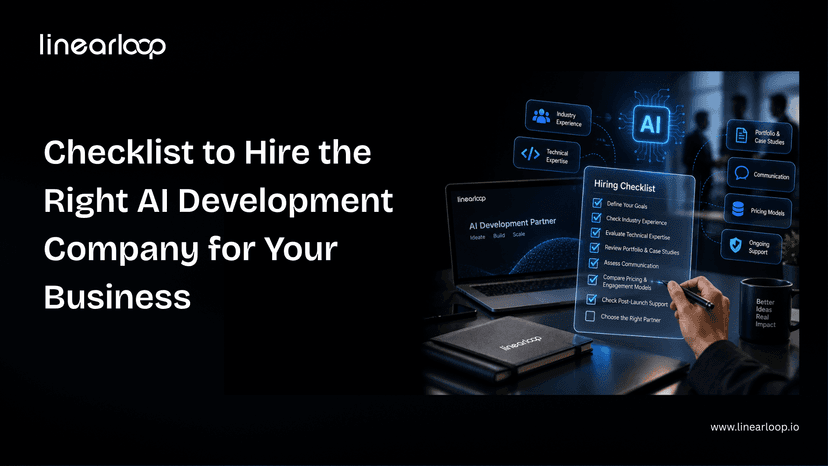
| Point | What to Check |
Goals | Clear business problem and measurable outcomes |
Technical Expertise | Range across ML, NLP, CV, generative AI |
Industry Experience | Case studies in your sector |
Team Structure | Data scientists, engineers, architects, DevOps |
Tech Stack | Current frameworks, cloud platforms, MLOps tools |
Compliance | GDPR, HIPAA, bias testing, ethical AI |
Communication | Transparent updates, collaborative workflow |
Pricing | Value-focused, not just lowest bid |
Support | Monitoring, retraining, scaling after launch |
Red Flags | Vague answers, weak security, poor responsiveness |
Hiring the right AI development company comes down to evidence over promises: a clear problem statement, proven technical range, a real team behind the work, and a track record of shipping to production rather than just prototyping.
None of these ten points are hard to check. What separates businesses that get a working AI system from those that don't is usually just whether they actually asked.
If you're evaluating partners for your next AI initiative, talk to the team at Linearloop about your specific goals. We're happy to walk through how we'd approach them, no pitch deck required.
Aarav Mehta
Sep 14, 20266 min read