AI Chatbot Product Development: Features, Cost & Process
Aarav Mehta
Aug 31, 2026
5 min read
Last updated Aug 31, 2026
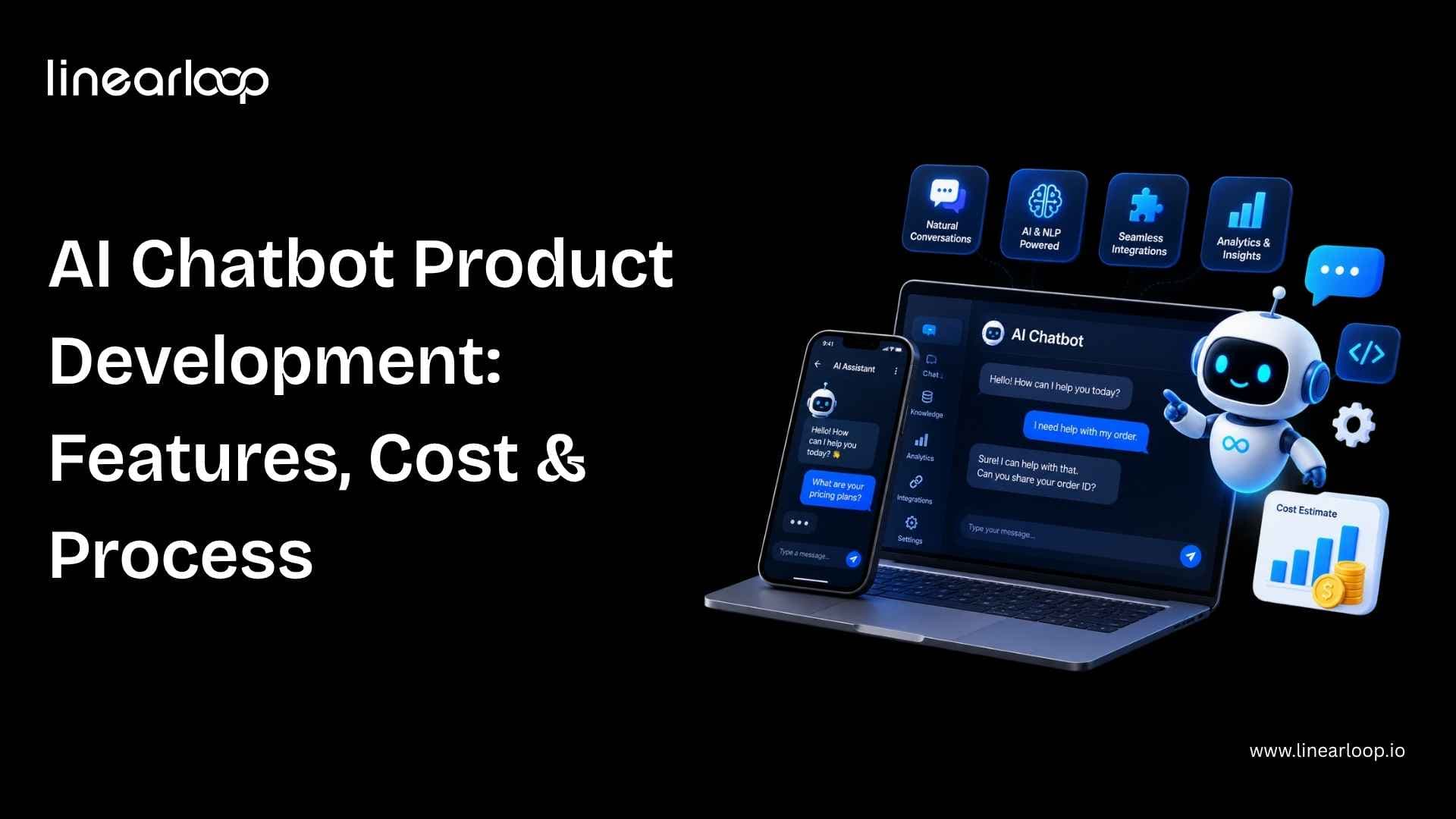
Table of Contents
What Is AI Chatbot Development?
Types of AI Chatbots (With Examples)
Key Features Every AI Chatbot Needs
What's Included in AI Chatbot Development Services
AI Chatbot Development Cost in 2026
The AI Chatbot Development Process
Choosing an AI Chatbot Development Company in India
Conclusion
FAQs
Share
Contact Us
Every business with a website has considered a chatbot at some point.
Far fewer end up with one that actually reduces support tickets or drives revenue.
The difference usually comes down to three things: picking the right type of chatbot for the job, building in the features that matter, and budgeting realistically for what it actually costs.
This guide covers all three, plus the step-by-step process for AI chatbot development, from first scoping conversation to a bot running in production.
What Is AI Chatbot Development?
AI chatbot development is the process of building a conversational system that understands what a user wants and responds, or acts, accordingly.
That's a broader definition than it sounds.
A basic FAQ bot and a chatbot that can check an order, process a return, and escalate to a human are both "chatbots," but they're built completely differently.
Modern AI chatbot development sits at the intersection of natural language understanding, AI/ML development, and standard product engineering. It's not just a script wired to a website widget.
Types of AI Chatbots (With Examples)
Not every chatbot needs the same underlying technology. Here are the main types businesses actually build.
1. Rule-Based Chatbots
These follow fixed if-this-then-that logic. Type "hours," get the store hours. Type anything else, and it often fails.
Example: A restaurant's website bot that answers "Are you open today?" and "Do you take reservations?" from a fixed script.
2. NLP-Powered Chatbots
These use natural language processing to understand intent, not just keywords. "I need to send this back" and "how do I return an item" both route correctly.
Example: A retail support bot that understands varied phrasing and pulls the right help article or order status.
3. Generative AI Chatbots
Built on large language models, these can hold open-ended conversations and generate original responses instead of picking from pre-written ones.
Example: A SaaS product's in-app assistant that explains features conversationally, drawing on product documentation in real time.
4. AI Agent Chatbots
These go beyond answering. They take multi-step actions: verifying a customer, checking a database, and completing a task, all in one exchange.
Example: A banking bot that authenticates a user, checks their balance, and files a dispute without human handoff. Our breakdown of AI agent development companies covers this category in more depth.
If you're building the agent yourself rather than evaluating a partner, our step-by-step guide on how to build an AI agent walks through the process in detail.
5. Voice-Based Chatbots
The same underlying technology, delivered through speech instead of text. Think IVR systems or voice assistants embedded in an app.
Example: A healthcare appointment line that lets patients reschedule by voice instead of navigating a phone tree.
6. Hybrid Chatbots
Most production chatbots today are actually hybrids: rule-based flows for common paths, with an AI layer as fallback for anything unscripted.
Example: A customer service bot that handles routine questions with fixed logic, then hands ambiguous ones to an LLM-backed layer.
Type matters, but so does what's actually built into it. These are the features that separate a chatbot people use from one they abandon.
Intent recognition. Understanding what the user wants, even when they phrase it differently than expected.
Context retention. Remembering earlier turns in the conversation, so users don't repeat themselves.
Human handoff. A clean escalation path when the bot hits its limits. This alone prevents most bad chatbot experiences.
System integrations. Connections to your CRM, helpdesk, or payment systems, so the bot can actually do something, not just talk.
Omnichannel support. The same bot working across your website, WhatsApp, or app, without rebuilding it per channel.
Analytics and logging. Visibility into what users are asking and where the bot is failing, so it can actually improve.
Security and data handling. Especially important if the chatbot ever touches personal or financial data. This is where private LLM deployment considerations come in.
What's Included in AI Chatbot Development Services
When people search for AI chatbot development services, they're usually picturing more than just "someone writes the bot."
A full engagement typically covers discovery and scoping, defining exactly what the bot needs to handle before any building starts.
It covers conversation design, mapping out how the bot should respond across both expected and edge-case inputs.
It covers model selection and integration, choosing between rule-based logic, an NLP layer, or an LLM based on the use case.
It covers knowledge base setup, often using retrieval so the bot answers from your actual content instead of generic training data.
And it covers testing, deployment, and ongoing monitoring, the same discipline used across broader AI development work, not a one-off script.
There's no single number here, but the ranges are fairly consistent across the market.
Rule-based chatbots typically run $2,000 to $15,000. Fast to build, cheap to maintain, limited to scripted paths.
NLP-powered AI chatbots typically run $10,000 to $35,000. This covers intent recognition, broader phrasing tolerance, and basic integrations.
Agentic or enterprise-grade chatbots typically run $35,000 to $150,000+. Multi-step actions, deep system integrations, and compliance requirements push costs up fast.
A few factors move a project up or down within these ranges.
Integrations are usually the biggest swing factor. A standalone website bot is cheap; a bot wired into your CRM, payment processor, and helpdesk is not.
Knowledge base and retrieval setup adds real cost, especially if the bot needs to answer accurately from a large or evolving body of company content.
Compliance requirements add cost. HIPAA, GDPR, and PCI-DSS all add both time and specialized expertise for chatbots in healthcare, finance, or any business handling regulated data.
Maintenance isn't optional, and it isn't free. Budget roughly 15 to 20% of the original build cost annually for updates, retraining, and monitoring.
Development location changes the number substantially. Teams in India often deliver the same scope at a meaningfully lower cost than North American or Western European agencies, without a quality trade-off.
Get a Real Cost Estimate for Your Chatbot
Ranges only go so far. Contact Linearloop for a scoped estimate based on your actual requirements.
The AI Chatbot Development Process
Here's how a chatbot actually gets built, from idea to something running in production.
Step 1: Define the job. What specific task is this chatbot solving? Vague scope is the single biggest cause of budget overruns.
Step 2: Choose the right type. Match the chatbot type from earlier in this guide to the actual complexity of the job. Don't default to the most advanced option out of habit.
Step 3: Design the conversation flows. Map out expected paths and, just as importantly, what happens when the user goes off-script.
Step 5: Connect the knowledge base. If the bot needs to answer from company-specific content, this stage sets up retrieval without requiring you to rebuild your entire data infrastructure. This approach can also be useful when enabling AI without modernizing the entire data stack
Step 6: Wire up integrations. CRM, helpdesk, payment systems: whatever the bot needs to actually take action, not just talk.
Step 7: Test rigorously. Accuracy, safety, and edge cases all get checked before launch. Skipping this step is exactly why enterprise AI projects fail after a promising demo.
Step 8: Deploy and monitor. Launch is the start of the lifecycle, not the end. This stage mirrors the broader product engineering lifecycle applied to a conversational product.
Choosing an AI Chatbot Development Company in India
India has become one of the strongest markets for AI chatbot development, and not just on price.
The cost advantage is real. Teams in India typically deliver the same scope at a meaningfully lower cost than North American or Western European agencies.
But the bigger reason companies choose an AI chatbot development company in India is the depth of AI/ML talent built up over the past decade of outsourced software delivery.
Linearloop operates as an AI chatbot development company in India, with delivery teams built specifically around conversational AI, integrations, and the evaluation work that keeps a chatbot reliable after launch.
The same team also works as an AI Development Company in USA, pairing US-based strategy with India-based engineering delivery.
Build Your AI Chatbot With Linearloop
Ready to scope your chatbot project? Talk to Linearloop's AI team for a no-pressure conversation about type, features, and budget.
Conclusion
AI chatbot development isn't one product. It's a spectrum, from a $2,000 FAQ bot to a $150,000 agentic assistant handling regulated transactions.
The right choice depends entirely on the job the bot needs to do, not on which option sounds the most impressive.
Get the type right, build in the features that actually matter, and budget for the full lifecycle, not just the initial build, and a chatbot becomes a genuine business asset instead of an abandoned widget.
Whether you handle it in-house or bring in an outside team, that's exactly what Linearloop's AI chatbot development services are built to do: match the chatbot to the job, ship it properly, and keep it working after launch.
Aarav Mehta is an AI & Technology Strategist sharing practical insights on artificial intelligence, software development, automation, emerging tech, and digital innovation.
With clean data in hand, the next decision is which model actually fits the job.
Sometimes that's a small, purpose-built model. Sometimes it's a frontier LLM. Sometimes it's a combination, wired into a broader AI/ML development effort spanning several use cases at once.
This is also the point where the build-vs-buy-vs-fine-tune decision gets made.
A validated model still isn't a product until it's wired into something people actually use.
This stage covers packaging the model, exposing it through an API, and integrating it into the existing product experience.
If the product handles sensitive data, this is also where private LLM deployment decisions need to be finalized, not improvised after launch.
Rolling out gradually, to a small slice of users first, catches problems before they reach everyone.
This stage is really a specific case of the broader product engineering lifecycle the same shipping discipline, applied to a model instead of a feature.
Stage 6: Monitoring, Governance, and Retraining
Launch day is the middle of the lifecycle, not the end of it.
Models degrade as real-world data drifts away from what they were trained on, a pattern often called model drift.
This stage means tracking performance continuously, watching for bias creeping in, and retraining when metrics slip below an agreed threshold.
Teams that treat this as optional are usually the same ones surprised, months later, by why enterprise AI projects fail after a strong launch.
Does the Lifecycle Change for AI Agents?
AI agents follow the same six stages; they just add weight to a few of them.
Evaluation needs to cover tool calls and multi-step reasoning, not just a single prediction.
Deployment needs guardrails for autonomous actions, not just an API endpoint.
If you're specifically scoping an agent rather than a predictive or generative model, our guide on AI agent development companies covers what to look for in a partner.
Our piece on agentic AI systems goes deeper into how multiple agents coordinate toward a larger goal.
Why AI Product Lifecycles Break Down
The stages above are simple to describe and surprisingly easy to derail.
Weak data quality is still the single most common cause of AI project failure; no amount of model sophistication fixes bad inputs.
Vague success metrics from Stage 1 tend to resurface in Stage 4, when nobody can agree on whether the results are actually good enough.
Build In-House vs. Partner With an AI Development Company
If your team already runs this lifecycle for other products, extending it to AI is a reasonable lift.
The calculation shifts once the product needs deep data engineering, rigorous evaluation infrastructure, or compliance work your team hasn't done before.
At that point, the cost of getting a stage wrong bad data decisions, an unvalidated model, a rollout with no monitoring usually outweighs the cost of bringing in a partner.
An AI agent is a system that uses a large language model as its reasoning engine.
It has access to tools it can call to act on the world.
It holds context across multiple steps.
And it decides its own next move instead of following a fixed script.
That last part is the distinction worth holding onto.
A chatbot answers a question. A traditional automation script follows a rule you wrote in advance.
An AI agent sits between the two. It reasons about a goal, chooses from a set of available actions, checks the result, and decides what to do next.
It repeats that loop until the job is done, or it hands off to a human.
This is also what separates a single agent from a broader agentic AI system, where multiple agents coordinate toward a longer-running goal.
Most teams should start with one well-scoped agent before reaching for orchestration across several.
Not everything needs to be an agent, either. Sentiment analysis, recommendation engines, and predictive analytics are often better served by standard AI/ML development than by wrapping them in an autonomous loop.
How AI Agents Actually Work: The Core Loop
Strip away the frameworks and the marketing language.
Every AI agent runs the same basic loop:
Read : take in the request, plus whatever context and conversation history matters.
Reason : decide what needs to happen next based on the goal and the current state.
Act : call a tool, query a system, or take some action in the outside world.
Observe : look at what came back from that action.
Repeat : feed the result back in, and decide the next step, until the goal is met.
An LLM on its own is text in, text out.
What turns it into an agent is the loop wrapped around it.
That loop is what decides when a tool is needed, executes it, and feeds the result back for the next decision.
Understanding this loop before touching a framework will save you more time than any tutorial on a specific library.
Core Components of a Production AI Agent
A weekend demo needs a model and a prompt.
A production agent needs quite a bit more around it.
Component
What it does
LLM (reasoning engine)
Interprets the request, plans the next action, and decides when the job is done.
Tools
The concrete actions the agent can take searching a database, calling an API, sending an email, editing a file.
Memory / context
Short-term state for the current task, plus a durable store for anything that needs to persist across sessions.
Orchestration / harness
The loop that wraps the model, executes tool calls, and manages retries and iteration limits.
Sandbox / environment
An isolated space where the agent can act without risking production systems if it makes a mistake.
Guardrails & human oversight
Rules about what the agent can do autonomously, and where a human has to approve before it acts.
Evaluation & monitoring
A way to measure whether the agent is actually doing its job well, both before and after launch.
Skip any one of these, and you don't have a broken agent.
You have a demo that happens to work in the specific scenario you tested.
This is the same gap that causes enterprise AI initiatives to stall before reaching production more broadly.
Agents are especially exposed to it, because they take real actions, not just predictions.
Tools are how the agent actually does anything beyond generating text.
A few rules matter more than they first appear.
One responsibility per tool. A tool that searches orders and a tool that issues refunds should be two separate tools, not one with a flag.
Agents make more mistakes when a single call is doing several things at once.
Clear, narrow inputs. The more precisely a tool's parameters are defined, the less room the agent has to call it incorrectly.
Idempotent where possible. If a tool call gets retried, it shouldn't cause duplicate side effects.
A dry-run mode for anything risky. This makes both testing and evaluation dramatically easier later.
Step 5: Give the Agent Memory and Context
Most agents need two kinds of memory.
Short-term memory is the working context for the current task. Think of the conversation so far, or the current state of a multi-step job.
Long-term memory is what persists across sessions. Prior decisions, learned preferences, historical outcomes.
For simple agents, a well-structured log of past actions is often enough.
For agents that need to recall information across a large body of knowledge, a vector store paired with retrieval is the more common pattern.
Whichever you choose, define clear write rules.
An agent that can write to memory without constraints will eventually pollute it with noise.
Step 6: Build the Loop
This is the part that actually turns a model call into an agent.
In its simplest form, the loop looks like this:
def run_agent(user_input, tools, max_steps=6):
messages = [{"role": "user", "content": user_input}]
for step in range(max_steps):
response = call_model(messages, tools=tools)
if response.tool_call is None:
return response.content # agent is done, return the final answer
tool_result = execute_tool(response.tool_call)
messages.append({"role": "assistant", "content": response.tool_call})
messages.append({"role": "tool", "content": tool_result})
return "Reached step limit without finishing — escalate to a human."
The specifics change from project to project. The shape doesn't.
The model decides, the runtime acts, the result feeds back in.
The loop has a hard limit so a confused agent can't run forever.
That step limit is small but easy to forget. It's one of the cheapest safeguards you can add.
Step 7: Add Guardrails and a Human-in-the-Loop Checkpoint
Decide upfront which actions the agent can take fully autonomously.
Decide separately which ones require human approval first.
Refunds above a threshold. Anything that sends external communication. Anything that can't be easily undone.
This isn't a limitation you add reluctantly.
It's what makes an agent trustworthy enough to actually deploy.
Step 8: Evaluate Before You Ship
This is the step most teams underinvest in.
It's usually why agents work in a demo and misbehave in production.
A workable evaluation approach covers a few layers:
Trace-level : replay recorded runs to confirm the same input reliably produces the same tool calls and outcome.
Task-level : a set of representative test cases with known-good outcomes, checked automatically and reviewed by a human.
User testing : put the agent in front of a small group of real users before a full launch, not just your own team.
Production-level : ongoing metrics once it's live: success rate, escalation rate to humans, latency, and cost per task.
Watch for the evaluation-set trap, too.
An agent that's been tuned only against your test cases can look great in review and still struggle on the messier traffic real users send it.
Skipping evaluation doesn't make the agent simpler.
It just moves the discovery of problems from your test environment to your first angry customer.
Step 9: Deploy, Monitor, and Keep Iterating
An agent isn't "done" at launch, any more than any other AI product is.
Decide where it actually lives first embedded in your product, on a website, inside an internal tool, or behind an API other systems call.
Then treat deployment as the start of an ongoing cycle, not the finish line.
Watch how it performs against real, messier inputs than your test set.
Track where it escalates to humans, and why.
Collect direct feedback too: a simple thumbs up/down or short survey after key interactions goes a long way.
Feed all of it back into the tools, prompts, and guardrails.
This is really the same discipline as the broader product engineering lifecycle, applied to a system that reasons with an LLM instead of following fixed logic.
How to Create an AI Agent Without Writing Code
Not every use case needs a custom-built runtime.
If the job is simple, well-defined, and maps closely to an existing integration, a no-code agent builder can genuinely be the right call.
Routing a form submission. Summarizing an inbox. Triggering a workflow when a condition is met.
The moment you need custom logic, multiple coordinated tools, or nuanced guardrails, things change.
The moment you need the reliability to run unattended in production, things change too.
You're back to the build-vs-buy decision from Step 2.
That's usually the point where it's worth a conversation with a team that builds these for a living, rather than stretching a no-code tool past what it was designed for.
How Much Does It Cost to Build an AI Agent?
There's no single honest number here. It depends heavily on scope.
A narrow proof of concept with one or two tools and a single model can be built in days.
A production agent with proper evaluation coverage, monitoring, guardrails, and integration into existing systems is a meaningfully larger engineering effort.
The biggest cost drivers are usually the number of integrations, the complexity of the guardrails needed, and how much evaluation infrastructure has to be built from scratch.
A working demo is realistic in days for an experienced engineer.
One tool, one model, a happy-path conversation.
Getting that same agent to handle edge cases gracefully, with real evaluation coverage and proper escalation paths, typically takes several weeks to a few months.
The gap between "it worked when I tried it" and "it's reliable enough to run without me watching it" is almost always where the real engineering time goes.
Common Reasons AI Agent Projects Fail
Most failed agent projects fail for a small, repeatable set of reasons.
Engineering-led design of the harness, guardrails, and evaluation layer not just wiring a model up to a few tools.
Linearloop works as an AI Development Company in USA, with delivery teams built specifically around taking AI agents from a scoped idea to a system that runs reliably in production.
The same team also operates as an AI Development Company in India, giving you US-based strategy paired with distributed engineering capacity.
Either way, the goal is the same: a system that's still working six months after launch, not just a demo that worked once.
Build Your AI Agent With Linearloop
Have an agent idea but not sure where to start scoping it? Contact Linearloop's AI team for a no-pressure scoping conversation.
Conclusion
Building an AI agent in 2026 is easier than it's ever been.
The models are capable. The tooling is mature. A working prototype is genuinely a weekend project for a competent engineer.
What hasn't gotten easier is the part that actually matters for a business.
The harness, the guardrails, the evaluation, and the discipline to keep iterating after launch.
Knowing how to build an AI agent step by step means knowing where the real engineering effort goes.
Not just knowing which library to import.
If you're scoping an agent project and want a second opinion on architecture, evaluation, or where the risk actually sits, talk to Linearloop's AI engineering team.

This article is a practical, research-based comparison of the AI product development companies in the USA that founders, CTOs, product leaders, and enterprise teams are evaluating in 2026.
Overview
Choosing an AI product development company has become one of the more consequential vendor decisions a business makes, because the gap between "having an AI idea" and "running a usable AI product" is where most teams get stuck. This guide walks through what AI product development actually involves, how we evaluated companies for this list, a side-by-side comparison of ten vetted firms, realistic cost and timeline expectations, the technologies commonly used, what production-readiness actually requires, and a practical framework for making the final decision. It's written for commercial investigation you're not looking for a definition of AI, you're trying to shortlist a partner who can take an idea to a shipped, working product.
What Is AI Product Development?
AI product development is the discipline of turning an AI capability a model, an agent, a generative AI feature into a usable, reliable product that real customers or employees interact with. It sits at the intersection of AI/ML engineering, product strategy, UX design, data infrastructure, and software engineering.
That's a broader scope than most people assume. AI product development typically spans
AI product strategy — deciding where AI actually creates value, rather than adding it because it's trendy
Product discovery — validating the problem and use case before writing any model code
AI/ML development — building or fine-tuning the underlying models
Generative AI and LLM applications — copilots, content generation, document intelligence
AI agents — systems that reason, plan, and take multi-step actions across tools (see what an AI agent actually is if this term is new to your team)
NLP and computer vision — language understanding and visual data processing
Recommendation engines and predictive analytics — personalization and forecasting
AI integrations — connecting AI into CRMs, ERPs, and existing SaaS platforms
Data infrastructure — pipelines, feature stores, and vector databases that feed the AI reliably
Product engineering, deployment, monitoring, and optimization — the parts that keep the product working after launch
AI product development vs. traditional software development
Traditional software development is largely deterministic: given the same input, the system produces the same output, and testing focuses on logic and edge cases. AI product development introduces probabilistic behavior, model drift, data dependency, and the need for continuous monitoring and retraining. A traditional app is "done" at launch in a way an AI product never fully is — it needs ongoing evaluation as data and user behavior change, which is why custom AI software development is treated as a distinct discipline rather than a variant of regular app development.
AI development company vs. AI product development company
An AI development company may focus narrowly on building or fine-tuning models, running data science experiments, or delivering a proof of concept. An AI product development company carries that work further through UX, full-stack engineering, integration, deployment, and long-term scaling so the output is a shippable product, not just a validated model sitting in a notebook. That distinction matters more than it sounds: a lot of "AI pilots" die precisely because no one owned the product engineering half of the equation.
What Services Do AI Product Development Companies Provide?
Most credible AI product development companies offer some combination of the following, though the depth varies significantly by firm.
AI Product Strategy — Defining which business problems are actually worth solving with AI, and what a realistic ROI hypothesis looks like before any build begins.
AI/ML Development — Custom model development, fine-tuning, and classical machine learning for prediction, classification, and optimization problems.
Generative AI & LLM Development — Building applications on top of large language models: copilots, document intelligence, content generation, and retrieval-augmented generation (RAG) systems.
AI Agent Development — Designing agents that can reason over context, call tools, and execute multi-step workflows rather than simply responding to a prompt; this has become specialized enough that many buyers now shortlist firms specifically for AI agent development rather than general AI vendors.
AI Application Development — Turning any of the above into a usable, deployed application with a real interface and real users.
AI Integration — Embedding AI into existing systems: CRMs, ERPs, support platforms, and internal tools, without a rip-and-replace of the underlying stack.
AI MVP Development — Getting a scoped, testable version of an AI product in front of real users quickly; this is close enough in scope to standard MVP development that many teams start there and layer AI in once the core value proposition is validated.
AI SaaS Product Development — Building AI capabilities as a multi-tenant, scalable SaaS product rather than a single-client tool, which typically draws on the same engineering discipline as broader SaaS development.
NLP & Computer Vision — Text understanding, sentiment analysis, document parsing, image classification, and visual inspection use cases.
Predictive Analytics — Forecasting demand, churn, risk, or other business-critical metrics from historical and real-time data.
Recommendation Engines — Personalizing content, products, or actions based on user behavior and context.
AI Product Optimization — Improving latency, accuracy, and cost once a product is live, rather than treating launch as the finish line.
AI Deployment & Scaling — Moving from a working prototype to a system that can handle production traffic, data volume, and uptime expectations.
How We Selected the Top AI Product Development Companies
This is an editorial comparison, not a paid ranking. The companies below were evaluated using publicly available information company websites, verified review platforms, press releases, and independent business databases against the following criteria:
Genuine AI/ML and generative AI expertise, not just software development with AI mentioned in passing
Evidence of product engineering capability, not only consulting or data science
Verifiable industry experience and client history
A real, substantiated presence in the USA
Experience with both startups and larger enterprises where applicable
Production deployment and post-launch support experience, where publicly documented
We excluded companies where we could not verify a real connection to AI product development, and we did not include unverifiable claims about pricing, awards, or specific project outcomes unless independently confirmed.
Quick Comparison of AI Product Development Companies in USA
Fortune 500 and growth-stage companies needing architect-led delivery
Markovate
Generative AI and agentic systems
Generative AI apps, AI agents, MLOps, custom AI models
Companies wanting design-driven, industry-specific generative AI products
ThirdEye Data
Data science and applied AI
ML/AI development, computer vision, data engineering
Data-heavy enterprises needing AI built on strong data foundations
Master of Code Global
Conversational and generative AI
AI agents, chatbots, voice AI, conversation design
Consumer brands wanting polished, brand-facing conversational AI
Thoughtbot
Design-led product development with AI
Product design, generative AI features, full-stack development
Startups wanting a design-first partner integrating AI into a broader product
Top 10 AI Product Development Companies in USA
Here's a closer look at ten companies teams are actively evaluating in 2026, starting with a firm that positions itself as an AI product development company in USA built around the full lifecycle rather than a single slice of it.
1. Linearloop
Linearloop operates as an AI product development services provider with delivery teams working across the USA and India, and positions itself around the full AI product lifecycle rather than isolated model work: idea, AI strategy, product discovery, MVP, AI development, product engineering, integration, deployment, and scaling. That framing is the company's clearest differentiator the pitch isn't "we can train a model," it's "we can take your AI idea to a running product and keep it running," regardless of whether the team requesting it sits in the USA, India, or both.
AI Product Development Services
The company's offering includes AI strategy and consulting as a starting point, followed by AI-driven product innovation and AI integration and optimization. On the technical side, the team builds generative AI (LLM) applications, NLP, sentiment analysis, computer vision, time series analysis, recommendation engines, predictive analytics, and lead scoring solutions.
AI Technologies & Capabilities
The stated technical stack spans generative AI and large language models, NLP, computer vision, and predictive analytics, delivered on cloud infrastructure such as AWS and Google Cloud. The team has also published detailed engineering guidance on private LLM deployment security — a signal of engineering depth beyond a generic service page.
Product Engineering Capabilities
AI development is paired with broader product engineering: full-stack and backend development, UI/UX, and cloud infrastructure work, along with published thinking on modern AI data stack architecture that underpins how those systems are built. This is the part that often gets skipped by narrower AI vendors, and it's the part that determines whether an AI feature actually becomes a usable product.
Industries
The AI work spans healthcare, e-commerce, fintech, and SaaS, with published applications including diagnostic imaging AI, virtual health assistants, and drug discovery support in healthcare.
Why Consider Linearloop?
Positions AI within the full product lifecycle instead of treating it as a standalone technical exercise
Publishes detailed, engineering-level content on production AI concerns governance, private LLM security, data architecture — that goes beyond marketing copy
Combines AI consulting with hands-on product engineering under one team
Works across both startup MVP timelines and enterprise-grade production requirements
2. Fingent
Founded in 2003 and headquartered in White Plains, New York, Fingent is an ISO 27001–certified custom software development company with more than two decades of enterprise delivery experience and a client list that includes Mastercard, Sony, PwC, and NEC.
AI Product Development Capabilities
Fingent embeds AI across the software development lifecycle rather than treating it as a separate service line including cost estimation, requirements validation, and testing. The company also builds custom agentic AI systems designed to integrate with existing ERP and CRM environments without a full rip-and-replace.
Key AI Technologies
Generative AI, agentic/multi-agent workflows, workflow automation, and enterprise system integration.
Industries / Use Cases
Enterprise operations, insurance, and customer service automation, based on Fingent's published case material.
Best For
Enterprises that want to modernize legacy systems and embed AI into existing workflows without disrupting core operations.
Why Consider This Company?
Two decades of enterprise software delivery with a verifiable Fortune 500 client base
Agentic AI offering built specifically around integrating with legacy ERP/CRM systems
Governance-conscious approach, with role-based access and audit trails built into agent deployments
3. 10Pearls
Founded in 2004 and headquartered in Vienna, Virginia, 10Pearls describes itself as an AI-native digital engineering partner, with a client roster that includes Capital One, PayPal, Adobe, and Johnson & Johnson.
AI Product Development Capabilities
10Pearls runs an "AI Launchpad" model built to move an idea to a proof of concept within roughly 90 days, alongside broader AI integration, cloud modernization, and QA services delivered as part of end-to-end product development.
Key AI Technologies
AI/ML integration, cloud architecture (AWS-certified for resilience), and AI-augmented software testing.
Industries / Use Cases
Healthcare, financial services, energy, and education, based on 10Pearls' published client work.
Best For
Mid-market and enterprise teams that want a fast, structured path from AI idea to a working proof of concept.
Why Consider This Company?
20+ years of custom software delivery with recognized enterprise clients
Structured 90-day idea-to-POC methodology rather than open-ended discovery
Repeated recognition from Inc. 5000 and Forrester for digital transformation and AI consultancy work
4. Grid Dynamics
Grid Dynamics (Nasdaq: GDYN) is a publicly traded, AI-first digital engineering and technology consulting company founded in Silicon Valley in 2006, with roughly 5,000 technical professionals and reported FY2025 revenue of $411.8 million.
AI Product Development Capabilities
Grid Dynamics offers AI-readiness consulting, use-case identification, agentic AI infrastructure, and enterprise-scale AI deployment, layered on top of its core platform and product engineering services.
Key AI Technologies
Generative and agentic AI, data and ML platform engineering, computer vision, and IoT/edge AI ("physical AI") for manufacturing and logistics use cases.
Industries / Use Cases
Retail, telecommunications, manufacturing, and financial services, with published outcomes spanning AI-powered merchandising, churn prevention, and structured-products automation.
Best For
Fortune 1000 enterprises that need the scale, financial transparency, and public accountability of a NASDAQ-listed engineering partner.
Why Consider This Company?
Publicly traded with disclosed financials, offering a level of transparency smaller private firms can't match
Nine years of dedicated enterprise AI delivery experience as of 2026
Delivery centers across 19 countries, supporting large, multi-region rollouts
5. HatchWorks AI
Founded in 2016 and headquartered in Atlanta, Georgia, HatchWorks AI combines US-based AI strategy with nearshore engineering delivery across Latin America.
AI Product Development Capabilities
HatchWorks AI's services span AI strategy and roadmapping, AI-ready data foundation work, and building AI-powered products that embed agents and intelligent experiences directly into core workflows supported by its proprietary "Generative-Driven Development" methodology for accelerating the software development lifecycle.
Key AI Technologies
Generative AI, machine learning, natural language processing, and retrieval-augmented generation (RAG) implementation.
Industries / Use Cases
Healthcare, financial services, and general enterprise software modernization.
Best For
Mid-market companies that want US-based AI strategy paired with cost-efficient nearshore engineering capacity.
Why Consider This Company?
Named a Top 100 enterprise software development company for 2025 by Techreviewer
Combines product strategists, AI specialists, data engineers, and developers into integrated delivery teams
High-retention nearshore teams reduce the disruption risk common with offshore-only models
6. Intellectsoft
Founded in 2007 and headquartered in Palo Alto, California, Intellectsoft is an enterprise software and AI engineering company whose clients include EY, Harley-Davidson, the London Stock Exchange, and Qualcomm.
AI Product Development Capabilities
Intellectsoft frames itself as an "AI transformation and AI product engineering partner," with solution-architect-led delivery that shapes scope, architecture, and integration before development starts, and explicit proof-of-concept-to-production expertise.
Key AI Technologies
AI-native systems engineering, cloud development, and enterprise data architecture.
Industries / Use Cases
Fintech, healthcare, construction, and logistics, based on Intellectsoft's published client engagements.
Best For
Fortune 500 companies and growth-stage businesses that want senior architect ownership from day one of an AI engagement.
Why Consider This Company?
Every engagement led by a senior solution architect, reducing the risk of scope drift
Explicit focus on validating AI use cases before committing to full production build
Nearly two decades of enterprise software delivery experience
7. Markovate
Founded in 2015 and headquartered in San Francisco, Markovate is a design-driven generative AI company led by CEO Rajeev Sharma, with more than 300 solutions delivered and ISO 9001/27001 certification.
AI Product Development Capabilities
Markovate's portfolio covers the full generative AI lifecycle agentic AI development, generative AI applications, AI chatbots, AI consulting, MLOps, and custom AI model development alongside proprietary vertical products like an AI-powered CAD-to-BOM classifier for manufacturing.
Key AI Technologies
Generative AI (including OpenAI and Anthropic model integrations), agentic AI, computer vision, and NLP.
Industries / Use Cases
Manufacturing, healthcare, insurance, construction, retail, and fintech.
Best For
Companies that want a design-driven partner building industry-specific generative AI products rather than generic chat interfaces.
Why Consider This Company?
Design-first approach to generative AI, with dedicated UX expertise alongside engineering
Proprietary vertical AI products demonstrate applied delivery beyond client consulting
Leadership team with direct enterprise AI experience at companies like AT&T and IBM
8. ThirdEye Data
Founded in 2010 and based in Santa Clara/San Jose, California, ThirdEye Data is a Silicon Valley data science and applied AI firm with a client history that includes Walmart, Microsoft, Amgen, Google, and Intel.
AI Product Development Capabilities
ThirdEye Data's work spans AI strategy building, proof-of-concept development, and production deployment of machine learning and deep learning models, built on a foundation of data engineering and big data infrastructure.
Key AI Technologies
Machine learning, deep learning, computer vision, NLP, and MLOps on Azure, AWS, and Google Cloud.
Industries / Use Cases
Manufacturing, utilities, retail, and enterprise operations, including predictive maintenance and anomaly detection use cases.
Best For
Data-heavy enterprises that need AI products built on a genuinely solid data engineering foundation rather than AI layered on top of messy data.
Why Consider This Company?
Over a decade of dedicated data science and AI delivery, not a recent pivot into the space
Verified enterprise client base spanning Fortune 500 and Fortune 10 organizations
Strong emphasis on MLOps and moving models from notebooks into real production environments
9. Master of Code Global
Founded in 2004 with development centers across North America and Europe and a San Francisco Bay Area presence, Master of Code Global has delivered more than 1,000 conversational and generative AI projects for brands including T-Mobile, Burberry, and Aveda.
AI Product Development Capabilities
The company specializes in custom AI agents, chatbots, and voice solutions, with services spanning agentic AI development, conversational AI platforms, generative AI, voice engineering, and conversation design supported by a proprietary delivery framework the company says reduces setup effort and speeds up MVP launch.
Key AI Technologies
Large language models, voice AI, and omnichannel conversational integration across messaging platforms, web, and voice assistants.
Industries / Use Cases
Retail, telecom, automotive, and consumer brands, with a strong focus on customer-facing experiences.
Best For
Consumer-facing brands that need a polished, brand-consistent conversational AI experience rather than a generic chatbot.
Why Consider This Company?
Two decades of dedicated conversational AI experience, predating the current generative AI wave
ISO 27001-certified, with a strong track record supporting high-profile consumer brands
Deep specialization in the design and UX side of conversational experiences, not just backend AI logic
10. Thoughtbot
Founded in 2003 and based in the United States, Thoughtbot is a design-and-development consultancy that has built products for more than 1,000 clients, including GitHub, Vimeo, Etsy, Disney, and Autodesk.
AI Product Development Capabilities
Thoughtbot integrates AI and machine learning including custom generative AI applications and chatbot/conversational AI — into its broader, design-led product development process, positioning AI as one capability within a larger product strategy and engineering practice rather than the entire offering.
Key AI Technologies
Generative AI application development, NLP, and voice/speech recognition, typically built on a Ruby on Rails or modern web stack.
Industries / Use Cases
SaaS, media, healthcare, and nonprofit sectors, based on Thoughtbot's published client work.
Best For
Startups and product teams that want a design-first partner who can weave AI into a broader product, rather than an AI-only shop that treats design as an afterthought.
Why Consider This Company?
Over two decades of product design and development experience with well-known, verifiable clients
Human-centered, design-led methodology that reduces the risk of technically sound but unusable AI features
Strong open-source and community credibility within the software engineering world
How Much Does AI Product Development Cost in the USA?
There is no single accurate number here, and any article that gives you one flat figure is guessing. What actually drives AI product development cost includes:
Product complexity — a single AI feature bolted onto an existing app costs far less than a full AI-native platform
Model approach — using a third-party API is cheaper up front than fine-tuning or training a custom model
Data requirements — clean, structured, accessible data reduces cost; messy or siloed data increases it substantially
RAG vs. fine-tuning — retrieval-augmented generation is typically less expensive to build and maintain than fine-tuning a model on proprietary data
AI agent complexity — a single-purpose agent costs less than a multi-agent orchestration system with memory and governance layers
Number of integrations — every additional CRM, ERP, or legacy system connection adds engineering time
UI/UX complexity — a conversational interface is a different cost profile than a full product redesign
Backend architecture and cloud infrastructure — scalability and multi-region deployment add cost relative to a single-region MVP
Security and compliance — HIPAA, SOC 2, or financial services compliance requirements add both time and specialized expertise
Testing, monitoring, and maintenance — production AI needs ongoing evaluation, which is easy to underbudget
Because of this range of variables, most credible AI product development companies quote custom pricing after a scoping or discovery phase rather than a fixed rate card. If you see a vendor quote a firm number before understanding your data, integrations, and compliance needs, treat that as a caution flag rather than a selling point.
How Long Does It Take to Build an AI Product?
Timelines vary by stage and ambition, and no responsible vendor should promise a fixed delivery date before scoping the work. In general terms:
Proof of concept — a narrow test of whether an AI approach works at all, often measured in weeks
AI prototype — a rough, internal-facing version used to validate the idea with real data
AI MVP — a scoped, usable version released to early users to test the core value proposition
Production MVP — an MVP hardened enough for real traffic, with basic monitoring and error handling
Full AI product — a complete, market-ready product with the UX, integrations, and reliability expected by paying customers
Enterprise AI platform — a scalable system supporting multiple use cases, teams, and compliance requirements across an organization
What extends timelines: unclear success metrics, messy or inaccessible data, a long list of required integrations, and regulatory review cycles. What compresses timelines: a narrowly scoped first use case, clean data, and a partner who pushes back on scope creep rather than agreeing to everything.
How to Choose the Right AI Product Development Company
Use this as a practical checklist when evaluating vendors:
Define the business problem before talking to anyone about models or tools.
Identify where AI actually adds value — not every workflow benefits from AI, and a good partner will tell you that.
Evaluate AI expertise beyond buzzwords — ask for specifics, not capability lists.
Review previous AI products they've shipped, not just industries they've served.
Check product engineering capabilities — can they actually build and ship a product, or only a model?
Review architecture expertise — how do they think about scalability, integration, and technical debt?
Ask about data security — what happens to your data during development and after deployment?
Evaluate scalability — will the architecture hold up if usage grows 10x?
Understand the technology stack — is it a fit for your existing systems and team?
Review development methodology — agile, iterative delivery tends to reduce risk versus large, one-time deployments.
Understand pricing and engagement model — fixed scope, time and materials, or dedicated team?
Check post-launch support — who owns the system once it's live, and for how long?
Ask how AI performance will be monitored — drift detection, retraining triggers, and accuracy tracking should be part of the plan, not an afterthought.
Understand ownership of code, data, models, and infrastructure before signing anything.
AI Technologies Used in Product Development
Generative AI — models that create new content (text, images, code) based on learned patterns
Large Language Models (LLMs) — the foundation models powering most modern generative AI applications
Retrieval-Augmented Generation (RAG) — connecting an LLM to your own data so responses are grounded in real, current information rather than only the model's training data
AI Agents — systems that can reason, plan, and take multi-step actions across tools and data sources, increasingly deployed as agentic AI systems inside US-based web and product platforms
Machine Learning — the broader discipline of models that learn patterns from data for prediction and classification
NLP (Natural Language Processing) — technology for understanding and generating human language
Computer Vision — technology for interpreting images and video
Predictive Analytics — using historical data to forecast future outcomes
Recommendation Systems — personalizing content or products based on user behavior
Vector Databases — storage systems optimized for the embeddings that power semantic search and RAG
AI APIs — third-party model access that reduces the need to train models from scratch
Cloud AI — managed AI infrastructure from AWS, Google Cloud, and Microsoft Azure
Data Engineering — the pipelines and infrastructure that feed AI systems reliable, structured data
MLOps — the operational discipline of deploying, monitoring, and retraining models in production
What Makes an AI Product Production-Ready?
A working demo and a production-ready AI product are not the same thing. Production readiness typically requires:
Data security and privacy — encryption, access controls, and data residency handled correctly from day one
Model reliability — consistent behavior under real-world, messy input, not just curated test data
Monitoring and observability — visibility into latency, errors, and model behavior in real time
Access control — role-based permissions governing who can see, modify, or query the AI system
Governance — clear policies for how the AI is allowed to behave and what it's not permitted to do
Human oversight — a defined point where humans review or override AI decisions in high-stakes scenarios
Error handling — graceful failure instead of silent, undetected mistakes
Scalability — the ability to handle growth in users, data, and request volume without breaking
Cost control — visibility into and management of compute and API costs at scale
Data privacy compliance — alignment with frameworks like GDPR or HIPAA where relevant
Continuous improvement — a defined process for retraining or refining the system as real-world data comes in
Faster product validation — an experienced partner has already seen which AI use cases tend to work and which tend to stall
Access to specialized expertise — AI/ML engineering, product strategy, and infrastructure skills are hard and expensive to hire in-house all at once
Reduced technical risk — architecture mistakes made early in an AI product are expensive to fix later
Better AI architecture — experienced teams design for drift, scale, and governance from the start
Faster MVP development — proven delivery patterns shorten the path from idea to testable product
Product and AI engineering under one team — reduces the handoff friction between "the AI team" and "the product team"
Integration with existing systems — a real partner can connect AI into your current CRM, ERP, or SaaS stack without a rebuild
Easier scaling — infrastructure built correctly the first time scales more predictably
Post-launch optimization — AI products need ongoing tuning, and a partner who plans for that avoids a slow decline in quality after launch
Conclusion
Choosing an AI product development company isn't really a technology decision. it's a decision about who will still be accountable for your product six months after launch, when the initial excitement has faded and what matters is whether the thing actually works, scales, and keeps earning its place in your stack. The ten companies above each bring a genuinely different strength, from enterprise-scale engineering to design-led product thinking to deep conversational AI expertise, and the right fit depends on your stage, budget, and how much of the AI product lifecycle you need one partner to own.
If what you're looking for is a partner who treats AI strategy and product engineering as one continuous job rather than two separate vendors, that's the specific gap Linearloop was built around, with delivery teams supporting clients across both the USA and India. Whether you're validating your first AI MVP or scaling an existing product into a full enterprise platform, working with an established AI Development Company in USA can help you figure out where to start and take it from there.