We're officially a Great Place To Work® certified company, India | 2026–27

Mayank Patel
Jan 21, 2025
4 min read
Last updated Jul 31, 2026
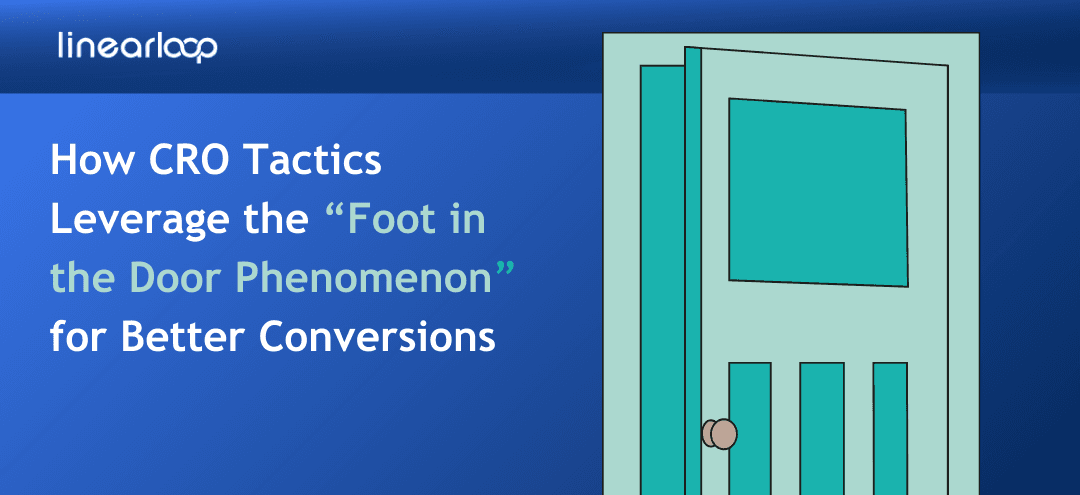
Imagine somebody lands on your website. They browse around, showing a bit of interest, but they're not ready to buy or commit. It's like trying to get someone to jump into the deep end when they haven't even dipped a toe in the water. This is where a smart online strategy steps in—borrowing a psychological trick to gently guide visitors into becoming customers. That's the strategy with the power of Conversion Rate Optimization, better known as CRO, combined with what is called the Foot-in-the-Door phenomenon.
Having trouble converting website visitors into customers? Well, Conversion Rate Optimization or CRO for short, makes your site better at getting people to act. But what if there was a way to make those "asks" feel easier? Enter the "Foot-in-the-Door" phenomenon: the surprising power of starting small to achieve big conversion wins.
Why does this "small ask" strategy actually work when someone's surfing the Web? It all comes down to the way our minds work.
First, there's consistency: people like to maintain harmony between their actions and beliefs. If a person clicks a button to download a free guide, he or she has taken a small step towards showing interest in something. The feeling of wanting to be consistent with that act now means they're likely to consider more steps regarding the subject. After all, they've already said 'yes' in a small way, making it harder to say 'no' to a slightly larger request.
Then there's self-perception: when someone takes a small action on your site, they start to view themselves in a certain light. Subscribing to your email list can lead them to think, 'I’m someone interested in this topic.’ That slight change in self-identity makes them more receptive to future engagement with your brand.
Crucially, small requests lower the perception of risk. Sharing an email address for a free download feels far less risky than entering credit card details for a purchase. This is a low-stakes way for someone to interact with you and see what you're offering without feeling pressured.
Finally, building a connection gradually avoids overwhelming visitors with a big sales pitch upfront... It will let you build trust and rapport over time before making them comfortable enough with your brand to make a bigger ask.
Also Read: What a Conversion Rate Optimization Agency Can Do for Your E-commerce Store
So how does that work in the real world of websites and online marketing? Well, here are a few examples of common CRO tactics which make very sly use of the Foot-in-the-Door principle:
Also Read: How a CRO Specialist Can Increase Website Conversions & Revenue
Also Read: Custom Retail Software Solutions: A Comprehensive Guide
Strategically applying the Foot-in-the-Door phenomenon to your CRO efforts can significantly boost your website’s performance. So, start thinking about the small steps you can offer, and watch how those small actions lead to significant gains for your business. At Linearloop, we believe that every small step counts to yield significant gains in your marketing efforts. Our custom software solutions ensure your CRO strategies are effective and tailored to your business needs.


How a CRO Specialist Can Increase Website Conversions & Revenue
You're paying for traffic. You're ranking on Google. People land on your site every single day.
And still, most of them leave without buying, signing up, or filling out a form.
Here's the uncomfortable truth: that's not a traffic problem, and no amount of extra ad spend or SEO ranking fixes it. If 98 out of every 100 visitors leave empty handed, the fastest, cheapest revenue on the table isn't a new acquisition channel. It's the visitors you already have.
That gap, between people arriving on your site and people actually converting, is exactly where a CRO specialist earns their keep. Not by sending you more traffic, but by systematically finding out why the traffic you already have isn't converting, then fixing it with data instead of guesswork.
This guide breaks down what that role actually involves, how it differs from a general marketer or web designer, what a good conversion rate optimization services provider delivers, and how to pick the right partner, whether you're an e-commerce brand in the US or a growing business in India.
A CRO specialist (short for Conversion Rate Optimization specialist) is the person, or team, responsible for turning more of your existing website visitors into customers, leads, or signups, without spending an extra dollar on ads or SEO.
They sit at the intersection of four skill sets that rarely live in one person:
Unlike a performance marketer who's judged on traffic and clicks, a CRO specialist is judged on one number: conversion rate. Did more of the same visitors take the action you wanted?
A good CRO specialist doesn't start with a redesign. They start with research. Here's the typical process:
Audit and research: They dig into analytics, heatmaps, session recordings, and on-site surveys to understand exactly where visitors drop off, whether that's the homepage, a category page, the cart, or checkout.
Build a hypothesis. Every change is framed as a testable hypothesis: "If we simplify the checkout from 4 steps to 2, cart abandonment will drop because users cited 'too many steps' as their top frustration."
Prioritize what to fix first. Not every friction point deserves equal attention. A specialist scores issues by potential impact and effort, so the highest-revenue fixes get tested first.
Run A/B or multivariate tests. They test a variation against the current version with real traffic, waiting for statistically significant results before declaring a winner.
Analyze and implement: Winning variations get rolled out; losing ones get documented so the same mistake isn't retested six months later.
Repeat CRO isn't a one-time project. It's a continuous loop of testing, learning, and compounding small wins into meaningful revenue gains.
Most businesses over-invest in acquisition and under-invest in conversion. Consider what a 1% lift in conversion rate actually means:
That's $30,000 in new monthly revenue without a single extra visitor. This is exactly why acquisition-heavy teams eventually bring in a CRO specialist. It's the fastest lever for revenue growth that doesn't depend on outspending competitors on ads.
Also Read: How to turn casual visitors into devoted customers
Plenty of people can set up an A/B test. Far fewer can consistently pick the right tests to run. Here's what separates the two:
| In-house CRO specialist | CRO agency | |
| Cost | Full-time salary plus tools and training | Pay for outcomes, scale up or down |
| Speed to start | Weeks to hire, months to ramp up | Days to kick off, immediate expertise |
| Breadth of experience | Limited to their past projects | Pattern recognition across dozens of brands and industries |
| Tooling | You buy and manage the testing/analytics stack | Agency typically brings its own stack and workflows |
| Best for | Large teams running CRO as a permanent function | Growing e-commerce and SaaS brands that want results without building a team from scratch |
For most growing businesses in the US and India, a CRO agency gets you to measurable results faster, because you're borrowing a team that has already run hundreds of tests, instead of paying one specialist to learn on your website.
If you're comparing a CRO specialist for e-commerce USA or looking for a CRO services expert based in India, evaluate agencies against these criteria:
Also Read: Top 10 CRO Agencies in the USA
Here's how the theory plays out in practice, using a typical e-commerce funnel:
Each stage is tested independently, so improvements compound instead of getting lost in a single big redesign.
Also Read: Top 10 Conversion Rate Optimization Agencies in India
At Linearloop, CRO isn't treated as a single audit or a one-off redesign. It's run as an ongoing, always-on system tied directly to revenue, not just behavioral metrics like clicks or time-on-page.
Our team specializes in e-commerce platforms including Shopify, Shopify Plus, WooCommerce, and custom builds, and focuses on the friction points that actually move revenue: cart abandonment, low average order value, and checkout drop-off. Every test is backed by real data from analytics, heatmaps, and session recordings, and every idea is carried through to production by an in-house team, so nothing gets stuck between "we found the problem" and "we fixed it."
If you're evaluating a CRO agency in the USA or India, Linearloop works with e-commerce and digital-first teams to turn existing traffic into predictable, compounding revenue growth. For a deeper look at what a CRO agency can do for your e-commerce store, see our related breakdown.
A CRO specialist doesn't just make your website "look better." They find the specific points where visitors hesitate or leave, test real fixes against real data, and turn that insight into measurable revenue. Whether you hire in-house or bring in a CRO agency, the businesses that treat conversion optimization as an ongoing discipline, not a one-time project, are the ones that keep compounding growth quarter after quarter.
If you're ready to stop losing revenue to a leaky funnel, talk to Linearloop's CRO team about what a tailored conversion audit could uncover on your site.

Mayank Patel
Jul 31, 20265 min read
Top 10 Conversion Rate Optimization (CRO) agencies in USA
Driving traffic is no longer the hard part. Consistently converting that traffic across devices, journeys, and intent levels is where most teams struggle. Many brands invest heavily in acquisition, only to leak revenue through unclear user journeys, weak experimentation, and assumptions that never get validated. This is where the right CRO agency makes a measurable difference, by combining user research, behavioural insight, and disciplined experimentation to improve decisions across the funnel.
This blog highlights the top Conversion Rate Optimization (CRO) services in the USA for 2025–2026, selected for their depth of experimentation, clarity of thinking, and ability to drive meaningful outcomes across eCommerce, SaaS, and enterprise platforms. The goal is not to rank agencies, but to help you choose one that actually moves the needle where it matters.
Not every conversion rate optimization (CRO) agency will work for your business, even if they look strong on paper. The difference usually shows up after a few months, when ideas stall, tests slow down, and results fail to compound.
The right agency operates with clarity, discipline, and a clear point of view on how optimization should actually work. These are the parameters to look for:
Linearloop embodies what a modern conversion rate optimization company in USA should be combining research depth, execution discipline, and eCommerce specialization to deliver compounding growth, not one-off wins.
Also Read: How Payment Failures Break Your CRO Funnel
| CRO agency | Primary focus | Key feature | Standout proof |
| Linearloop | E-commerce CRO systems | Full-stack experimentation tied directly to revenue metrics | HDFC EMI Store, LedKoning, Gochk, Parfumoutlet |
| Invesp | Enterprise CRO programs | Research-heavy SHIP methodology for scalable experimentation | ZGallerie, eBay, 3M |
| Conversion Sciences | Revenue-focused experimentation | Behavioural funnel diagnostics to isolate revenue leaks | Old Khaki, Careers24. Property24 |
| CRO Metrics | Experimentation at scale | Organisation-wide experimentation frameworks and tooling | Zendesk, Calendly, Tommy Hilfiger |
| SiteTuners | Usability-led CRO | Friction reduction through usability analysis | Costco, Nestle, Norton |
| The Good | E-commerce UX optimisation | Deep buyer-journey and checkout optimisation | Adobe, The Economist, Autodesk |
| Conversion (GAIN Group) | Enterprise experimentation | Scalable CRO and personalisation frameworks | Dollar Shave Club, Whirlpool, The Guardian |
| Single Grain | Growth-led CRO | CRO integrated with SEO and paid acquisition strategy | Schumacher Homes, LS Building Products, Klassy Networks |
| Speero (by CXL) | Experimentation maturity | Behavioural science-led testing and maturity models | ClickUp, Freshworks, MongoDB |
| OuterBox | Integrated CRO and analytics | CRO aligned with UX, analytics, and business outcomes | University Hospitals, Drip Drop, Crayola |
Traffic growth has become easier to buy but sustainable growth has not. As funnels grow more complex and acquisition costs rise, the ability to convert existing demand consistently is what separates efficient teams from wasteful ones. The agencies featured here stand out because they combine research, data, and execution to drive outcomes that compound over time, whether that is improving checkout performance, clarifying product journeys, or reducing friction across high-intent flows.
This list highlights the top e-commerce conversion rate optimization (CRO) agencies in the USA that demonstrate strong strategic depth, disciplined experimentation, and a track record of measurable impact across eCommerce, SaaS, and enterprise platforms.
Linearloop approaches CRO as a revenue system. Instead of running isolated A/B tests, the team treats optimization as an always-on loop that connects user behaviour, UX decisions, experimentation, and engineering execution. The focus is on compounding improvements that hold up as traffic and complexity scale.
The team specializes deeply in eCommerce platforms such as Shopify, Shopify Plus, WooCommerce, and custom builds. Their work consistently targets high-impact friction points, such as cart abandonment, low average order value, and checkout drop-offs. Linearloop’s AI-assisted CRO Magic framework helps generate sharper hypotheses and prioritize experiments faster, allowing brands to move with speed without sacrificing rigour.
Linearloop combines deep eCommerce context with disciplined experimentation and full-stack execution as a leading conversion rate optimization company in USA. Every test is backed by data from analytics, heatmaps, and session recordings, and every idea is carried through to production by an in-house team. This tight loop between insight and execution is where most CRO efforts break down and where Linearloop consistently delivers.
Brands working with Linearloop, a conversion rate optimization (CRO) company in USA, commonly see meaningful improvements in conversion rates, higher average order values through offer optimization, reduced cart abandonment, and stronger mobile performance.
Invesp is one of the few Conversion Rate Optimization (CRO) agencies that helped define how modern optimization is practiced. Their work is rooted in structured research, disciplined experimentation, and frameworks that scale across large, complex organisations. Rather than chasing quick wins, Invesp focuses on building optimization programs that compound over time.
Their SHIP methodology brings clarity to experimentation by forcing teams to slow down where it matters most, understanding behaviour before acting on it. This approach has been applied across thousands of experiments for global enterprise brands, giving Invesp a depth of pattern recognition that most agencies simply do not develop.
Large organizations that need a mature, research-driven CRO partner with proven frameworks and the ability to influence decision-making at an executive level.
Based in Austin, Texas, Conversion Sciences approaches CRO as an applied science rather than a creative exercise. Their work is anchored in deep behavioural analysis, funnel diagnostics, and methodical experimentation designed to unlock revenue from existing traffic. The focus is on identifying where value leaks occur and fixing them with evidence-backed design and testing decisions.
Teams that want predictable, measurable revenue gains from their current traffic by applying structured experimentation instead of incremental guesswork.
CRO Metrics works with teams that treat experimentation as a long-term capability, not a short-term conversion fix. Their focus is on helping fast-growing and enterprise organisations move beyond one-off tests and build scalable, repeatable experimentation programs that can support complexity over time. Clients such as Calendly and Codecademy reflect this orientation toward mature product and growth teams.
Their strength lies in designing experimentation systems that hold up at scale. This includes proprietary internal tools to manage complex testing frameworks, as well as deep involvement in helping teams operationalise CRO across functions. Rather than acting as an external testing vendor, they work closely with internal teams to embed experimentation into day-to-day decision making.
Companies that want to build a durable culture of experimentation rather than run isolated or short-term CRO initiatives.
Founded in 2002, SiteTuners is one of the earliest specialists in conversion rate optimization, long before CRO became a common line item in growth budgets. Their work focuses on identifying friction in user journeys and removing it through structured usability analysis rather than surface-level experimentation. Over the years, they have worked with both growing businesses and large enterprises, collectively helping clients unlock more than $1 billion in incremental revenue through optimisation.
Small to mid-sized businesses that want practical, usability-driven CRO improvements without over-engineering experimentation programs.
The Good is a CRO agency built specifically for e-commerce, and that focus shows in how they approach optimization. Their work centres on removing friction from the buying journey, not by chasing cosmetic wins, but by understanding how real customers move, hesitate, and drop off. They are especially strong at combining UX research with disciplined experimentation, making them a solid partner for brands that want clarity before change.
E-commerce brands looking for a CRO agency in the USA with a strong UX and behavioural research foundation, especially those operating at scale or on Shopify.
Conversion works with large, complex organisations where experimentation needs to scale beyond isolated tests. Their work with brands like Meta, Microsoft, and Domino’s reflects a focus on building optimization programs that hold up across multiple products, markets, and customer touchpoints.
Rather than running one-off experiments, Conversion helps teams design long-term CRO frameworks. This includes enterprise-grade experimentation, advanced personalisation, and processes that enable ongoing optimisation even as platforms and teams evolve. A notable part of their approach is enabling internal teams, so experimentation does not remain dependent on external support.
Large organizations with complex digital ecosystems that need a disciplined, scalable approach to conversion optimisation rather than isolated testing efforts.
Led by growth marketer Eric Siu, Single Grain approaches conversion optimization as part of a wider growth system rather than a standalone exercise. Their CRO work is closely linked to paid acquisition, SEO, and content strategy, enabling optimization decisions to influence the entire funnel. This makes their approach particularly effective for teams that view conversion as a revenue problem.
Brands that want conversion optimization to reinforce overall marketing performance, not operate in isolation from acquisition and growth channels.
Speero helps organizations move beyond surface-level experimentation into structured, scalable optimization programs. Backed by CXL, their work is rooted in behavioral science and disciplined research rather than isolated A/B tests. Instead of chasing short-term lifts, Speero helps teams build experimentation systems that compound learning over time.
Their approach is especially relevant for teams that already run experiments but struggle with prioritization, insight quality, or translating test results into long-term strategy. Speero treats CRO as an organizational capability.
Mid-to-large enterprises that have outgrown basic A/B testing and want to build a more mature, research-driven experimentation practice.
OuterBox treats conversion optimization as an integrated growth discipline that connects analytics, UX insight, and business outcomes. Rather than running experiments in isolation, they prioritize improvements that reduce friction across key buyer journeys, from landing page engagement to cart completion and post-purchase success.
Their methodology emphasizes rigorous analytics and performance measurement as the foundation for all recommendations. This means teams get optimization strategies rooted in data patterns and behavioural insight. OuterBox also stresses alignment between optimization goals and broader revenue objectives, ensuring work moves beyond surface metrics like clicks to deeper metrics like qualified leads and orders.
Brands and mid-sized businesses that want CRO integrated with broader digital marketing and revenue goals, rather than treated as an isolated experiment engine.
Also Read: Top 10 Conversion Rate Optimization agencies in India
Choosing a Conversion Rate Optimization (CRO) agency comes down to one question:
Do you want incremental lifts, or a system that compounds growth over time?
Rankings matter less than alignment with your business model, internal maturity, and the outcomes you are accountable for. As competition intensifies in 2026, CRO is a core growth capability. Teams that treat optimization as a structured, ongoing discipline consistently outperform those running isolated tests.
Linearloop works with e-commerce and digital-first teams to build CRO systems. By combining deep experimentation, user insight, and revenue-focused execution, Linearloop helps turn existing traffic into predictable, long-term growth.
If you are looking to build Conversion Rate Optimization (CRO) as a long-term capability rather than a series of isolated tests, Linearloop works with e-commerce and digital-first teams to design experimentation systems that tie directly to business outcomes.
Also Read: How CRO Tactics Leverage the Foot in the Door Phenomenon for Better Conversions

Mayur Patel
Jan 7, 20266 min read