Why Teams Optimise Conversion Rate Instead of Revenue

Mayur Patel
Mar 13, 2026
5 min read
Last updated Mar 12, 2026
Growth teams run constant experiments, celebrate higher conversion rates, and report improvements in form completions, demo requests, or trial sign-ups. Yet leadership often sees a different reality: revenue growth slows, pipeline quality stagnates, and profit margins remain unchanged. The issue is not a lack of experimentation; it is that teams optimise the easiest metric to move rather than the metric that reflects real business value.
Conversion rate became the default optimisation metric because it responds quickly to experiments, is easy to attribute to UI changes, and fits neatly into A/B testing workflows. Over time, experimentation programmes began optimising behavioural metrics simply because they were measurable and controllable. This creates a structural paradox where businesses care about revenue, profit, and qualified pipeline, but growth teams optimise conversion rate. This blog examines why that misalignment happens and why the metric itself deserves scrutiny.
Read more: Why Enterprise AI Fails and How to Fix It
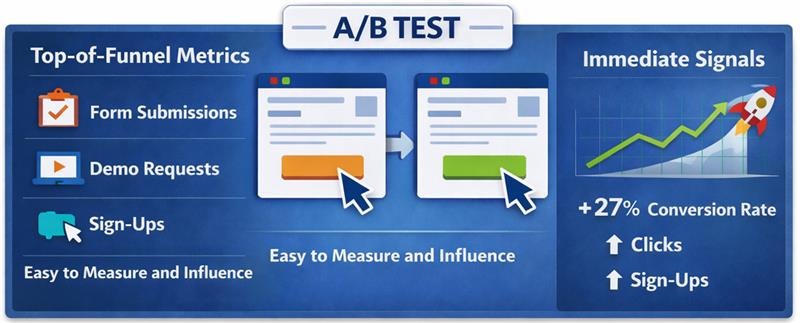
Conversion rate optimisation emerged as digital products and marketing funnels became fully measurable, allowing teams to track how users moved through landing pages, sign-up flows, checkout processes, and onboarding journeys. Instead of waiting for revenue reports or quarterly sales outcomes, teams could immediately see whether a page change increased form submissions, trial activations, or checkout completions. This visibility made conversion rate a practical optimisation target for marketing, product, and growth teams responsible for improving funnel performance.
Experimentation platforms accelerated this shift. A/B testing tools allowed teams to test headlines, layouts, pricing visibility, and form structures while measuring immediate behavioural outcomes. Because experiments required a fast success metric to determine winners, conversion rate became the most reliable signal. Teams could run tests frequently, observe results within days, and report measurable improvements through conversion lifts.
Over time, this experimentation culture established conversion rate as the default optimisation metric. Landing pages, signup flows, checkout experiences, and onboarding journeys were all evaluated based on whether conversions increased. Since the metric was simple to measure and responded quickly to interface changes, growth teams built experimentation programmes around improving conversion rate, gradually treating it as a growth indicator rather than a behavioural signal within a broader revenue system.
Read more: Executive Guide to Measuring AI ROI and Payback Periods
Conversion rate is a behavioural metric that measures the proportion of users who complete a predefined action within a digital journey. It helps teams understand whether visitors respond to a page, message, or product flow, but it does not reveal whether those actions generate business value. The metric captures user behaviour inside the funnel.
- It measures the percentage of users completing a defined action: Conversion rate represents the share of visitors who complete a specific event such as submitting a form, activating a trial, or finishing a checkout. It is calculated by dividing completed actions by total visitors or sessions, making it a straightforward signal of behavioural response.
- It reflects actions at specific stages of the funnel: Different funnel stages use different conversion definitions. Marketing teams track landing page submissions, product teams monitor trial activations or onboarding completion, and ecommerce teams evaluate checkout completion. Each conversion event represents progress within the journey rather than the final outcome.
- Common conversions include sign-ups, demo requests, trials, and checkouts: Typical conversion events include newsletter registrations, demo request submissions, product trial activations, account sign-ups, and completed checkouts. These actions indicate user engagement or intent but do not necessarily confirm that revenue or qualified pipeline will follow.
- It measures behaviour: A higher conversion rate simply means more users completed the defined action. It does not indicate whether those users generate revenue, contribute to qualified pipeline, or improve profitability, because the metric captures behavioural response rather than financial impact.
Read more: How to Deploy Private LLMs Securely in Enterprises
Most organisations do not intentionally prioritise conversion rate over revenue or pipeline. The metric becomes dominant because it fits how experimentation, reporting, and team responsibilities are structured. Conversion rate responds quickly to changes, is easy to attribute to specific actions, and sits within the direct control of marketing and growth teams.
- It provides fast feedback for experiments: Conversion rate reacts quickly to interface changes, messaging updates, or form adjustments, allowing teams to measure the impact of experiments within days rather than months. Revenue and pipeline metrics often require long sales cycles or extended user behaviour before outcomes become visible.
- It offers clear attribution to specific changes: When a headline, form layout, or page design is modified, conversion rate makes it easier to attribute performance changes to that specific experiment. Revenue or profit metrics involve multiple variables such as pricing, customer quality, and retention, which complicate attribution.
- It sits within the direct control of growth teams: Marketing, product, and CRO teams can directly influence landing pages, forms, onboarding flows, and calls to action. Since these elements shape conversion behaviour, teams focus on the metric that reflects the impact of the changes they can actually implement.
- It simplifies reporting and performance tracking: Conversion rate produces a clear and immediate signal that can be tracked across experiments, campaigns, and funnel stages. Dashboards, testing platforms, and growth reports commonly highlight conversion improvements because the metric provides a straightforward way to demonstrate measurable progress.
Read more: How to Deploy Private LLMs Securely in Enterprises
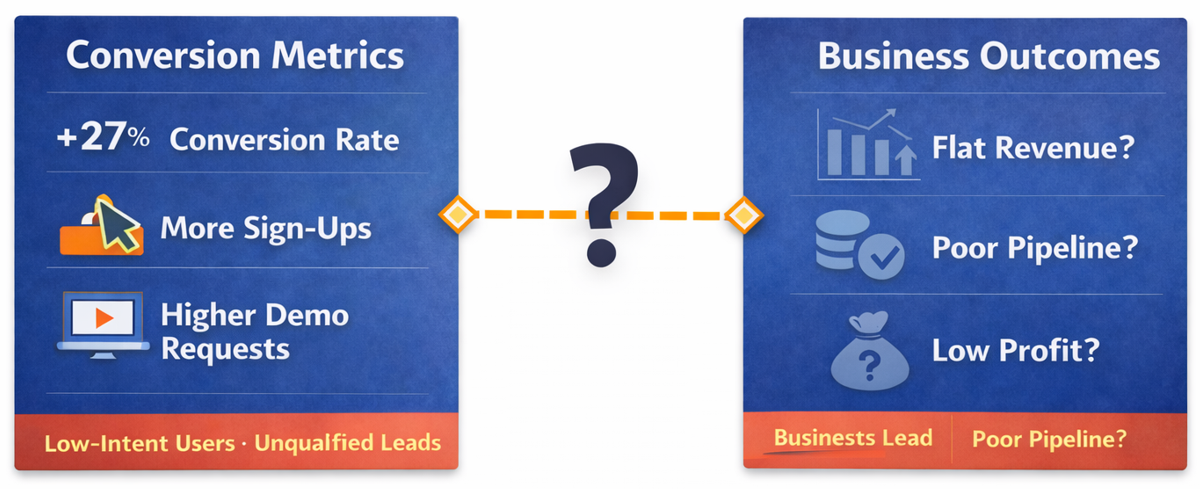
Higher conversions often create the appearance of growth, but the metric measures behaviour inside the funnel rather than the value created after the action occurs. A landing page may generate more demo requests, a signup flow may produce more trial users, or a checkout page may record more completed transactions, yet these improvements do not automatically translate into stronger revenue, healthier margins, or a higher-quality pipeline. When teams treat conversion rate as the primary success metric, they risk optimising user actions that do not necessarily contribute to business performance.
This gap emerges when optimisation metrics are misaligned with business outcomes. Experiments that increase conversions can attract lower-intent users, generate leads that do not qualify for sales, or encourage transactions that require heavy discounting and reduce margins. In such cases, the conversion metric improves while the economic result weakens, because the optimisation process prioritises behavioural responses instead of evaluating whether those responses create measurable financial value.
Read more: Modern AI Data Stack Architecture Explained for Enterprises
Conversion improvements often appear positive in experiment dashboards, but the metric alone does not indicate whether the underlying business outcome improved. When optimisation focuses only on increasing conversions, experiments can unintentionally attract the wrong users, reduce economic value, or distort the signals that leadership relies on to evaluate growth performance.
- Low-intent leads entering the funnel: Reducing friction in demo request forms or signup flows often increases submissions, but it can also allow low-intent visitors to enter the pipeline. Sales teams then spend time on leads that lack purchasing intent, increasing operational effort while qualified pipeline remains unchanged.
- Aggressive discounting increasing transactions but reducing margins: Checkout optimisation frequently uses discounts, urgency messaging, or price incentives to push conversions higher. While transactions increase, the business may generate lower margins or attract customers who respond primarily to promotions rather than long-term value.
- Unqualified trial users inflating product metrics: Simplifying trial activation can increase the number of users entering the product, but many may never engage meaningfully with core features. Product teams observe higher trial conversions while activation rates and paid upgrades remain flat.
- Distorted signals in growth reporting: When conversion rate becomes the primary optimisation target, experiment reports show continuous improvements even while revenue, pipeline quality, or profitability stagnate, creating misleading signals about actual growth performance.
Read more: Personalization vs Borad UX Changes in Conversion Rate Optimization Services
Revenue and profit represent the outcomes businesses ultimately care about, yet these metrics are difficult to optimise through isolated experiments because they depend on multiple interconnected factors across the entire customer lifecycle. Unlike conversion rate, which responds immediately to interface changes, revenue and profitability emerge from a combination of pricing decisions, customer quality, retention behaviour, and operational costs that extend far beyond a single page or funnel step.
- Revenue depends on multiple interconnected variables: Revenue does not originate from a single user action; it results from pricing structure, deal size, sales cycle progression, upsell opportunities, and customer retention. A landing page experiment may influence sign-ups or leads, but the final revenue outcome depends on many downstream processes.
- Customer quality determines revenue impact: Not every conversion contributes equal value to the business. Some users convert but never activate the product, while others become long-term customers with significant lifetime value. Revenue optimisation therefore requires evaluating the quality of conversions rather than simply increasing their quantity.
- Profit depends on cost structures and margins: Profitability involves acquisition costs, discounting strategies, support requirements, and operational overhead. An experiment that increases conversions may simultaneously increase servicing costs or reduce margins, making profit optimisation significantly more complex.
- Experimentation teams cannot isolate these variables easily: Most growth experiments modify messaging, design, or flow structure, which influence behavioural metrics quickly but only indirectly affect revenue or profit. Since these economic outcomes depend on long sales cycles and operational systems, direct optimisation through short experimentation cycles becomes difficult.
Read more: Why Some Lead Form Fields Kill Conversion
In B2B growth systems, conversions and pipeline represent very different signals, yet many teams treat them as the same indicator of demand. Metrics like demo requests or form submissions only reflect top-of-funnel activity, not real sales progress. What ultimately matters is whether those leads qualify and move into opportunities. Measuring sales-qualified pipeline instead of raw conversions aligns growth efforts with revenue potential.
| Dimension | Conversion-focused growth | Pipeline-focused growth |
| Primary metric | Form submissions, demo requests, or sign-ups recorded at the top of the funnel. | Sales-qualified opportunities that meet defined criteria and enter the pipeline. |
| Objective | Increase the number of users completing a marketing action. | Increase the number of opportunities with real purchasing potential. |
| Lead quality | Often includes low-intent or exploratory leads. | Prioritises leads that meet qualification standards. |
| Business impact | Activity increases but sales outcomes may remain unchanged. | Directly reflects potential revenue generation. |
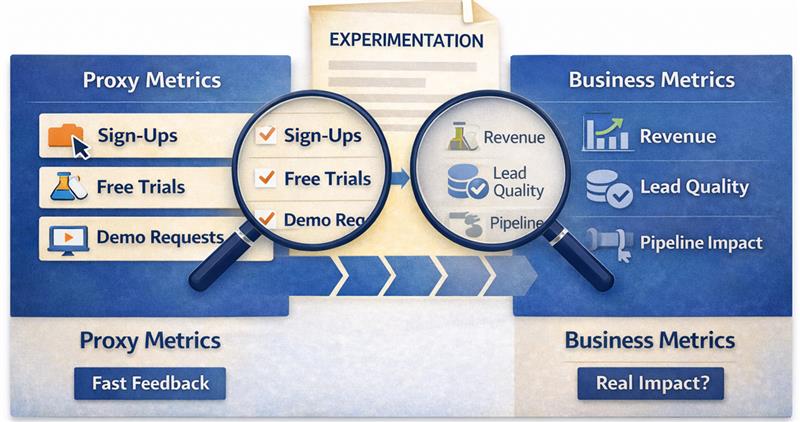
Proxy metrics exist because experimentation requires fast signals that indicate whether a change influences user behaviour before the final business outcome becomes visible. Metrics such as click-through rate, form completion, or conversion rate provide immediate feedback about how users respond to a page, message, or flow, allowing teams to evaluate experiments within short timeframes. In this context, conversion rate functions as a proxy for potential business impact because it captures behavioural movement within the funnel, even though the actual outcome may only appear much later.
The risk emerges when proxy metrics begin replacing the business metrics they are meant to approximate. When experimentation programmes treat conversion rate as the primary success indicator, teams may optimise behavioural responses without evaluating whether those responses create economic value. Experiments can therefore produce consistent improvements in proxy metrics while revenue growth, pipeline quality, or profitability remain unchanged. Over time, excessive reliance on proxy metrics shifts optimisation away from business outcomes and toward behavioural signals that only partially represent the true performance of the growth system.
Read more: From Custom Builds to 60 Stores: BVB Media Ecommerce Platform Story
Growth programmes become misaligned when behavioural metrics sit at the top of the optimisation hierarchy instead of supporting business outcomes. A more reliable approach is to organise metrics in layers so that experimentation signals connect directly to economic impact.
In this structure, behavioural metrics help diagnose user behaviour, economic metrics connect behaviour to value creation, and business metrics represent the final outcomes the organisation ultimately cares about.
Business metrics
Business metrics represent the final economic results produced by the growth system. These metrics define whether the business is creating sustainable value rather than simply increasing activity within the funnel.
- These metrics measure real outcomes such as revenue growth, gross profit, and sales-qualified pipeline, which reflect the actual performance of the business rather than behavioural responses.
- They capture long-term impact because they incorporate pricing, retention, deal size, and customer lifetime value rather than a single user action.
- They provide the final benchmark for evaluating experiments, ensuring that optimisation efforts ultimately contribute to measurable business performance.
Economic metrics
Economic metrics translate behavioural activity into financial impact, helping teams understand whether changes in user behaviour improve revenue potential or pipeline quality.
- Metrics such as revenue per visitor, revenue per signup, or pipeline per lead connect top-of-funnel activity with downstream economic outcomes.
- These indicators help teams evaluate whether experiments improve the quality of users entering the funnel rather than simply increasing volume.
- Economic metrics act as a validation layer that ensures behavioural improvements are moving the business metrics in the right direction.
Behavioural metrics
Behavioural metrics provide immediate feedback about how users respond to interface changes, messaging adjustments, or product flow improvements.
- Metrics such as conversion rate, click-through rate, and form completion indicate whether users engage with specific pages or funnel steps.
- These signals help experimentation teams evaluate hypotheses quickly because behavioural responses appear within short testing cycles.
- Behavioural metrics should guide diagnostics and iteration, but they must remain connected to economic and business metrics to ensure optimisation improves real outcomes.
Read more: How to Optimize Demo Request Flows Without Disrupting Sales Infrastructure
When the objective shifts from improving conversion rate to improving business outcomes, the way experiments are designed and evaluated changes significantly. Instead of measuring success through immediate behavioural responses alone, teams begin examining whether experiments increase revenue potential, improve lead quality, or strengthen the pipeline.
- Define success metrics that reflect business value: Experiments should begin by identifying the outcome the organisation ultimately cares about, such as revenue growth, pipeline expansion, or margin improvement. Conversion rate can remain a diagnostic signal, but the primary success criteria must connect directly to economic outcomes.
- Evaluate experiments through downstream impact: A page change that increases demo requests or trial sign-ups should also be evaluated based on what happens after the conversion event. Teams need to examine whether those additional conversions lead to higher-quality opportunities, stronger product activation, or improved revenue contribution.
- Prioritise lead quality over lead volume: Experimentation should focus on attracting users who demonstrate genuine intent rather than maximising the number of conversions. This may involve testing qualification signals, pricing transparency, or messaging that clarifies the product’s value for the right audience.
- Connect experimentation metrics across the funnel: Teams should track how behavioural changes propagate through the growth system by linking experiment results to economic metrics such as revenue per visitor, pipeline per lead, or activation-to-revenue conversion. This ensures that improvements at the top of the funnel translate into measurable business outcomes.
Read more: How Linearloop Built a Zero Loss ERP for a Gold Refinery
Conversion rate is a useful behavioural signal, but it cannot be the final objective of a growth programme. When teams optimise only for conversions, they often increase funnel activity without improving revenue, pipeline quality, or profitability. Sustainable experimentation requires aligning behavioural metrics with economic impact and ultimately with business outcomes.
Growth teams therefore need experimentation frameworks that connect user behaviour to measurable business value. Experiments should be evaluated through revenue contribution, lead quality, and pipeline impact rather than isolated conversion lifts. If your organisation is rethinking how experimentation aligns with real growth outcomes, Linearloop helps teams design optimisation systems that link product changes, behavioural signals, and revenue impact.

Mayur Patel, Head of Delivery at Linearloop, drives seamless project execution with a strong focus on quality, collaboration, and client outcomes. With deep experience in delivery management and operational excellence, he ensures every engagement runs smoothly and creates lasting value for customers.
Related Posts

7 signs you should opt for UI/UX Audit
In a time when virtual interactions shape how users connect, emphasizing a meticulously designed user interface (UI) alongside an enriching user experience (UX) holds immense significance. As companies aim to reach new heights in their digital endeavors, the necessity for continuous assessments rises to the forefront.
Engaging in a UI/UX audit emerges as an invaluable resource designed to confirm that your website or application fulfills user desires while resonating with corporate aspirations. Throughout this discussion, we shall investigate seven indicators that suggest the moment has arrived to ponder a UI/UX audit for your digital platform.
Before delving deep into the signals that call for such a review, it’s important to shed light on what constitutes a UI/UX audit. This thorough inspection encompasses a wide array of elements pertaining to your website or application, spanning design appeal, ease of use, functionality, and overall user contentment. The essential aim of this assessment revolves around uncovering opportunities for enhancements capable of enriching the user experience and ultimately boosting conversions.
Typically, a UX audit unfolds through diverse methods, including heuristic assessments, user experience trials, and meticulous data evaluation. By harnessing these approaches, organizations can unravel insights regarding how individuals engage with their platforms while pinpointing challenges that might obstruct their satisfaction. Continuous evaluations are indispensable for nurturing a successful user experience, ensuring that your platform retains its place in a swiftly changing digital arena.
Probably the most telling indicator that you need a website UI/UX audit is when you notice high drop-off rates on your site. Drop-off rates refer to the number of users who leave your site after having viewed only one page. If users exit and do not complete the desired actions, such as signing up for a newsletter or making a purchase, the reason for such has to be investigated.
High drop-off rates can often result from bad navigation, slow loading, or poor on-page content. It may be conducive to pinpointing such issues in the user journey, and a UI/UX audit might urge users to abandon their sessions because users find the navigation too poor to navigate toward finding what they're looking for, for example. Thus, an audit could give recommendations that would smoothen the user flow and hence improve usability in general.
Also Read: Mobile App Design Fundamentals: Difference between UI and UX
Apart from being complex, another surefire way to know something is off with your UI/UX is low conversion rates. Conversion rates measure the amount of visitors who take a desired action on your site-it could be filling out a form, subscription for something, or even a sale. If you see users traffic your site but fail/are not converting, that may be high time for an e-commerce UX/UI audit.
Poor calls-to-action, poorly communicated value propositions, and checkout flows that are unnecessarily convoluted are some of the possible causes. A comprehensive UI/UX audit will grade each of these items and give some recommendations for ways to improve those elements. Businesses stand to see huge improvements in conversion rates-driving revenue growth by addressing these issues and implementing best practices based on data-driven recommendations.
User feedback is supremely valuable to gauge the effectiveness of a UI/UX design. If you keep getting negativity about the usability or look and feel, that's a sure-shot signal toward the need for a UX design audit. Negative reviews left on Google or other social media show pain points that may be masked in analytics.
These will help explain in greater detail the experiences and frustrations of the users through questionnaires or interviews. A proper UI/UX audit will observe and find common trends from user feedback. Understand what users don't like about their experience, be it sluggish page load time, confusion over the layout, or lack of mobile optimization.
In the digital world, design trends emerge and disappear in the blink of an eye. That thing that seemed the most innovative some time ago is now perceived as outdated. If your website or application looks stale compared to the competition or doesn't adopt modern design principles, then it's time for renewal. This UI/UX audit report will grade how fresh the current design is, recommending updates in line with contemporary standards.
An obsolete design interferes with the aesthetic sphere, and functionality, and with users' trust in general. Users relate modern designs to reliability and professionalism; if your platform looks old, they will question its credibility. A full-scale UI/UX audit shall help you find where updates are due to refreshed color scheme, updated typography, or improved responsive design features to ensure that your platform meets the expectations of today.
Your UI/X should efficiently support your business objectives. If you recognize that the design of your platform is not in support of strategic goals, such as increased brand awareness or sales, now may be the time for a UI/UX audit. A successful audit will gauge how well your existing design serves these goals and propose improvements in the name of creating synergy between UX and business objectives.
For example, if a business objective involves increasing customer loyalty, but a website lacks personalization features or targeted content for repeat visitors, then that would be shown in an audit. Matching UX strategies with business goals requires actionable insights from the auditing process in order to enable organizations to create more substantial interactions with users and develop long-term relationships.
Also Read: Wireframe vs Mockup vs Prototype - What's the Difference?
Generally speaking, any sudden increase in the number of customer support requests is very often a signal of deeper usability issues. If users find it difficult to work with your platform, or if their use is disrupted with errors like broken links and forms that are not very intuitive, then they would turn to support more often. An audit of UX UI in WordPress may discover the problems of usability and give way to a seamless user experience.
Analyzing support requests helps organizations in spotting the problems most of their users are bumping into. Suppose a large number of customers say they want to find some information on your website. That could imply something about navigation, or that the content is poorly sorted. A full-scale UI/UX audit would find these usability issues and give suggestions for improvements toward ease of understanding and navigation across the entire platform.
Lastly, when your metrics of user engagement begin to stagnate or fall-for instance, time spent on the site or a number of pages viewed per session is the time to act. With respect to finding a strategy for engaging users, taking control of UI/UX requires ongoing assessment and adaptation. A complete UI UX audit checklist makes sure the fallen engagement finds a way to restore interest in your platform.
Of the many key performance indicators that show the level of good interaction with your users, engagement metrics are the most important. If they are not able to spend enough time on your website or navigate through other pages than your homepage, it may be that they don't believe in the value of what you offer.
A good UI/UX design audit will take a closer look at these metrics, plus some qualitative data from user feedback, to come up with strategies aimed at improving engagement: showing better content interaction, interactive features, or personalized experiences.
Recognizing these seven signs will help you keep an effective digital presence that will surely meet users' needs and drive business success. A UI/UX audit report not only identifies issues but provides actionable insights necessary for a strategic improvement in user experience. Here at Linearloop, our specialty is full-cycle UI UX audit services, and we support businesses like yours to optimize your platforms toward maximum effect.
Our team does an in-depth review following predefined methodologies that give personalized recommendations through the UI/UX audit report, ensuring that every single element of your design complies with best practices and users' expectations. Whether you can identify any of these signs or just want to make sure your platform is competitive in today's fast-moving digital landscape, this is the time to get in touch with Linearloop and have a professional review of your UI/UX needs! By drawing on the expertise, we are able to craft a unique digital experience for users that will continue driving enduring success for your business.

Mayank Patel
Nov 29, 20244 min read

Psychology driven product design: fruitful experience for both user & business
We have all heard or used the term “psychology” at some point in our lives. So today we'll have an in-depth discussion about psychology and psychology-driven product design. With all the why's and how's, just dive into the conversation, and we assure you that by the end, you'll get the clarity to use a psychology-driven product design approach for a more fruitful experience for users and better business-oriented results.
First, let's talk about.....
Psychology is the study of mind and behavior. Its subject matter includes the behavior of humans and nonhumans, both conscious and unconscious phenomena, and mental processes such as thoughts, feelings, and motives.
Now let’s understand the technical point of view and market perspective.
Where new products hit the market every day, it's tough for product owners, CEOs, and founders to make their mark.
The key to success lies not just in creating a product that works but in crafting an experience that resonates with users and aligns seamlessly with business goals. Enter psychology-driven product design, a strategic approach that goes beyond aesthetics and digs into the complexities of the product interface.
In this blog post, we'll explore the Collaborative relationship between UX design psychology, the product design process, and user satisfaction, shedding light on the critical question: What is software product design?
Not just a visually unappealing product, but one that fails in terms of user experience can lead to significant financial losses for companies. Thousands of dollars invested in product development can go to waste if the end result does not meet user expectations and, consequently, business objectives.
To address this challenge, we introduce psychology-driven product design, a methodology crafted to ensure that not only does a product look good, but it also functions seamlessly, providing a positive user experience. Our strategy is specially designed for end-users, aiming to create a more fruitful experience for them while keeping in mind the company's business goals.
In our approach, we thoroughly follow more than 100 psychology principles and cognitive biases while designing any product. This comprehensive understanding of the human psyche allows us to craft interfaces that not only increase joyfulness for users but also contribute to profitability for businesses.
One of the principles we integrate into our design strategy is Hick's Law. Hick's Law, also known as the Hick-Hyman Law, is a psychological principle that states that the time it takes for a person to make a decision is directly proportional to the number of choices they have. In simpler terms, as the number of options increases, the decision-making time also increases. The law suggests that reducing the number of choices can lead to quicker and more effective decision-making. As an example, consider the below illustration:

Menu A has more options than Menu B. According to Hick's Law, users presented with Menu A might take longer to decide which option to click compared to users presented with Menu B. This illustrates how understanding and applying psychology principles, such as Hick's Law, can significantly impact the decision-making process, ultimately enhancing the user experience.
Also read: Wireframe vs Mockup vs Prototype
Before delving into the practical applications of psychology in the product design process, it's crucial to understand the cognitive landscape of users. Humans are complex beings, and a variety of psychological factors influence how they interact with products. Cognitive load, for instance, plays a pivotal role in determining how users process information. UX design psychology-driven processes involve optimizing user interfaces to minimize cognitive load, making interactions smoother and more intuitive.
Every click, swipe, or tap a user makes involves a decision. Understanding the psychology behind decision-making processes allows product designers to create interfaces that guide users seamlessly through their journey. Anchoring, choice architecture, and the paradox of choice are concepts that, when applied intelligently, can significantly impact user decision-making in a way that aligns with business objectives and product strategy.
Beyond functionality, successful products evoke emotions. Whether it's the delight of using a well-designed app or the frustration of a confusing website, emotions shape the user experience. Product design psychology recognizes the power of emotions and intentionally incorporates elements that elicit positive responses. From color schemes to micro-interactions, every detail is curated to resonate emotionally with users, tapping into the essence of color psychology in product design.
Also read: Difference between UI and UX
Headspace, a meditation app, exemplifies the power of emotional design. By incorporating calming colors, gentle animations, and a user-friendly interface, Headspace leverages psychological principles to create a serene and positive experience for users. The emotional resonance enhances the app's effectiveness in guiding users through meditation and mindfulness practices, showcasing a perfect blend of product psychology and UX design psychology.
Rolex, the luxury watch brand, employs psychology in its product design process to convey a sense of prestige and exclusivity. Beyond the functional aspects of timekeeping, Rolex's design emphasizes craftsmanship, durability, and timeless aesthetics. The brand understands the psychological impact of wearing a Rolex watch, symbolizing status and achievement in the world of design psychology.
Apple's iPhone is a quintessential example of psychology-driven product design. From the intuitive interface to the seamless integration of hardware and software, every aspect is meticulously crafted to appeal to users. The iPhone's design instills a sense of sophistication and reliability, tapping into users' desires for both cutting-edge technology and a premium user experience – a true testament to the marriage of UX design psychology and product design psychology.
The bridge between user satisfaction and business success is a user-centric approach. Products that prioritize the user experience inherently contribute to the achievement of business objectives. Customer loyalty, positive word-of-mouth, and increased user retention are byproducts of a well-designed user experience. Psychology-driven product design ensures that every interaction serves a dual purpose: meeting user needs and advancing business goals.
Skeptics might question the tangible returns on investing in user experience. However, numerous case studies support the idea that a positive user experience directly correlates with financial success. From reduced customer support costs to increased conversion rates, the return on investment in psychology-driven product design extends beyond just the aesthetic appeal of a product.
Rado, the Swiss watchmaker, combines precision engineering with a focus on user experience. The brand's watches not only showcase technological innovation but also feature designs that resonate with elegance and modernity. Rado understands that the user experience extends beyond the product's functionality, encompassing the emotions and aspirations associated with wearing a Rado timepiece – a masterstroke in UX design psychology.
Amazon, the e-commerce giant, has mastered the art of user-centric business strategies. The one-click ordering system, personalized recommendations, and a seamless checkout process are all rooted in understanding user behavior. By simplifying the user journey and anticipating user needs, Amazon has created an online shopping experience that not only delights users but also drives unparalleled business success – a showcase of the amalgamation of ux design psychology and product design psychology.
Also read: How Headless eCommerce Can Scale Your Business
For Product Owners, CEOs, and founders looking to integrate psychology-driven design into their products, the journey begins with comprehensive user research. Understanding the target audience's needs, preferences, and pain points is the foundation upon which successful products are built. User personas and empathy maps are invaluable tools that guide product design decisions, ensuring they align with the psychology of the end user.
The iterative nature of product development is enhanced through usability testing and continuous feedback loops. Psychology-driven design acknowledges that the user experience is not a one-time consideration but an evolving process. Usability testing allows designers to identify friction points and refine the product iteratively, aligning it more closely with user expectations and business objectives – a testament to the practical application of ux psychology principles.
Spotify, the music streaming platform, is a testament to the significance of usability testing. The platform continually evolves based on user feedback and behavior. Features like personalized playlists, daily mixes, and a user-friendly interface are a result of Spotify's commitment to understanding and adapting to user preferences through ongoing usability testing – a case study in the application of ux psychology principles in the real world.
Netflix, the streaming giant, relies heavily on user research to drive its product design decisions. The platform's recommendation algorithms, binge-worthy user interface, and personalized content suggestions are all informed by a deep understanding of user behavior. Netflix's commitment to providing a tailored and engaging experience has contributed significantly to its global success – a living example of the synergy between ux design psychology and the product design process.
Also read: How We Use Feedback in Product Development?
As with any strategic approach, psychology-driven product design is not without its misconceptions. Some may view it as a luxury reserved for consumer-facing products, while others might underestimate its impact on business outcomes. Addressing these misconceptions head-on is crucial for fostering a comprehensive understanding of the value that psychology-driven design brings to the table.
While the initial investment in psychology-driven design may seem significant, emphasizing the long-term benefits is essential. The positive impact on user loyalty, brand perception, and overall business success creates a ripple effect that extends far beyond the product launch. Product Owners and CEOs need to adopt a forward-thinking mindset, recognizing that the benefits of psychology-driven design compound over time – a guiding principle in growth design psychology.
Google's minimalist and intuitive design is a prime example of overcoming misconceptions about the necessity of complexity. The search engine's clean interface and straightforward design have become synonymous with user-friendly experiences. By prioritizing simplicity and ease of use, Google has solidified its position as a leader in the tech industry – a beacon in the world of design psychology.
The landscape of product design is dynamic, with emerging trends and technologies shaping the future. Augmented reality (AR), virtual reality (VR), and artificial intelligence (AI) present new avenues for incorporating psychology-driven design. Understanding these trends and proactively integrating them into product development strategies positions businesses at the forefront of innovation—a glimpse into the future of psychology and UX design.
In an era where competition is fierce, staying competitive goes beyond features and functionalities. The user experience becomes the differentiator, and businesses that prioritize psychology-driven design gain a strategic advantage. Product owners and CEOs need to view the user experience as a continuous journey, adapting to evolving user expectations and technological advancements—a call to embrace the ongoing evolution in UX design.
Also read: Machine Learning And IoT: How It Can Be Beneficial For Businesses?
Designing products with psychology in mind isn't just a fancy idea—it's a must for businesses to do well in the digital world focused on users. The good experiences it brings for both users and businesses show how important it is to understand and use psychological ideas when creating products. For people in charge, like Product Owners, CEOs, and founders, using psychology in design isn't just a choice but something they really need to do to keep succeeding in the long run.
We're big fans of using psychology in design too, and we want to talk about a great example: BetterBugs, made by US. This product thinks about the user first and deals with the problem of confusing bug reports. It does more than just track bugs like other tools—it gives a clear and good solution.
- Improved Teamwork: BetterBugs makes it easy for QA teams and developers to communicate by providing detailed bug reports. This boosts collaboration and speeds up issue resolution.
- Faster Fixes: BetterBugs gives developers thorough information, making debugging quicker and more effective by filling in any information gaps.
- Simplified Bug Management: Project managers benefit by efficiently handling bugs, streamlining the software development process, and ensuring top-notch product delivery.
- Happy Support Teams: BetterBugs empowers QA teams to share detailed bug reports effortlessly, helping support teams address customer concerns with precision and speed.
As the creators of BetterBugs, we showcase the power of psychology-driven product design. Beyond just bug tracking, we provide services to enhance your product development journey.
Our Services:
- Product Design: Create visually appealing and user-friendly interfaces that connect with your audience.
- Frontend Development: Implement cutting-edge solutions to improve the user experience.
- Backend Development: Build robust and scalable backend systems to support your product's functions.
- DevOps: Streamline your development process and ensure smooth collaboration between development and operations teams.
- Team Augmentation: Add skilled professionals to your team as needed for your project.
With a commitment to psychology-driven design, we're here to help you create standout products in the competitive digital landscape. Whether you need a complete product development strategy or expertise in design, frontend or backend development, DevOps, or team augmentation, we can bring your vision to life.
Mayank Patel
Dec 29, 20236 min read